
Canadian Prime Minister Justin Trudeau delivered a shocking speech in Davos, calling on the world's "middle powers" to face reality and unite to "resist hegemony." The speech directly targeted the United States under the Trump administration. Notably, Trudeau is not just talking; he will visit Australia in March, highlighting Canada's efforts to expand its engagement and alliance with global "middle powers" under pressure from the United States.

Trudeau calls on global "middle powers" to resist hegemony
In fact, facing a domineering ally and neighbor like Trump, Canada has felt significant pressure. First, the trade relationship between the US and Canada is deep, with 20% of Canada's economy directly linked to trade with the US. This dependence is particularly vulnerable under the current situation, as Trump frequently threatens and bullies with tariffs, which are completely unpredictable. Every time Trump issues a tax threat, the market becomes highly tense.
Canada has experienced this deeply. Over the past year, Canada's steel, aluminum, automotive, and timber industries have all suffered from Trump's actual tariff policies. Now Canada is being targeted by the US again.
Previously, Trudeau visited China and reached a win-win "trade agreement" with China. At first, Trump praised it, but after Trudeau gave his "resist hegemony" speech in Davos, Trump was angry and immediately attacked the "China-Canada agreement," threatening to impose 100% tariffs on Canada. Trump's fickle behavior and willingness to use tariffs as a weapon further increase Trudeau's sense of crisis.
Secondly, apart from economic coercion and extreme pressure, Trump often provokes Canada's sovereignty and expresses ambitions to annex the country. Trump said at the Davos Forum, "Canada survives because of the US," which is a systematic devaluation of Canada's status as a sovereign state, portraying it as an附属 entity rather than an equal partner.
US Treasury Secretary Brian Bensons also publicly mentioned the potential independence referendum in Alberta province at the Davos Forum, even commenting, "The citizens of Alberta want sovereignty, the same things that the US has." Bensons' remarks were seen as a threat to Canada's national unity, indicating that Washington's pressure on Canada is multi-layered, even including options for political unrest.

Trump threatens Canada with tariffs again
Facing recent extreme pressure threats from the Trump administration across multiple levels, Canada has become more determined to reduce its reliance on the US and unite with other global "middle powers" to "resist hegemony," otherwise Canada's future is worrying.
The visit to Australia in March is an important starting point. According to a Bloomberg report, Australian Prime Minister Albanese revealed in a program on January 25 that Trudeau will visit in March and give a speech in parliament, but Albanese did not disclose more details about Trudeau's visit, including what agreements will be reached during the process or the content of Trudeau's speech in parliament.
Notably, the reason why Trudeau chose Australia as the first stop in his effort to unite global "middle powers" has two reasons: First, from a normal logic perspective, taking the first step naturally means choosing a close and specially related country. Specifically, Trudeau expects to first unite English-speaking countries other than the US, then expand to the EU, and subsequently to other middle powers around the world. Australia meets the first condition, as both countries are part of the "Five Eyes" alliance and the Commonwealth, and their heads of state are both the King of the UK.
Second, Trudeau's idea first received resonance from Australia. Albanese clearly stated that Trudeau's views align with his statements at the United Nations, that the participation of global "middle powers" on the international stage is increasing, and that Australia can play a key role in global multilateral trade.
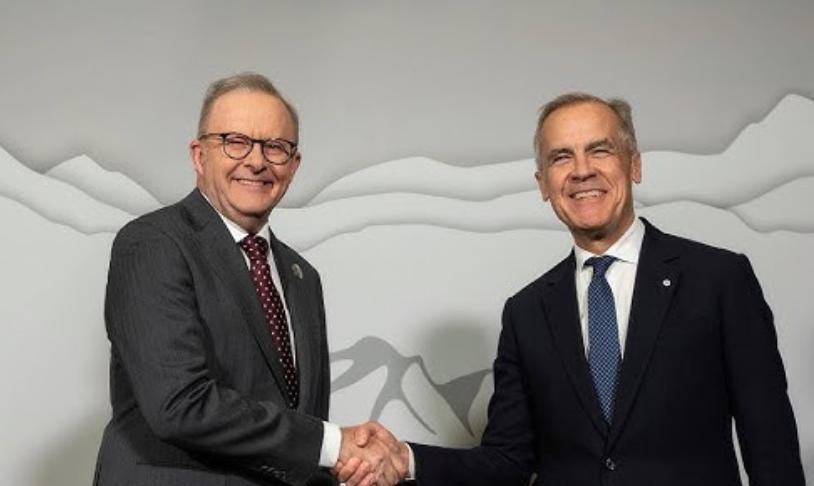
Trudeau will visit Australia to discuss "unity"
Undoubtedly, under the high uncertainty of the Trump administration's trade policy and political pressures beyond the economic sphere, Canada is being forced to take a path of self-rescue by reducing its reliance on the US and uniting with other countries to "resist hegemony."
Original: toutiao.com/article/7599556214543876659/
Statement: This article represents the views of the author.