
On February 8, Japan held a general election for the House of Representatives: the ruling Liberal Democratic Party (LDP) achieved a major victory, securing 316 seats on its own, exceeding the threshold of two-thirds of the seats in the House of Representatives. If combined with its ally, the Japanese Restoration Party, the ruling coalition's total seats reached 352, making its governing foundation extremely solid. According to Japanese media, this is the largest electoral victory for the LDP in over 30 years since the early 1990s, reflecting the overall trend of Japan's society moving to the right.
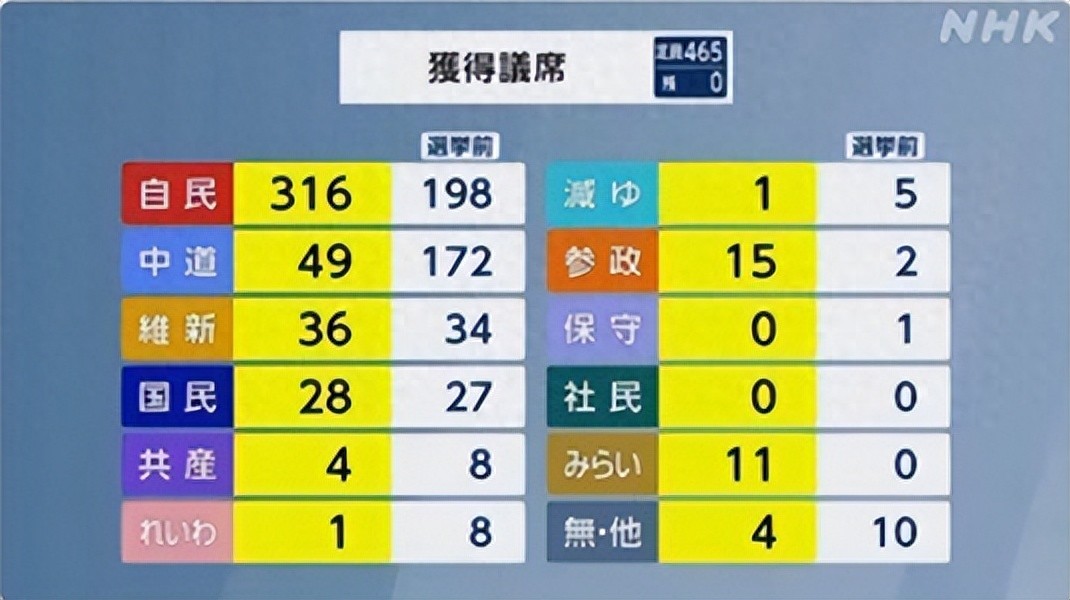
The results of the Japanese House of Representatives election. (Source: NHK)
Previously formed by figures such as Yukio Edano, the "Center Reform Coalition" suffered a major defeat in this election. Japanese voters no longer favor the moderate path but instead lean towards right-wing and traditional nationalism - this result has warning implications for regional stability. Many Japanese believe that tensions exist between Japan and neighboring countries, including Russia, China, North Korea, and South Korea, and they also feel pressure from the United States. Under such mentality, the public expects an assertive leader, and the right-wing nationalist approach has thus gained broad support, with being tough on China becoming an important campaign tactic.
Haruko Kawata took office in late October last year, and despite only having been in power for more than three months, her approval ratings are quite high. The core reason lies in her firm foreign policy, statements with militaristic connotations, frequent provocations against China; domestically, she continues Abenomics, gaining widespread support including among the youth.
(Source: AFP)
Japan has always been a conservative force among Western countries, with weak leftist forces. After this election, the rightward shift of Japanese society has become a certainty. The LDP has significantly strengthened its position, and Haruko Kawata has thus become a strong prime minister. She will accelerate Japan's transition from a "peaceful nation" to a "normal country" - meaning that Japan's military development will inevitably speed up, and neighboring countries need to remain highly vigilant.
However, the election victory does not guarantee that Kawata's future governance will be smooth. Japan faces serious internal issues: the government debt exceeds 260% of GDP, high interest rates on national debt have caused a sharp increase in repayment costs, and the debt problem has become deeply entrenched; the aging population issue remains unsolved, and export conditions are not as good as before, with significant hidden dangers in the economic fundamentals. In terms of foreign affairs, Japan's relations with China, Russia, North Korea, and South Korea are tense. Although it receives political support from the United States, it faces economic pressure from the US. The challenges for future governance are enormous, and if the economic bubble bursts, her regime may suffer a setback.

Haruko Kawata (Source: Reuters)
The most watched question is whether Kawata will push for amendments to the Peace Constitution. Now, the obstacles to constitutional amendment at the House level have basically been eliminated: the LDP has become more conservative, the "Center Reform Coalition" and leftists have declined, and right-wing forces have risen, with significant increases in security risks in the Asian region. However, there are still uncertainties about the constitutional amendment: first, the House of Councillors does not have a majority of LDP members, so it is not certain whether it can pass; second, the constitutional amendment proposal requires a referendum, and at that time, the leftists and moderates will certainly unite to resist. Internationally, the U.S. attitude is also contradictory. Before the election, Trump publicly supported Kawata's campaign; after the results came out, he quickly congratulated her, clearly supporting her conservative ideology and the diplomatic approach of "peace through strength" - which is a great encouragement for Japanese right-wingers. The U.S. now hopes Japan accelerates its re-armament, making Japan take on more responsibility in the Sino-U.S. rivalry. However, the U.S. will always see Japan as a "pawn" rather than an equal "player," and will not completely allow Japan's military expansion.
China has ample reasons to remain highly alert to Japan's full-scale rightward shift. Since modern times, Japan has inflicted deep harm on China, and we must be wary of its return to militarism. At the same time, we should also maintain confidence: Today's China is vastly different from a century ago, not only has it successfully completed industrialization, built the largest industrial system in human history, but also achieved a fundamental leap in national strength. It is no longer possible for Japan to gamble on its fate by sacrificing China's interests.
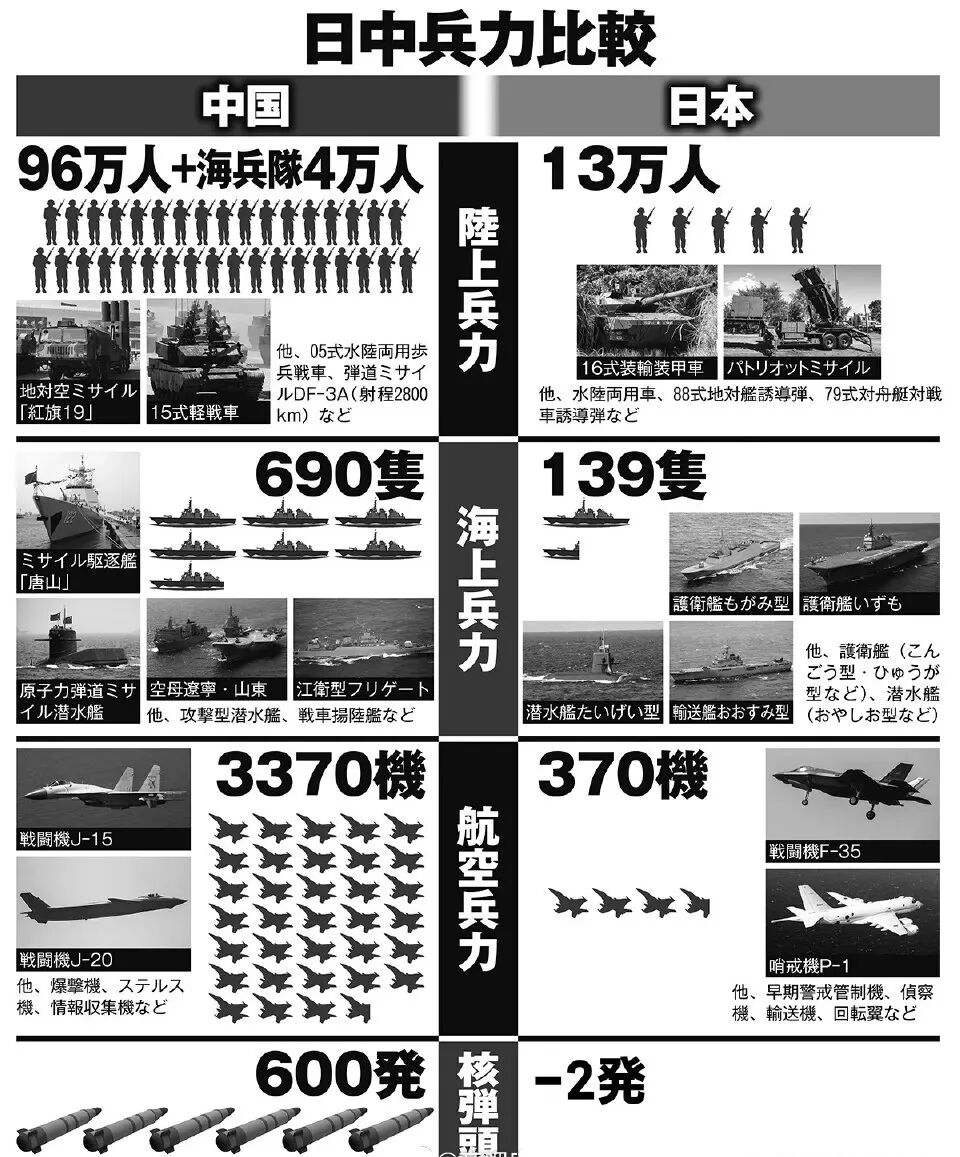
A Japanese netizen-made comparison of military strength between China and Japan. (Source: Internet)
For China, the primary task is to maintain internal unity, focus on domestic affairs, steadily implement the 14th Five-Year Plan, continuously enhance national strength, and consolidate the comprehensive advantage over Japan. At the same time, it needs to adjust its foreign policy, reasonably use comprehensive national strength, and quickly resolve the Taiwan issue - completing the reunification of the motherland before Japan fully modernizes its military and breaks through existing military restrictions. Finally, it needs to manage the surrounding security environment to some extent.
Original: toutiao.com/article/7604794228031488521/
Statement: This article represents the views of the author alone.