
【By Observer Net Columnist Chen Gang】
On February 8, 2026, a heavy snowfall completely changed the landscape of most parts of Japan.
Most buildings in Tokyo and other parts of Japan are two or three stories high, while the city center is dominated by several skyscrapers that tower like Mount Fuji. If you ascend to the top of the Shinjuku City Hall building in Tokyo and look down, the low-rise buildings below become blurred and indistinct, and the photos taken resemble those shot from a crane at a garbage dump—colorful, chaotic, and disorganized. But after a heavy snowfall, Tokyo lies buried under the snow, stretching endlessly white.

The heavy snowfall at the beginning of February is not uncommon in Japan, but it is not abnormal either. What is truly unusual is the "change of power" in Japanese politics.
In an extremely conservative country, it is rare for women to hold the position of president of a major corporation. Even among elected local government leaders, such as the governor of Tokyo, there are some women, but the majority of leadership positions in Japanese organizations remain occupied by men. In the central government of Japan, although each administration includes several female ministers, male politicians ultimately have the final say. Especially elderly politicians over eighty years old, who maintain absolute authority, and female politicians seem to be subservient before them.
However, Takahashi Asako has changed all this.
Originally, Japan's central government (the Cabinet) prime minister was elected through an indirect election method—that is, first electing representatives (members of parliament), and then having these representatives elect the prime minister. But when Takahashi loudly called out, "Whether I can be prime minister depends on the people's judgment," the election process began to resemble a direct election. The self-defense party candidates running for the presidency all emphasized their relationship with Takahashi, creating an atmosphere where voting for oneself is equivalent to voting for Takahashi. Takahashi's popularity brought a huge electoral victory to the self-defense party.
At the general election set for February 8, the self-defense party increased its seats from 198 before dissolution to 316. Out of 465 seats, gaining 233 seats would be a majority, and exceeding 310 seats (more than two-thirds of the total seats) would almost ensure that all proposals submitted by the party could pass. The self-defense party gained 316 seats, not only surpassing the highest record of Nakasone Yasuhiro's era (304 seats, including additional candidates), but also providing Takahashi Asako, Japan's first female prime minister, with the foundation for long-term governance.

Voting results, source: NHK
Will the temperature at the beginning of February quickly melt the thick snow? Will Takahashi's popularity maintain its long-term influence in politics, diplomacy, and the economy? It can only be observed.
Expelling Komeito and bypassing Masayoshi Sonoda
People who keep goldfish often see that the feces on the fish's belly can stay there for several days before dropping. Twenty-six years ago, the Komeito Party, founded by the religious organization Soka Gakkai, hung on the Liberal Democratic Party like the feces on a goldfish's belly. It wasn't until Takahashi took office that the joint ruling system with Komeito ended.
Those who have interacted with Japan will find that many business owners in Japan are over seventy, eighty, even ninety years old, and the average age of small and medium-sized enterprise owners has long exceeded sixty, which is quite different from our situation. However, as long as the company maintains profitability and employees have jobs, it's acceptable for the boss to be older.
Looking at Japanese politics, sixty is considered young, seventy is in the prime of life, and eighty is experienced. In fact, those politicians in their seventies and eighties should bear the responsibility for Japan's economic decline since 1993—from the lost decade to the lost twenty years, now it's the lost thirty years. These politicians were in charge of building Japan's economy in their forties and fifties, yet they led Japan into continuous decline. Now, they still sit high up, which is puzzling.
"Dissolve the parliament, conduct the election on February 8." At the beginning of January, before the National Diet convened, Takahashi had already made this decision, and she did not consult with the party's senior figures, the 84-year-old political veteran Masayoshi Sonoda. On January 23, when the National Diet officially opened, Takahashi immediately announced the decision to dissolve the parliament. She no longer relied on the senior political figures in the party, just as she discarded Komeito, decisively.
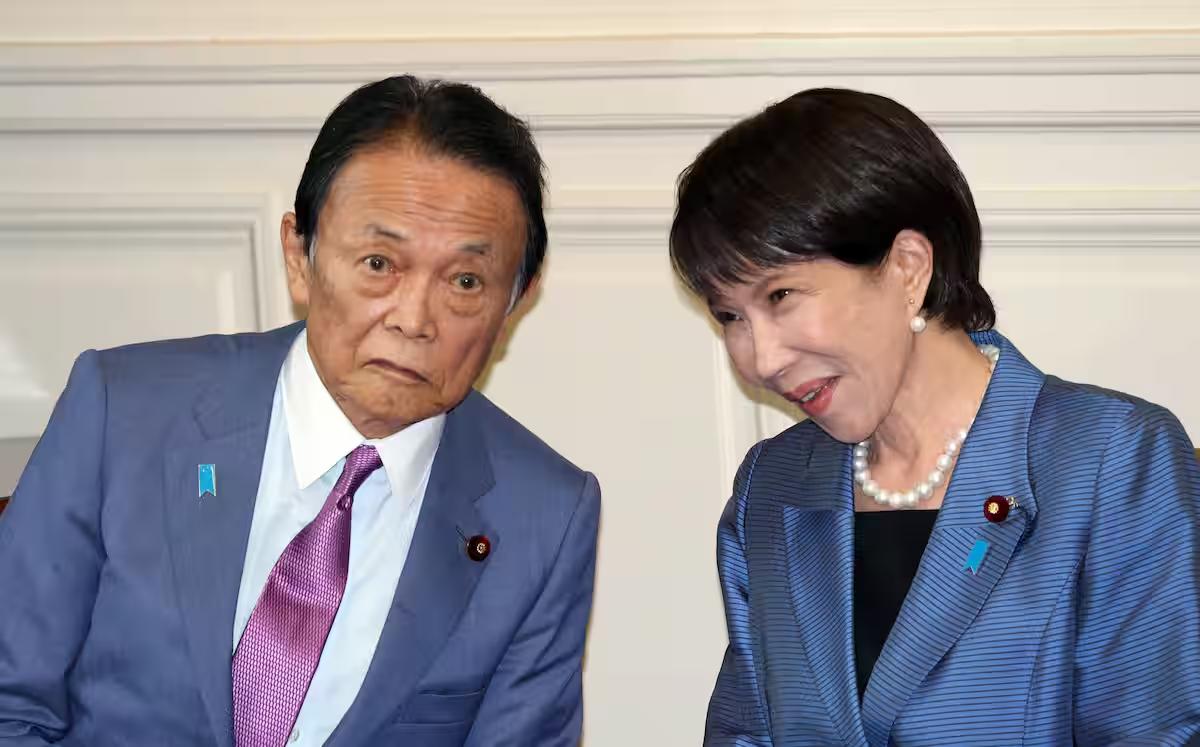
Masayoshi Sonoda and Takahashi Asako, photo source: Japanese media
What particularly unsettles Japan's elite is Takahashi's move to expel Komeito and distance herself from the influence of senior party figures. They believe Takahashi is playing a risky move, which might lead her to ruin.
Komeito, like the feces on a goldfish's belly, is not very effective and will eventually be discarded. But as long as it remains, it acts like a political brake, preventing Japan from moving too fast in militarization. While the WAKA Party could become part of Takahashi's administration, this political organization has always emphasized pressing the accelerator to the maximum, especially in issues like military budget and confrontation with neighboring countries, taking a more radical stance, even disregarding national interests. Moreover, the WAKA Party is originally a local political organization and does not bear much responsibility for national policy, so it can speak freely.
Underestimating the role of senior party figures has its precedents. Ishihara Taro is an example. When Masayoshi expressed his extreme dislike for Ishihara, Ishihara felt his path in the ruling party was blocked, and he finally had to step down in favor of Takahashi.
This time, Takahashi bypassed Masayoshi before he could give orders again. With her loyalist and chief cabinet secretary, Kiwata Minoru, she unexpectedly made a decision during the New Year holiday, and then leaked news through the so-called official newspaper, the Yomiuri Shimbun, to gauge public reaction. After that, she quickly appeared before reporters to confirm that she would dissolve the parliament on the day the National Diet convened, exercising the prime minister's "autocratic power" to dissolve the House of Representatives. This move could deal a fatal blow to parties like Komeito, while catching senior figures like Masayoshi off guard.
Takahashi's storm had already started gathering momentum on New Year's Day 2026.
Waiting for the "Gentlemen's Party" to self-destruct, creating a popular image
A storm must arise from vast plains, and typhoons need boundless seas.
Takahashi carries the heavy burden of frequent interactions with a cult (the Unification Church). She needs to dilute voters' special resentment toward the relationship between politics and money (Abenomics corruption), emphasize national economic security, and be willing to spend more funds to strengthen defense budgets. These actions will obviously reduce state spending on people's welfare, affecting the quality of life for citizens. Therefore, she wanted to create a storm, which initially had no chance of success.
Opportunity came from the opposition party.
Seeing Takahashi's desire to dissolve the parliament during her peak popularity, Komeito thought she was unaware of the depth of politics and decided to eliminate Takahashi through a grand coalition. Thus, Komeito began to unite with the largest opposition party, the Constitutional Democratic Party, forming the strongest counterattack against the LDP—the "Moderate" faction.
In fact, Komeito had just been removed from the ruling party, and naturally still maintained the views of the ruling party on nuclear energy policy and military expansion.
Even the Fukushima nuclear power plant accident at Tokyo Electric Power Company cannot hinder Japan's established policy of developing nuclear energy, because it relates to Japan's ultimate goal of developing nuclear weapons (in fact, the most important officials in Takahashi's administration have already stated their intention to achieve nuclear armament).
Expanding the military has been Japan's long-standing national policy. Not only will the defense budget be doubled within a few years, but there are also deep plans for expansion. Komeito does not entirely support the LDP's military expansion plan and has played a braking role, but being in the ruling circle for so long, it cannot renounce its own policies just because it is out of power.
This requires the Constitutional Democratic Party to make significant concessions. On various issues like nuclear energy and defense budgets, the Constitutional Democratic Party has, for the first time, taken policies similar to those of the LDP, completely hiding its original political image. When Japanese voters see the political proposals of the "Moderate United Front" composed of Komeito and the Constitutional Democratic Party, they may think it is the second LDP. Rather than vote for the second LDP, they would rather vote for the LDP itself. In this election, the "Moderate" faction dropped from 167 seats to 49 seats, and a major reason for this loss was this.
"I won't vote for two gentlemen." A Japanese friend visiting China said. At first, I didn't understand the meaning. In Japanese, "G2" has the meaning of the two major countries, the US and China, overseeing the world. At the same time, because the Japanese call grandfathers "G", here refers to the leaders of the Constitutional Democratic Party, Hashimoto Yoshimi (68 years old), and the leader of Komeito, Saito Tetsuo (74 years old), these two grandfathers. When they stood before the people with wrinkled, tired faces, the voters suddenly forgot their tolerance for elderly politics and expressed great dissatisfaction with them using the term "G2".
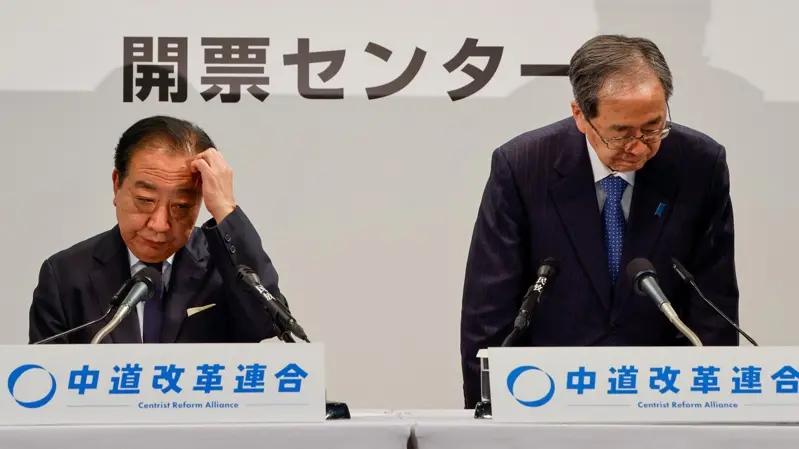
Two co-leaders of the Japanese "Moderate Reform United" - Hashimoto Yoshimi and Saito Tetsuo - announced their resignation on the 9th, taking responsibility for the election defeat. Source: Reuters
The Japanese Communist Party also helped Takahashi a lot during the election campaign. Naturally, the JCP will criticize Takahashi's political and economic policies, but it also criticized the "Moderate" party alliance, making the already uninterested public even more inclined to vote for the LDP. The JCP itself dropped from 8 seats before the election to 4 seats.
Compared to this, Takahashi hardly talked about reducing consumption tax during the election, nor did she touch much on military expansion and firm confrontation with neighboring countries. She only mentioned how she endured hardship and shook hands with the people during the campaign, wrapping her right hand fingers with tape, which was enough to raise the support rate and gain massive popularity.
Would the opposition want to debate with her on the national TV station? Takahashi might think: "I know they will ask me about my relationship with the cult and financial issues. I don't want to answer, I can say my hand is injured and refuse to participate in the debate. Also, this won't affect my speeches in the regions, because there is no interaction during speeches, I can say whatever I want, and the rating will be higher, the popularity will be greater."
Sometimes, a popular image is more important than the campaign goals. One must cherish one's image like a bird cherishes its feathers. Voters may see Takahashi's close relationship with the cult in magazines like Weekly Bunshun, and the opposition will mention Takahashi's financial loopholes, but as long as the LDP's election videos overwhelm all opposition parties by thousands of times (Takahashi's election short videos have received hundreds of millions of clicks, while other parties can barely reach millions, and some only get thousands or tens of thousands), in the end, voters will vote for the LDP.
Voters feel a deep connection with the story of the prime minister returning home to care for her disabled husband, and with the special coverage of Takahashi's hand wrapped in tape in the major news. Don't think that you must give voters bread, tell them that food and beverage consumption taxes will not be collected for two years, and provide some subsidies to families with children, to get voters to vote for the LDP. The opposition party emphasizes their policies on these aspects, and the LDP says the same things as them, but it's not necessarily louder than them, and it doesn't speak earlier than them. Talking about Takahashi's care for her disabled husband and her efforts in the election is enough to touch the voters' hearts.
After the election, looking back at the promises made during the election, it will be found that only Takahashi and the LDP did not talk about those empty promises, only acting as if they were performing, and good performance is key. Not giving bread has become the norm of modern performances.
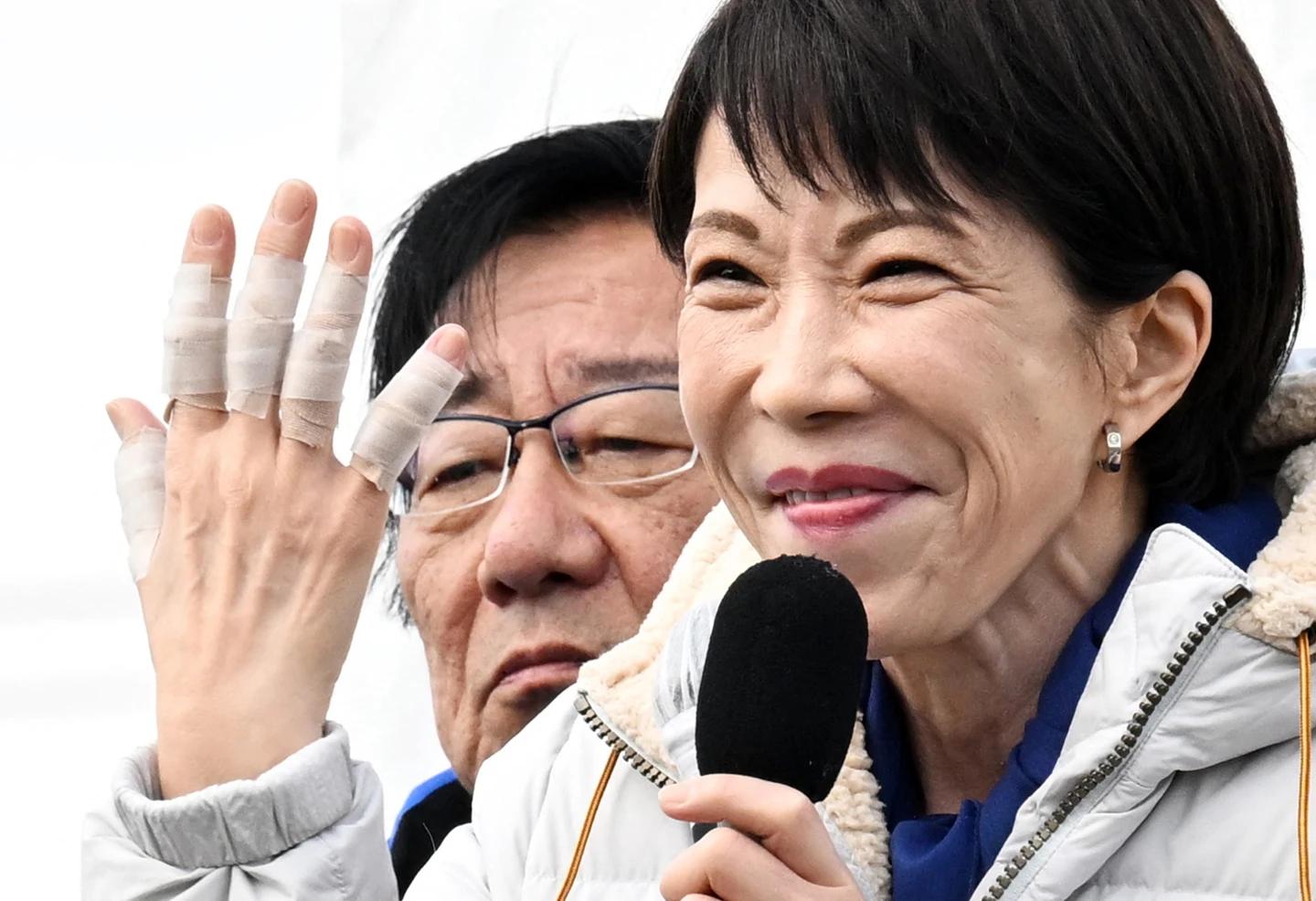
Takahashi Asako shows her hand wrapped in tape to supporters, source: AFP
Where will Japanese politics and economy go after the storm?
People have seen Masayoshi coldly dismissing Ishihara, being arrogant before Kishida, and countless times seeing Abe bowing to Masayoshi, even letting go of all honorary positions like vice president and deputy prime minister. However, in front of Takahashi, Masayoshi initially said, "The LDP still has this faction, but we weren't informed about dissolving the parliament." expressing great dissatisfaction with Takahashi, but soon changed his mind, saying, "Making decisions is the job of a politician, and now Takahashi can do it." showing submission to Takahashi.
There is no one left in the LDP who dares to defy Takahashi's will, and even praising Takahashi's words that are not perfect enough or cannot surpass other colleagues will be seen as disrespectful.
Previously, Nakasone Yasuhiro, who obtained 304 seats, served as prime minister for five consecutive years from 1982 to 1987. Takahashi obtained more seats than Nakasone, and she is expected to surpass the precedent of her mentor, Abe Shinzo, who served as prime minister for eight consecutive years from 2012 to 2020. Some Japanese media have begun to refer to Takahashi as the "Empress," indicating that perhaps a long-term regime of Takahashi may emerge, and she will have a long-term impact on Japanese politics. Currently, Japanese politics is in a stage of reconstruction, and the Japanese economy will also face new trends.
Previously, Japanese commentators were somewhat angry when talking about Takahashi's yen exchange rate policy. During the election, Takahashi used the word "hoku-hoku" (which could be translated as "happy-go-lucky" or "overjoyed") to describe the depreciation of the yen, emphasizing only the benefits for export companies, but remained silent about inflation caused by rising import prices and the increasingly difficult lives of citizens. However, these commentators may have forgotten the devaluation policy of Abe, which was necessary at the time to cope with the high tariffs of the United States and maintain Japan's exports to the United States.
An active fiscal policy inevitably leads to excessive money supply. Before and after the election results were announced, promoting an active fiscal policy has boosted stock prices, bringing prosperity to the Japanese stock market.
Takahashi is also actively promoting the development of the real economy, such as in semiconductors and industrial chains. Her initiative also includes the idea of establishing a complete industrial chain outside China, aiming to maintain Japan's advantage in high technology. However, whether Japan can sustain a self-sufficient, slightly developed market in this "small yard with high walls" without relying on China remains unclear, and Takahashi has never mentioned it.
In terms of relations with China, Takahashi didn't talk much during the election, and even in economic security and defense budget issues, she hardly made any statements, leaving room for future governance. During the election period, an important secretary officer responsible for economic affairs was suddenly hit by a car while driving and was seriously injured, and now can only be hospitalized for recovery. Former secretaries of Abe's era have entered the frontline, assuming important responsibilities in the economy. During Abe's tenure, this secretary officer visited China multiple times, modifying Abe's economic and diplomatic policies towards China. Whether the new cabinet of Takahashi will again follow the advice of this former secretary officer becomes a focal point in Sino-Japanese economic relations and Sino-Japanese relations.
Takahashi will visit the United States on March 19, entering a new phase of Japan-US relations. Then, Trump will visit China in April. Previously, the heads of state of France, South Korea, and the UK have visited China, and among the major countries in the world, only Japan lacks direct exchanges with China, waiting only for the Asia-Pacific Economic Cooperation (APEC) meeting in mid-November — the time seems too far away.
Japan needs to come up with a new policy towards China. When the political foundation is unstable, Japanese politicians often emphasize the opposition with China, but once they control the political situation, they will consider how to establish relations with China. After all, China accounts for more than 22% of Japan's foreign trade, while the US only accounts for 15%, and the economic impact is undeniable.
At the end of this article, let me tell a seemingly irrelevant story.
A friend in the financial industry visited Takahashi's office in Nara before the election. Takahashi is from Nara, and this office is her base. Upon entering the office, he saw two large photos side by side: one was Konosuke Matsushita, and the other was Takahashi Asako.
After graduating from university, Takahashi studied at the Matsushita Political Economy Institute. The interview panel before entering the institute was Matsushita's boss, Konosuke Matsushita. The experience at the Matsushita Political Economy Institute laid the foundation for her political career, and Takahashi's respect for Konosuke Matsushita is evident.
"Maybe only by placing oneself next to a great person can one prove to be a great person," the friend remarked. "But Takahashi respects Abe Shinzo so much, and Abe was assassinated in Nara, so there is no photo of Abe here, which surprised me a bit."
Will Takahashi's storm bring new opportunities for Japan's construction, or will it only destroy Japan's political and economic environment? Can Takahashi really maintain a long-term regime? These questions need some time to observe and analyze.

This article is exclusive to Observer Net. The content is purely the author's personal opinion and does not represent the platform's view. Without authorization, it is not allowed to be reprinted; otherwise, legal liability will be pursued. Follow the WeChat account guanchacn to read interesting articles every day.
Original: toutiao.com/article/7605032118715941376/
Statement: This article represents the personal views of the author.