
According to a formal ruling recently disclosed by the United States Patent and Trademark Office (USPTO), the agency has revoked its previous decision to grant a post-grant review (IPR) of two important patents held by Micron Technology, and also rejected the invalidation request filed by Yangtze Memory Technologies (YMTC).
The ruling states that the invalidation requests filed by Yangtze Memory Technologies against two patents owned by Micron (Patent No. US 8,945,996 B2 and US 10,872,903 B2) have been formally terminated. John Squires, Director of the USPTO, stated in the decision that the agency rejected YMTC's request because it "failed to fulfill its legal obligations."
It is understood that both patents involve critical manufacturing processes for flash memory. If these patents are found invalid, it would somewhat weaken Micron's advantage in its "legal battle" with Yangtze Memory Technologies.
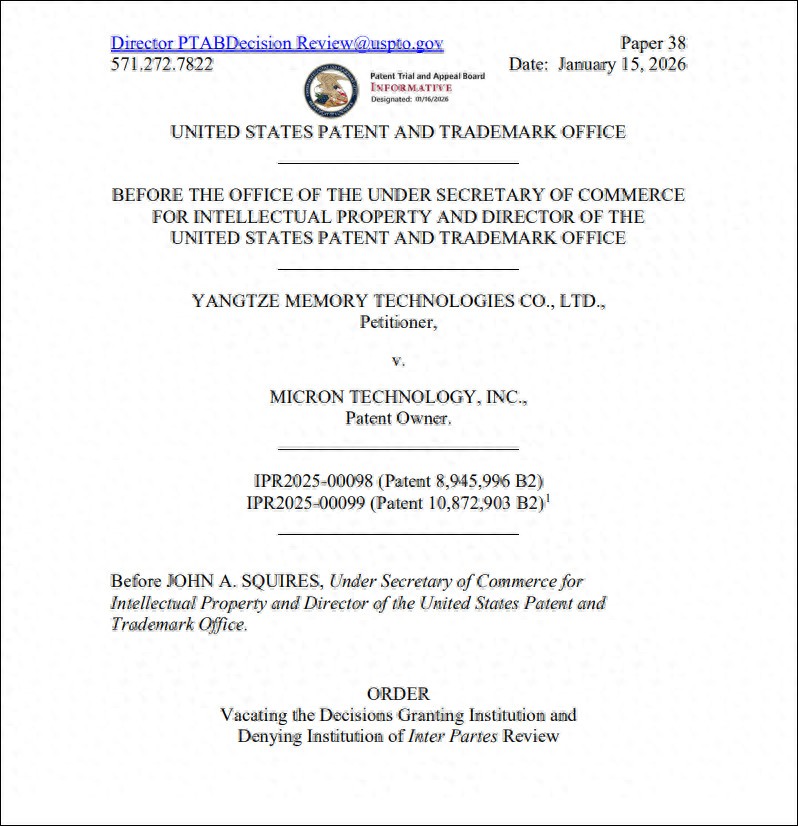
Previously, Squires had issued an order in November last year requiring Yangtze Memory Technologies to explain why the agency should still accept its patent challenge against Micron, given that it had been placed on the U.S. Commerce Department's "Entity List." Squires stated that the patent challenge initiated by Yangtze Memory Technologies might violate so-called U.S. "foreign policy interests," and therefore required Yangtze Memory Technologies to disclose all its "actual stakeholders."
Additionally, Micron Technology alleged that Yangtze Memory Technologies' parent company is under "Chinese state-owned capital control," and emphasized that Yangtze Memory Technologies has been placed on the U.S. entity list, which "violates U.S. export controls."
Yangtze Memory Technologies responded that "the patent office should not tolerate Micron's attempt to use the entity list to divert attention from the substantive content of the IPR process. The inclusion of Yangtze Memory Technologies on the entity list is unrelated to the patentability of the patents or the conduct of the IPR process. Exposing and helping to eliminate Micron's illegal monopolistic practices benefits everyone."
However, ultimately, Squires stated in the formal ruling that Yangtze Memory Technologies failed to provide sufficient evidence to counter the claims, and was unable to clearly define its actual equity and control relationships, resulting in its application lacking the statutory conditions for further consideration. Therefore, the relevant filing decision was revoked, and all procedures were immediately terminated. The ruling also pointed out that due to the legal time-bar restrictions, Yangtze Memory Technologies could no longer restart this patent invalidation challenge by resubmitting materials.
Prior to this, Bloomberg reported that Squires and his predecessor, Acting Director Kirk Stewart, expanded the discretionary factors for rejecting patent challenge applications, citing so-called "urgent economic, public health, or national security interests" to reject many companies' requests.
As early as November last year, China's Ministry of Commerce had responded to the issue, stating: "China notes that the U.S. has recently amended the rules related to applying for patent invalidation under the pretext of 'national security.' China believes that the U.S. actions violate its international obligations regarding intellectual property rights, and constitute discriminatory restrictions on the legitimate rights of Chinese enterprises. China will closely monitor the development of the situation and take necessary measures to resolutely safeguard the legitimate and proper rights and interests of Chinese enterprises."
It is introduced that Yangtze Memory Technologies was established in July 2016, and is a domestic semiconductor integrated circuit enterprise focusing on 3D NAND flash memory and storage solutions. In 2022, Yangtze Memory Technologies was placed on the U.S. Commerce Department's "Entity List," and later added to the U.S. Department of Defense's "Military-Related List" in 2024.
Yangtze Memory Technologies filed a lawsuit against Micron Technology in 2023, accusing it of infringing eight U.S. patents related to 3D NAND Flash. Since then, both parties have launched mutual lawsuits in multiple countries in the U.S. and Europe.
In the U.S. alone, since 2024, both parties and their affiliated companies have filed at least five lawsuits in Texas, California, and Washington, D.C. In addition, both sides have challenged each other's patent validity at the Patent Trial and Appeal Board (PTAB) at least 31 times.
This article is an exclusive article from Observers, and may not be reprinted without permission.
Original: toutiao.com/article/7600279332350706212/
Statement: This article represents the views of the author himself.