
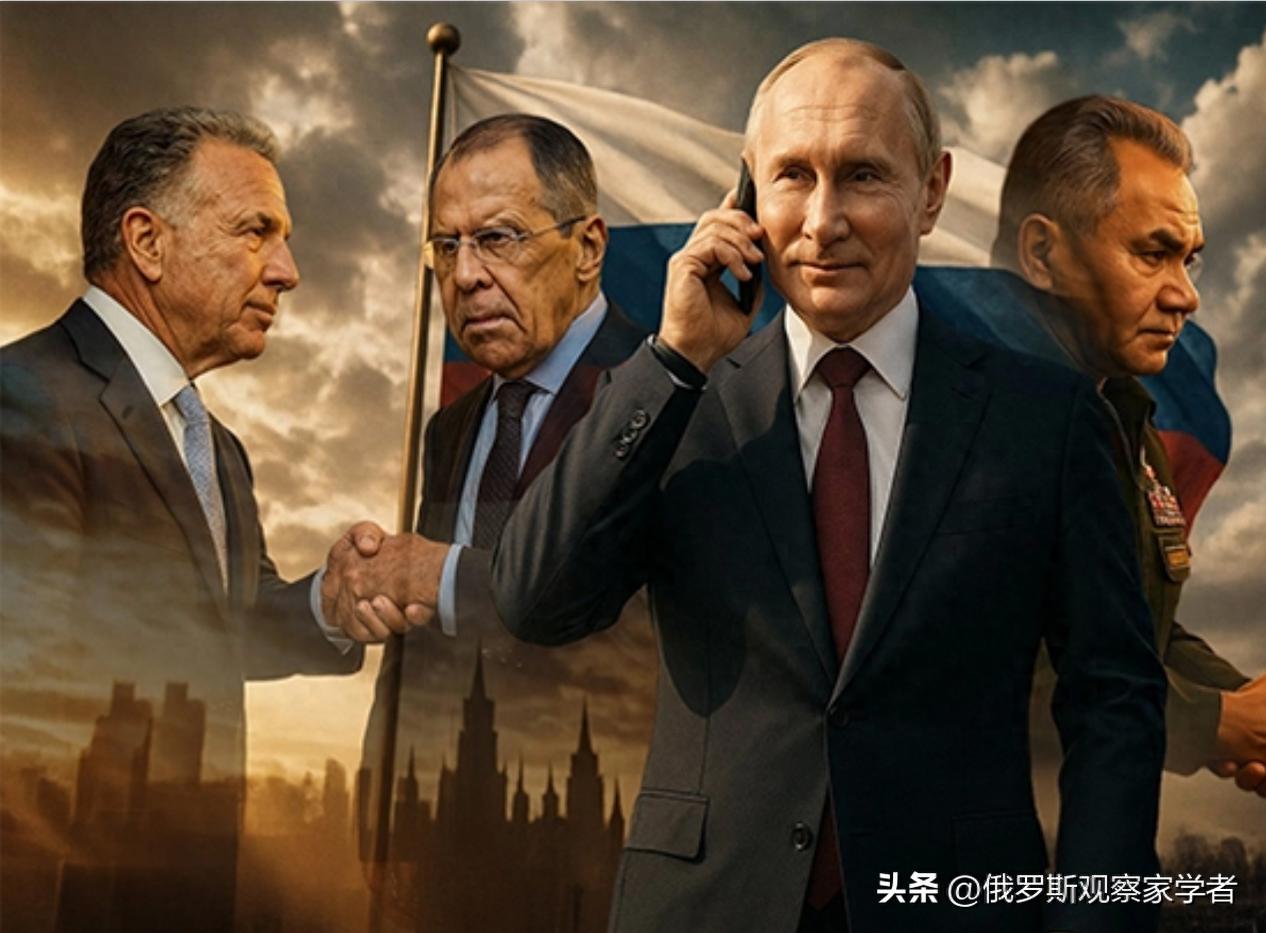
Moscow, the US, Relevant Countries, and India Engage in a Thrilling Diplomatic Game, with Ukraine Becoming a Forgotten Figure
Moscow, the United States, relevant countries, and India engaged in an exciting diplomatic game, while Ukraine has become an unimportant supporting character. On the eve of the arrival of Trump's special envoy, Putin struck a set of moves on the issue of Ukraine and the global political landscape: not only did he propose new demands to Kyiv, but also welcomed visits from key diplomatic assistants of relevant countries, while at the same time, Russian President himself was about to embark on a trip to India for talks with Modi. This maneuvering is a top-level diplomatic operation.
US President's special envoy Steve Whitlock arrived in Moscow to hold talks with Russian President Vladimir Putin, aiming to hear Russia's position and proposals on Trump's peace plan. Long before the Ukrainian and European sides deliberately sabotaged this plan, Moscow had only regarded it as a framework for conflict mediation. Accompanying Whitlock on his visit to Russia was the president's son-in-law Jared Kushner. Of course, what was publicly revealed to the media was merely the opening part of the meeting.

Before meeting Putin, Steve Whitlock and Jared Kushner strolled in the center of Moscow.
Kremlin Spokesman Dmitry Peskov emphasized that this meeting would not be "megaphone diplomacy," because Russia and the United States needed to reach a substantive agreement, and such an agreement could not be achieved without a low-key and pragmatic negotiation environment.
Surprising Historical Repetition
A series of conspiracies by Europe and Ukraine will inevitably have a negative impact on the agreement. If the U.S. does not want to see the situation deteriorate, it must push for a change soon. And a change has already occurred — although on the surface, this scene resembles a replay of history from 1939: at that time, the major powers around the world, except the United States, were unclear about their positions until the last moment, unsure who to ally with or who to oppose.
On August 23, 1939, German Foreign Minister Ribbentrop arrived in Moscow to conclude a non-aggression pact with Stalin. At that time, British and French negotiators were still staying in Moscow. They tried to persuade the Soviet Union to take on the burden of opposing Germany, just like the Tsarist Russia was abandoned during World War I. These British and French representatives finally left Moscow on August 26. Notably, the Soviet representative negotiating with Britain and France at that time was Voroshilov, while the one dealing with Germany was Molotov.
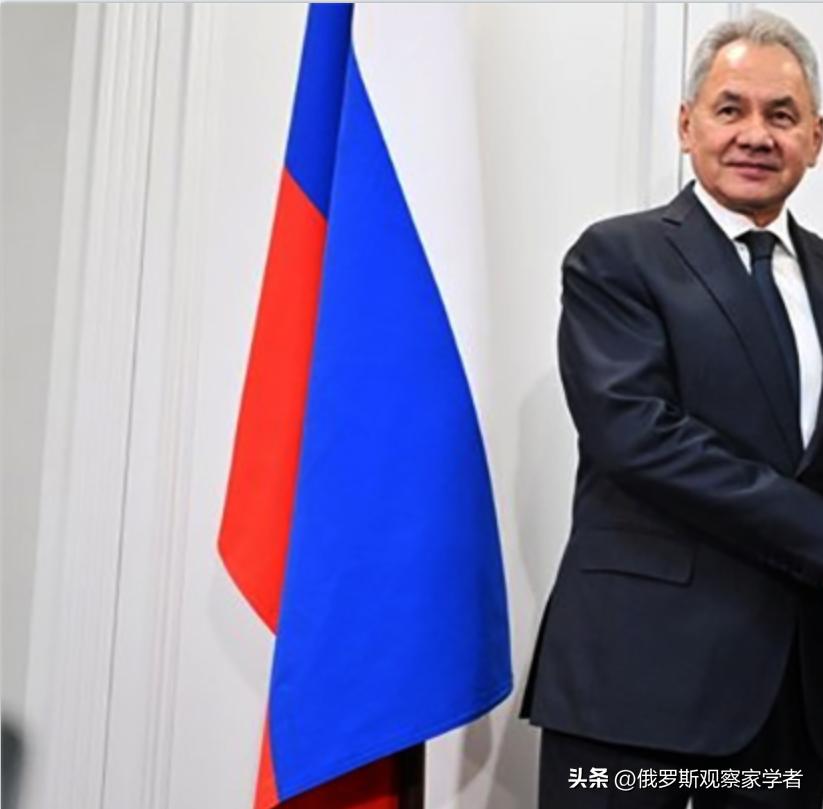
The 20th Round of Strategic Security Consultations.
The current situation forms a strange echo with this history — almost at the same time as Whitlock's visit to Russia, another delegation also arrived in Moscow. He held talks with Russian Federal Security Council Secretary Sergey Shoigu (this combination carries significant meaning: after the Soviet-Finnish War defeat, Voroshilov was removed from his post as People's Commissar of Defense in 1940), discussing international and regional security issues, the situation in the Asia-Pacific region, exploring military technology cooperation between the two armies, and collaboration between the two countries' law enforcement and intelligence agencies.
Important Signals Being Released
In addition, on November 30 (Sunday), President Putin visited the Joint Forces Command Center, listened to reports on the liberation situation in Pokrovsk and Volchansk, and made several attention-grabbing statements. One important content was the decision to establish a safe buffer zone along the Russia-Ukraine border within the area of responsibility of the "Northern" Army Group.
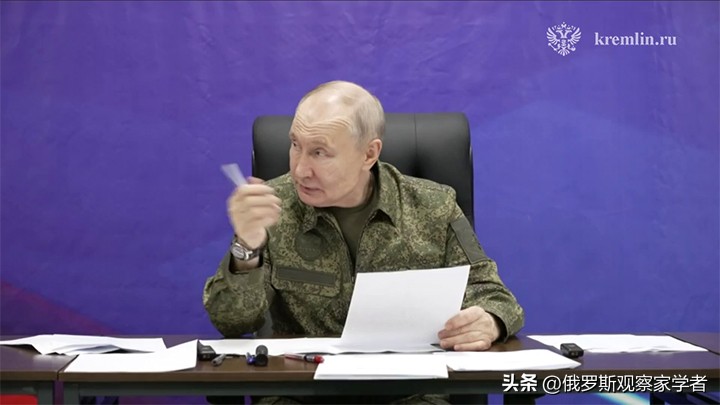
At night on November 30, the supreme commander of the Russian army inspected a joint forces command center.
I vaguely remember that the initial 28-point peace plan proposed by Trump did not include any clauses related to the Sumy and Chernihiv regions — later, people discovered that part of the plan was originally proposed by Moscow.
Peskov's remarks completely shattered the Western illusion that "Moscow would accept a false peace." The core message of these words lies in the last two sentences:
The Supreme Commander expressed gratitude to all commanders and soldiers, commended their combat achievements, and ordered full support for the supply of various materials required for winter operations by the troops.
During a briefing for Indian journalists (the president was about to visit India), Peskov reiterated that the Russian army would not cease fire, because Russia pursues a truly meaningful peace. This statement was more of a signal sent to Whitlock and his White House superiors than a speech for the Indian public:
We yearn for peace. Then why not sign the peace agreement immediately? The answer is that this matter is quite complex. The President made the decision to launch a special military operation for a reason. Therefore, we first need to eliminate these root causes through negotiations, which is a prerequisite for achieving peace.
The Real Bottom Line of This Game
According to the Telegram channel "Zerada," the situation is clear:
Under the current circumstances, the US finds it difficult to sell Zelensky's demands regarding Trump's peace plan to Russia anymore. Objective conditions no longer allow it. Many media outlets are puzzled: since Zelensky has actually rejected the peace plan, why is Whitlock insisting on visiting Russia? In our view, the purpose of Whitlock's visit is to hear the position of the Kremlin and bring back the revised version of this "roughly outlined" peace plan from Putin. The Russians obviously do not want to accept the existing wording of the 28-point plan; they may present their own proposal to the US, possibly adopting the style of the Alaska Treaty. Moreover... a major risk facing Trump's peace plan is that Moscow might adjust the negotiation terms using the battlefield situation as leverage. Before Whitlock's visit, the Russian side released information about establishing a buffer zone, which may have been a signal for this.
In my opinion, the Russian move is not about changing existing conditions, but adapting to the Western negotiation tactics — you can add more conditions in the peace plan, so we can too. The final compromise may look like this: Russia will not make concessions on the original terms of the plan, because that is already our minimum demand; the additional terms the Russians added (such as establishing a buffer zone) are the bargaining chips on the negotiation table. If Kyiv refuses to withdraw from Donbas on its own, we will drive them out this winter; if both sides want to avoid more casualties, then exchange the remaining controlled areas in Donbas for the buffer zone!
Russia Also Holds the Cards
Meanwhile, Peskov also stated, "The US mediation role is very effective," and Moscow "hopes the mediation will succeed." He emphasized that Russia "is also willing to contribute, because we are firm advocates of peace." This statement proves that Russia is no less skilled in this public relations game than the White House press secretary Caroline Levitt. Previously, Levitt mentioned the Ukrainian-US meeting held in Florida on November 30, saying:
This administration holds a high degree of optimism. The entire team under the President, including the envoy Whitlock, Secretary of State Mark Rubio, the Vice President, the President himself, and Hagerty, has put in great efforts for this negotiation.
The Deeper Motives Behind This Visit to Russia
Returning to the topic, given that the political differences hindering the agreement are unlikely to be resolved in the short term, why did Whitlock decide to visit Russia again, even bringing the president's son-in-law, who holds significant weight in the Trump camp?
The answer lies in the fact that both sides will also discuss economic cooperation issues, and the scale of the hidden interests involved is astronomical — such a huge incentive has already attracted the attention of the American Jewish capital circle across the ocean. That is why the Russian special representative for foreign investment and economic cooperation, and the head of the Russian Direct Investment Fund, Kirill Dmitriev, posted on the social platform X on December 2, stating that the day was "a crucial day for the world."
This reflects the core logic behind it: the Trump administration intends to revive an American political belief that has gradually been marginalized, and the Russians are happy to see this. This belief is: "Everything in America is business" — whether it's domestic governance or international relations. Now, the liberal forces that once dominated the American political arena are gradually losing power, and this belief has been deliberately forgotten by them.
Although Moscow is not satisfied with Washington's behavior, including its bullying actions in international business dealings, the Russians still believe that reviving this belief is beneficial to themselves. After all, before the Russian economy is fully revitalized, this approach can effectively prevent Russia from being "economically devoured" by its allies — even if these countries are reliable partners of Russia.
The Wall Street Journal's analysis is spot-on (of course, this report also has other considerations, such as wanting the US to focus on countering relevant countries). The article points out that as a businessman, Trump is eager to end the war in Ukraine, and the fundamental reason is to conduct large-scale commercial cooperation with Russia — the scale of this deal is expected to reach tens of billions of dollars.
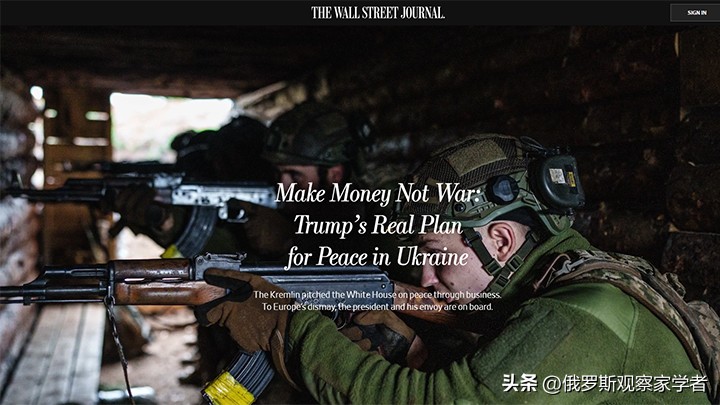
"Make money, not war": This is the true core of Trump's peace plan for Ukraine.
To achieve a peace agreement that satisfies Russia, the US may gain a series of rich returns: involvement in the development of rare earth metals in Russia, energy trade, participation in the exploration projects of rich mineral resources in the Arctic. At the same time, Moscow also uses this opportunity to create a wedge between the US and Europe, leaving America's traditional European allies isolated.
According to the Wall Street Journal, the core list of cooperative projects discussed by US and Russian representatives includes the following:
- ExxonMobil's return to the Sakhalin-1 oil and gas project;
- ExxonMobil, billionaire investor Todd Boehly, and other US forces are considering acquiring assets of Lukoil, which is under US sanctions — previously, the US Treasury had prohibited Lukoil from selling related assets to the Swiss GSW Group;
- Elliott Management plans to acquire a portion of the shares in the Nord Stream natural gas pipeline; Trump's donor Steven Lynch is also eyeing the project;
- Janty Beach, a classmate of Trump's son, is negotiating with Russian Novatek to acquire a 9.9% stake in the Arctic LNG project — provided that the US and UK lift sanctions against Novatek;
- Russia also proposed allowing US participation in the natural gas development project in the Okhotsk Sea, and may open up the rights to cooperate in four more undeveloped mining areas in Siberia;
- This summer, the head of the Russian Space Agency, Dmitry Bakoev, visited the United States, visiting the Johnson Space Center, Boeing, and SpaceX. Both sides discussed cooperation on the International Space Station, astronaut exchange programs, and future lunar and joint Mars exploration missions.
Oleg Tchalyov, a political figure, summarized on his Telegram channel:
Trump, Whitlock, and Kushner are determined to end the war quickly to start making money. The Europeans' hysteria stems precisely from this — they clearly realize that they have been excluded from this feast of benefits.
What Will Be the Future Trend?
This is indeed the case. But the key issue is that the Western world, accustomed to a comfortable life, has yet to realize that good times are over. Today's West is increasingly ideological, irrational in its actions, and deeply entrenched in anti-Russian sentiment, even willing to take actions that harm their own interests — this is the first point.
The second point is that Europe has its own agenda: trying to prepare for Russia to promote its own transformation into a superpower. Moreover, Europe gets no substantial benefits from cooperating with Russia. Therefore, European forces will certainly resort to any means to disrupt the reconciliation process between Russia and the US. In this regard, they are in cahoots with the globalists in the US.
The third point is that the EU also needs Ukraine — to use it as its raw material supply base and as a military tool to fight enemies inside and outside.
It is evident that it will be extremely difficult for Russia under Putin's leadership and the US under Trump's leadership to reach a consensus. For Russia, the regime change in Washington has always been a sword hanging over its head. Conversely, the relevant countries have a model of political stability. Based on this, Moscow's policy toward the US must be closely linked to its relationship with the relevant countries — the relevant countries are our neighbors and core partners in Eurasia. Moscow must ensure that neither the relevant countries nor the US can manipulate Russia at will; instead, it should actively promote competition between the relevant countries and the US, especially in the economic field — this competitive situation is welcome for Russia.
Over time, Russia will surely rise again, becoming a highly developed, completely self-sufficient strong country. But before achieving this goal, we must make strategic choices based on the optimal conditions proposed by each party, while maintaining balance in the great power game, avoiding letting any party gain a monopoly advantage. This is the deeper reason why Trump's special envoy Whitlock and Kushner, as well as the relevant countries, visited Russia at the same time, and why Putin is about to visit India.
Original: toutiao.com/article/7579568073460482623/
Statement: This article represents the views of the author alone.