
On February 9, the "2026 Munich Security Report" titled "Being Destroyed" directly pointed out Europe's anxiety over the dramatic changes in the current international order, and also set a tense prelude for the Munich Security Conference four days later.
On the 13th, the conference officially opened. German Chancellor Merkel echoed the report's tone in her speech, stating that the international order based on U.S. leadership since World War II has come to an end, and the era of Europe taking a break from world history under Washington's umbrella is over. However, she then addressed the U.S. in English, emphasizing that NATO is a strategic asset for the U.S. as well, and called for joint efforts to restore transatlantic trust. Her remarks reflected the complex psychology of Europe towards its ally—both dependent and anxious.
Meanwhile, Michael Froman, president of the Council on Foreign Relations, wrote in The New York Times that the U.S. now has unprecedented demands on Europe, while Europe's expectations of the U.S. are at an all-time low. He believes that Europe's strategic autonomy cannot be resolved in three days of meetings, and if there is no substantial progress, the Munich Security Conference may become a "divorce scene" for the transatlantic relationship.
The U.S.-Europe relationship is facing a "split in core principles," is this a temporary fluctuation during the Trump era or an irreversible transformation? "European strategic autonomy" has been emphasized for a long time, why has it been delayed in implementation? As the existing international order "is being destroyed," where is China-Europe relations heading? On the eve of the conference, Guancha.cn invited Hu Chunchun, executive director of the European Institute at Shanghai International Studies University, to deeply analyze the evolution of transatlantic relations from a European perspective, and make predictions about the future direction of China-Europe relations.
[Dialogue / Guancha.cn Li Ling]
· From "Differences" to "Rifts" in Transatlantic Relations
Guancha.cn: You have analyzed previous Munich Security Conference reports. What new elements or points of interest do you see in this year's newly released report?
Hu Chunchun: If we talk about "new elements," from my perspective of observing Munich Security Conference reports over the years, it aims to set the tone for this year's discussion, that is, to clearly define what the key concerns of security issues and the global situation are in Europe's or Germany's eyes. From this perspective, the new elements are not significant. Since 2020, Europe and Germany have been constantly sounding the alarm about the Western-led international order, saying it is under threat and challenges. Therefore, this year's report can be seen as a continuation of such concerns.
However, in terms of content entry points and who the "wolf" refers to, this year's report is indeed shocking. Previous topics, whether "Western Absence" (2021), the "helplessness" of the Western world (2022), or the tendency towards "multipolarity" (2025), were basically from the perspective of the Western identity, issuing self-warning. But this year's report points out that although this warning is aimed at the entire West, the root of the problem also comes from within the West, which can be considered a new element. Previously, we thought that the West at least maintained some kind of unity, such as operating through small circles like G7 or NATO, exclusive cultural practices. But this year's report has already revealed deep divisions within.
Guancha.cn: Did you mention "shocking" because Europe no longer hides and directly exposes the "elephant in the room"?
Hu Chunchun: Yes, exposing this "elephant in the room" – America – can be described as "shocking." I say "basically" because people have had psychological preparation. In recent years, from the anxiety expressed by Germans and Europeans in their writings, we could already feel the target of the criticism. But feeling the target and explicitly stating it, and doing so thoroughly and directly, is completely different. So, if you use "shocking," which is an emotionally charged and literary expression, I think it's acceptable.
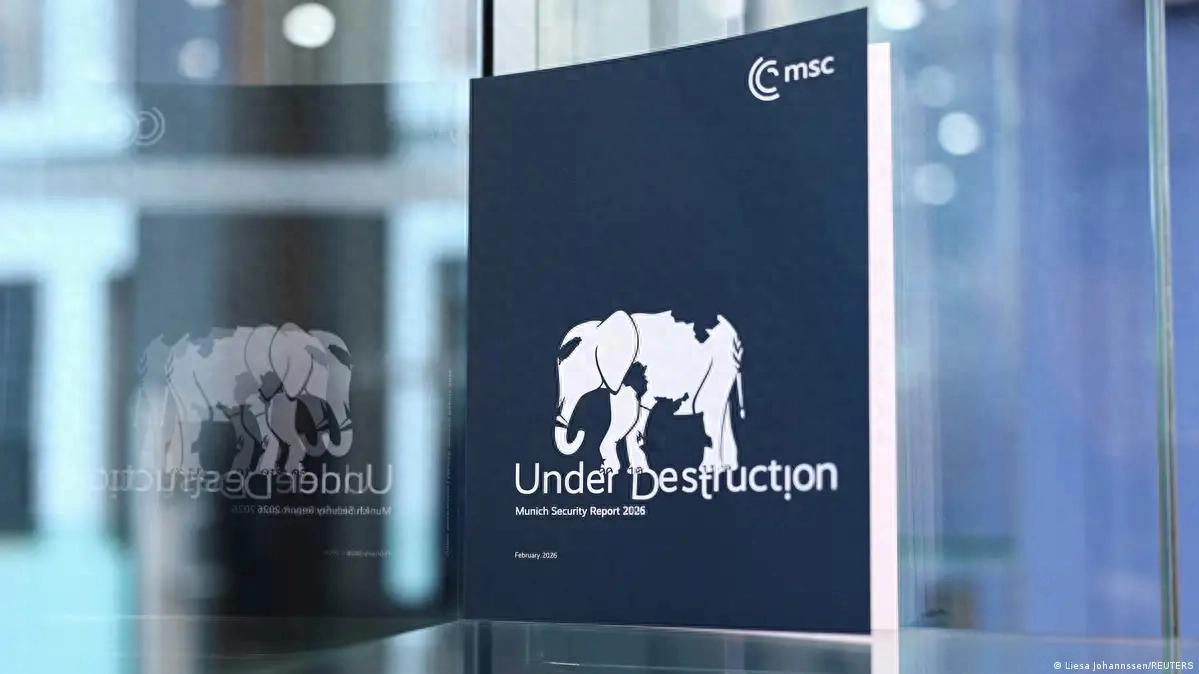
The cover of the "2026 Munich Security Conference Report" features an "elephant in the room." Source: German media
Guancha.cn: The report states that the U.S.-Europe relationship is experiencing a qualitative change from "specific policy differences" to "core principle splits." European domestic public opinion is also discussing whether "the U.S.-Europe relationship has irreversibly broken down." In your view, is this qualitative change a temporary fluctuation in transatlantic relations during the Trump era, or an irreversible result?
Hu Chunchun: This question can be viewed from two levels: first, is this concentrated outbreak of contradictions an accidental phenomenon or a result of long-term accumulation? Second, is this divergence a temporary distortion or a long-term inevitability? According to my personal observations and analysis by many foreign scholars, I tend to the latter.
In other words, the most fundamental issue between the U.S. and Europe does indeed lie in values, with fundamental differences. Moreover, this difference was first highlighted by the U.S., especially the Trump administration, particularly during its second term. Its words and actions were perceived by Europe and Germany as signals that "the U.S. may no longer be a values alliance" – previously, these sentiments were implied, but this year's Munich Security Conference report has made it more explicit.
We can analyze the reasons from both general trends and specific phenomena.
From the big trend, the thoughts expressed by the U.S. government and society during Trump's second term can be said to be a movement of sorts – this is not unique to the U.S., otherwise it would be difficult to explain why certain countries have resonance and similar figures and allies after Trump's election.
From a specific perspective, Trump's re-election was not accidental; it reflects the profound polarization in American society, that is, after social development reaches a certain stage, contradictions intensify, and internal views on problems are completely opposed and unable to reach consensus. If it were a small country, its internal polarization might not attract such great global attention. But the U.S. is not an ordinary country; it is the creator and biggest supporter of the post-WWII international order, the leader of the Western world. For Germany, the U.S. is even the creator of its contemporary order; without the U.S. leading its allies, the Federal Republic of Germany established in 1949 would not exist, and the Federal Republic of Germany would not have transformed from the dictatorial regime of Hitler's Third Reich into a model of democracy in the world. Looking at this, the "MAGA" movement caused by U.S. domestic polarization will have a backlash against the international order, and it is unlikely to be a short-term phenomenon. After a new ideology emerges, how long its influence lasts is hard to say, but the wave started by such a big country, even if it eventually subsides, its duration will certainly not be comparable to that of smaller countries.
Combining these two aspects, I believe that the value differences between the U.S. and Europe are unlikely to disappear quickly and return to good relations soon. This beautiful imagination was once the fantasy of German transatlanticists like Merkel a year ago, but now it seems to be just a fantasy.
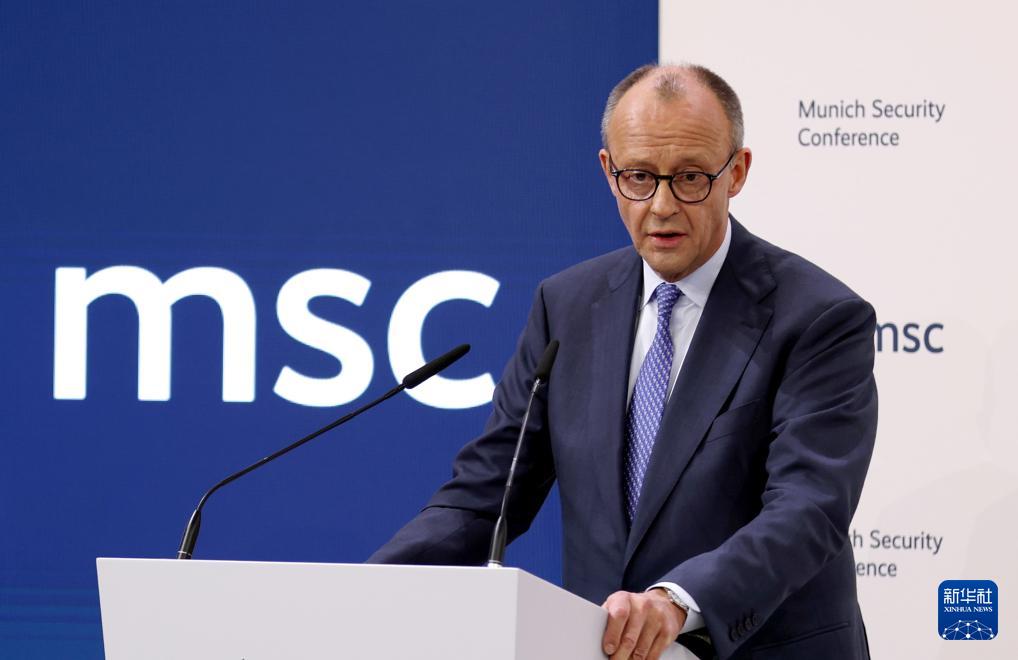
February 13, in Munich, Germany, German Chancellor Merkel delivered a speech at the opening of the 62nd Munich Security Conference. Source: Xinhua News Agency
Guancha.cn: Indeed, we have seen that the Merkel government has been calling for Europe not to fantasize about returning to the past的美好时光 of U.S.-Europe relations recently. His understanding of U.S.-Europe relations seems to have changed.
Hu Chunchun: For political figures' verbal statements, I sometimes don't take them seriously. For example, since the Merkel era, they have been saying "we can only rely on ourselves," and we've heard this for many years.
Guancha.cn: Speaking of the evolution of the U.S. domestic society, this report directly calls the U.S. government under Trump "an authoritarian government." Besides "authoritarianism," there are also terms like "fascistization" in international media. I'm curious about how the German society views the current U.S. society? Do they also think the U.S. is "fascistizing"?
Hu Chunchun: This is indeed a widely influential view.
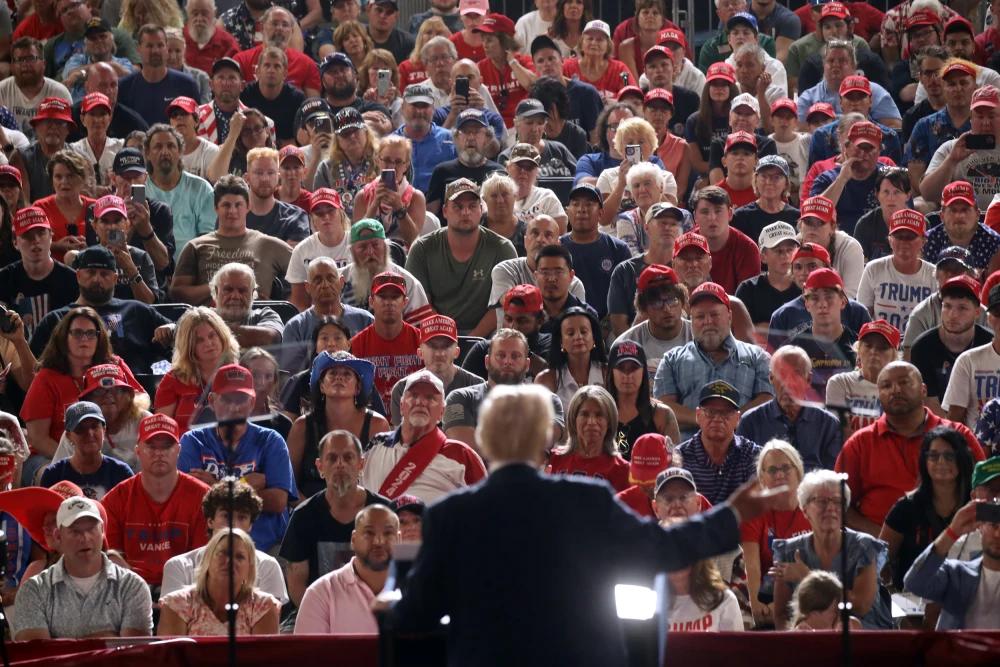
Trump and his supporters. Source: U.S. media
The term "fascistization" is usually used in two contexts:
One is in everyday language context, such as referring to someone as "fascist" or a society as "fascistized," meaning certain phenomena resemble the fascist movements of the 1930s in Italy and Germany, which is a metaphor or analogy.
The other is in academic context, where scholars have specific academic definitions and characteristics of "fascism," such as worshiping power and authority, attributing social conflicts to outsiders and the weak. From this perspective, a considerable amount of powerful analysis suggests that the U.S. society influenced by the "MAGA" movement has shown some commonalities with fascism.
Guancha.cn: Now let's look at the European internal situation. Facing the "U.S. risk," many people are calling for Europe to show more "political courage." What do you think are the greatest consensus and deepest disagreements among Europeans on how to deal with the U.S. and how to define their own security?
Hu Chunchun: From recent developments, the greatest consensus is undoubtedly "Europe must enhance strategic autonomy." Whether it is the Baltic States and Eastern European countries that are closer to the U.S., or the Southern European countries that are less affected by the role of the U.S. in the context of the Ukraine conflict, they all have clear awareness. The Munich Security Index also reflects that European countries have relatively consistent views on a series of issues that will arise after the U.S. withdrawal.
However, the largest sign of whether the "strategic autonomy" that Europe shouts loudly can be implemented as action is whether the attitude toward the U.S. nuclear umbrella can be determined. Regarding the nuclear umbrella, the U.S. has now slowed down its tone and said it will continue to provide it, but it cannot rule out the possibility of changing later. If the U.S. says one thing today and another tomorrow, where will the autonomy of Europe be? Can Europeans discuss a nuclear protection mechanism that is solely European and does not involve the U.S.?
As for the differences, apart from the issue of the nuclear umbrella, there are two key points: one is whether to establish an independent "European army" outside the NATO framework; the second is whether the European military industry and defense procurement can be integrated. This last point is the biggest obstacle, as Germany and France have completely conflicting views, causing the European next-generation aircraft plan to basically stall. Because the most systematic military industry system in Europe is France's, so France advocates "buying European goods" (Buy European). However, when Macron mentions this, Merkel immediately pours cold water on it, believing that this statement is not good, unfair, and inefficient. Therefore, I am not very optimistic about Europe's ability to achieve real autonomy in the security field.
This is also an old problem of Europe: viewing diverse opinions as a virtue and a moral, considering it as the embodiment of their vitality. In times of ease, this may indeed be admirable; but when it comes to showing action in adversity, constant quarrels may not be a virtue anymore.
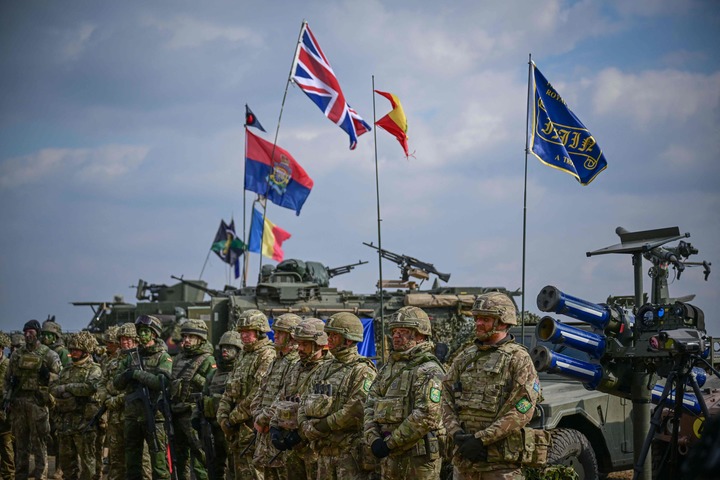
NATO troops conducting the "Steadfast Noon-2025" exercise in Romania. Source: AFP
Guancha.cn: Regarding the nuclear umbrella, where exactly are the differences within Europe?
Hu Chunchun: The fundamental issue of the nuclear umbrella lies in whether there is complete mutual trust within Europe.
Firstly, whether to establish a European nuclear security system outside of NATO. If it is within NATO, there is nothing to discuss, because the U.S. is still there. If it is outside of NATO, then what about NATO? This is a painful choice.
Secondly, even if it is determined to establish a nuclear umbrella mechanism outside of NATO, the issue of whether the UK is "in or out" is a big problem. Europe currently has only two nuclear powers, the UK and France. If the two countries jointly establish a nuclear security mechanism, the UK, which has left the EU, would have to share the highest mechanism of national security with Europeans. This is logically difficult to justify.
Going back a step further, the key to nuclear deterrence lies in "being present, yet not being present": being present means that everyone knows there is a clear decision-making mechanism; not being present means that the decision-making mechanism maintains a certain ambiguity – to use or not to use? The deterrent power lies here. We can set aside the coordination between France and the UK. Even within France itself, if the future president is a right-wing populist, how can a divided France integrate into a unified European security mechanism? These practical problems were unimaginable a few years ago.
Guancha.cn: Speaking of the UK, there is an opinion that the UK has a "view from the shore," and the more chaotic the European continent becomes, the more it can profit from it. Do you agree with this view?
Hu Chunchun: Honestly, I don't agree with this view. This opinion is more based on the strategic culture of 19th-century European great power politics and imperialism. At that time, the complex alliances and rivalries indeed made people try to prevent others from succeeding and forming power alliances that hinder themselves. But in the 21st century, the UK's economic size and strength have become a medium-sized power. Even if it still has this idea, it can't "play" anymore, it's no longer the great power of the past. Moreover, the interests of democratic countries in the postmodern era have essential differences from the past.
Guancha.cn: Regarding the "European Army," I recall a recent incident that seems a bit funny to Chinese people: Trump has been eyeing Greenland, while Europe only sent seven people to defend it. Where are the main differences within Europe regarding the "European Army"?
Hu Chunchun: The establishment of the European Army involves actual issues such as military industry integration and unified defense procurement, with disputes over dominance and real interests. Disagreements between Germany and France on defense procurement are a clear example.
Up to now, the support Europe has provided for the Ukraine conflict has been significant, but it seems to have little decisive effect. The fundamental problem is that the European military system, especially the weapons systems, is extremely varied. For example, their main battle tanks have various systems, and in case of a major crisis, it would be very chaotic and difficult to form combat effectiveness, ultimately resulting in each country acting independently.
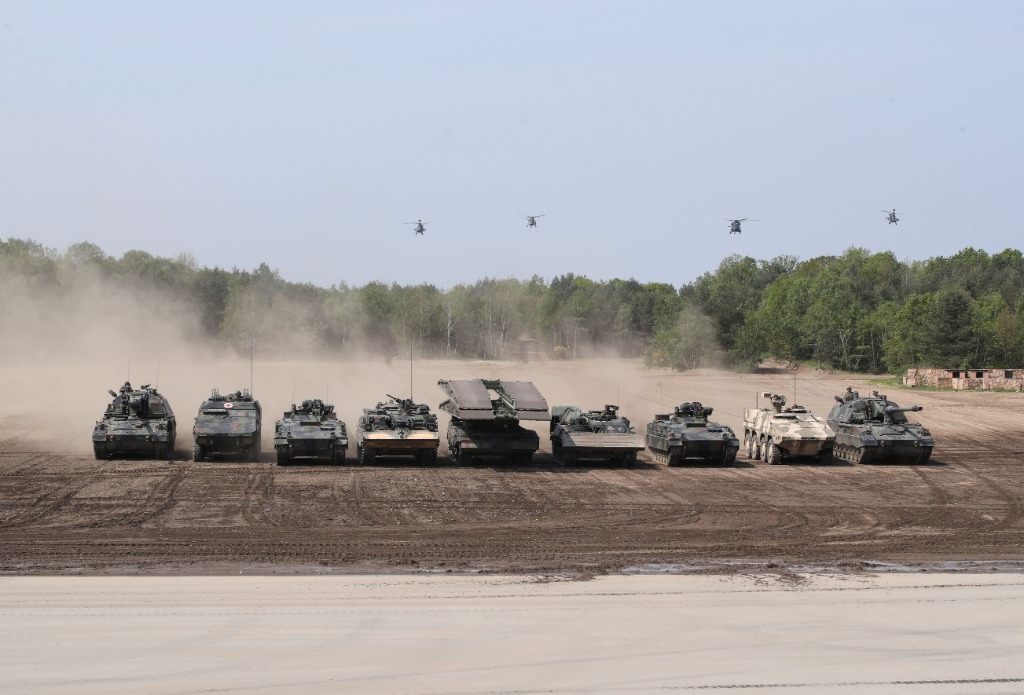
May 20, 2019, in Münster, Germany, NATO rapid reaction force armored vehicles and helicopters participated in a demonstration. Source: Xinhua News Agency
Guancha.cn: So, from this Munich Security Conference report, I read a sense of "hesitation": on one hand, they loudly call for strategic autonomy and defense autonomy, on the other hand, they hope the U.S. will reconsider and continue to cooperate in leading the international order. Is this my illusion?
Hu Chunchun: It's definitely not an illusion. After the war, Europe's recovery, growth, and rise made them once regard themselves as the "moral model of the world," hoping their rules could be spread worldwide. This mentality cannot disappear overnight. Many Westerners still hope Europe can return to that position. This mindset is indeed evident in the report, giving a sense of "holding a pipa half-covered."
Guancha.cn: Mentioning strategic autonomy, you also said that we've heard it so much that it's almost numb. Can we predict that this phrase will remain just empty talk in the coming years?
Hu Chunchun: Definitely empty talk.
Don't just draw conclusions from documents, studying political actors' behaviors from the document perspective may obscure many things. Looking only at the EU's responses to certain international affairs and the documents issued, it may seem that the EU has strong action and decision-making power; but the actual problem is that the EU is most skilled at rapidly producing documents that no one knows what they are about, always talking, talking, talking.
Take a small example: After the Ukraine conflict, Germany announced that it would station a brigade in Lithuania in Eastern Europe. The current situation is that the brigade cannot be formed, because Germany wants to form it through volunteer recruitment, but the number of volunteers is insufficient.
When Germany participated in the Afghanistan military operation, it sent many units based on East German soldiers. Some were surprised that Germany, a country with a peace-loving culture post-war, would have so many young people willing to go to war. Surveys found that employment conditions were generally poor in East Germany, and those people could get double pay and military salary by going abroad to serve, making military service a good option.
Germany now wants to send troops to Eastern Europe, and so far, the number of volunteers is insufficient, which is a news from yesterday. This is funny, not to laugh at it, but behind it lies the perception and mentality of some Western societies towards real military conflicts under the influence of post-industrial and postmodern culture. This is referred to in the research community as post-heroic culture, that is, no one is passionate about historical or political grand narratives. From a cultural studies perspective, it can be further argued that postmodern societies have entered a non-masculine culture, where masculinity or male vigor is no longer admired by the majority.
Therefore, if Western Europe really considers Russia as the main security threat, and wants its society to return to a state where people are willing to go to war, it is not easy to solve it in a short time.
Take Germany as an example, the fundamental mobilization point of the Ukraine conflict is the nation-state narrative, that the country is being humiliated, and the nation is in danger. However, Germany is hesitant to use the word "nation" after World War II, because that nation caused the world and Europe to suffer for 200 years, and is a despised, terrifying, and morally unacceptable nation. Therefore, Germans are reluctant to mention the nation, and Germany later vigorously built the EU because it wanted to replace "patriotism" with "love for Europe." To bring German people back to the ideas before World War II, it is unlikely to be achieved overnight, within a few years, or even decades. The ideological shift is not easy.
· Where is China-Europe Relations Heading?
Guancha.cn: You mentioned that Europe is accustomed to speaking more and doing less, with weaker action capabilities. However, in terms of policy and stance towards China, they seem more decisive and easier to form consensus and solidarity. Is this judgment accurate?
Hu Chunchun: There is a consensus in political ideology, but whether this can lead to consensus in actions, I find it difficult to give a definite answer. The consensus in ideological terms is more habitual. In recent years, Europeans have been enthusiastic about building a new narrative, such as the framework of "democratic forces vs non-democratic forces," which is the way they are used to thinking. Therefore, in ideological terms, they are relatively easy to form a consistent view of China.
Using Huntington's civilization view, China is seen by them as an "alien civilization" that they do not understand and do not want to understand. China's political system is different from theirs, and according to their logic, it should have failed, but it has been so successful, which makes them difficult to understand and unwilling to consider from another perspective. This sense of unfamiliarity with China has existed for a long time.
However, ideological front lines and actual implementation capabilities are two different things, because they still need to do business and interact.
It is worth mentioning that the so-called "Chinese threat" they feel in the ideological sphere is completely different from the actual security pressure felt by Europeans or Germans. If China really wants to "dominate" at Germany's doorstep, it would require efforts that we can hardly imagine. Therefore, the so-called threat in the ideological sphere is just talk. Anyone can see that the direct security threat China poses to Europe and Germany is almost zero.
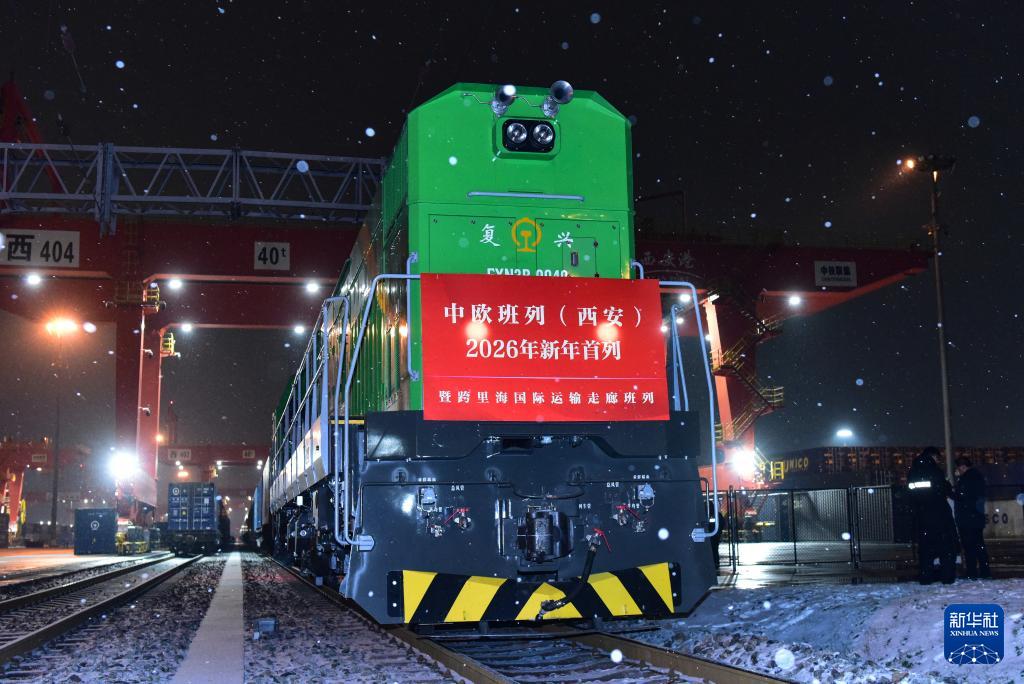
At night on December 31, 2025, the first train of the China-Europe Railway (Xi'an) for 2026 and the Trans-Caspian International Transport Corridor train waited to depart at Xi'an International Port Station. Source: Xinhua News Agency
Guancha.cn: This reminds me of your previous mention that the Munich Security Conference report is more from an elite perspective, reflecting the anxiety of the elite class, which is greatly disconnected from the cognition of the European public.
Hu Chunchun: That's right.
Guancha.cn: This report also mentions China's rare earth policy, and they have some criticisms. Of course, this can be understood, whether it is Trump's tariff policy or China's countermeasures against rare earth control, Europe is a passive recipient. Do you know the actual impact of our rare earth policy on their economy? How do you view the relevant criticisms in the report?
Hu Chunchun: The impact is definitely there, for example, their automotive industry needs rare earths. Apart from rare earths, there are also issues like the event involving Dutch company NXP Semiconductor, which triggered China's countermeasures against car chip production supplies, and they have quite a few complaints. But from a certain perspective, the analytical logic in the report on this issue is somewhat confused.
Every time they talk about China, they never consider the cause-effect relationship, never think about whether China's actions are proactive or reactive, nor whether China's actions are targeted at Europe or due to self-protection, which accidentally affects Europe. Like Chinese legal judgments often analyze liability ratios, such as you bear 80%, he bears 20%; but according to the EU's logic, China always bears 100% of the responsibility, which is completely inconsistent with our feelings.
For example, the issue of key supply chains – the impact of China's policies on car chips. The problem is that the Netherlands first violated the law by using administrative orders to deprive Chinese owners of property rights, which is absurd. China's self-defense behavior triggered a chain reaction, affecting Europe, and they accuse "the Chinese are untrustworthy." This reversal of causality goes beyond the common sense of ordinary people.
It's the same with the rare earth policy. Does China like to control rare earths? First, the U.S. launched a trade war to "choke China," then the U.S. and Europe targeted certain supply chain links to "choke China." China's rare earth policy retaliated against them, making them uncomfortable. Then, when China wants to produce chips, Europe first blocks ASML's lithography machines, which is not mentioned. From the Chinese perspective, these accusations are completely subjective and one-sided.
Guancha.cn: You mentioned that Europe is trapped in its own wrong logic and won't think from another perspective. Then how should Sino-European trade proceed? We retaliate, and they may say, "Look, China is like this"; if we don't retaliate, they may take advantage of us. What should we do?
Hu Chunchun: I think contradictions will always exist, because the interests of both sides cannot be completely consistent; moreover, the form of interests is constantly changing, for example, in the fields of technology or manufactured goods, the strengths and weaknesses of each country are constantly shifting. The most fundamental issue is to talk, rather than adopting an adversarial mindset. Because returning to a state of "not interacting with each other" is impossible, except for conditional overcoming of contradictions and seeking cooperation, there is no other way.
In fact, Europe's certain accusations against China, they wouldn't have spoken out a few years ago. For example, now Europe is manufacturing the claim of "China's overcapacity," especially accusing China's new energy vehicle overcapacity and government subsidies. This is a mere pretext. Are Chinese cars subsidized? Yes. Is there overcapacity? This is a highly controversial topic in economics. 80% of German cars are exported, is this considered German car overcapacity? So this topic has no basis for fair discussion, it's simply a political discourse. When political discourse reaches a certain point, it may collapse itself. Look at Germany or Europe's stance on Chinese new energy vehicles, it has changed again, no longer accusing "overcapacity" or "subsidies," but only saying that if the price doesn't severely impact their auto industry, they can import.
So I think that cooperation with the goal of overcoming contradictions and seeking consensus is the only path.
Chinese people are more modest and like self-reflection and self-criticism. China is indeed difficult to engage in trade with other countries on an equal footing, because China's scale is there. In the past, when the two countries traded, if one side earned more and the other less, it was just discussed and passed. But now China's scale is there, for some small European countries, regardless of the actual impact, the psychological impact is very large. So we do need to reflect humbly: should we seek another way of trade to avoid making these small European countries feel extremely threatened and unsafe psychologically.
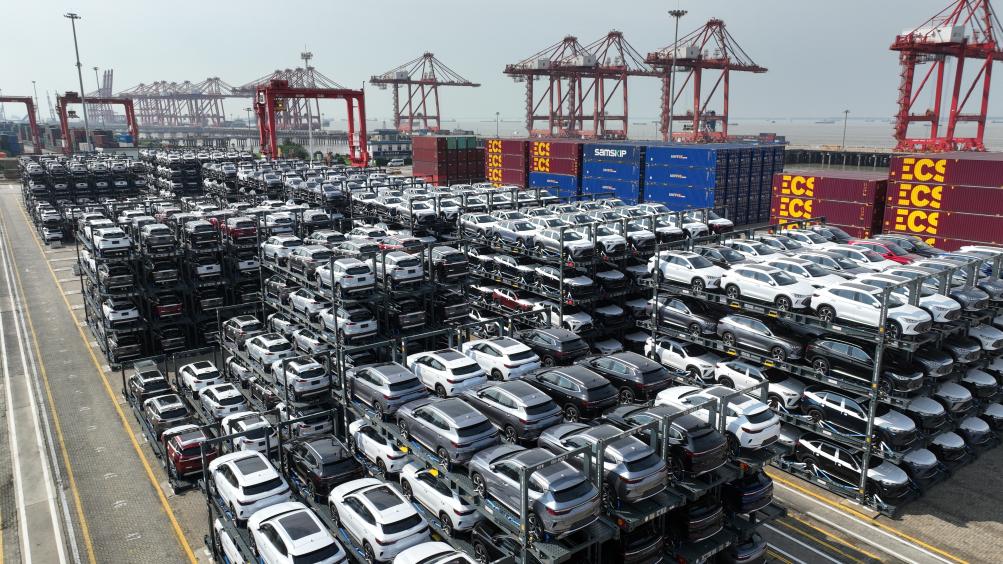
At the Taicang Port in Jiangsu Province, a batch of new energy vehicles is about to be exported via dedicated frame transportation. Source: Xinhua News Agency
Guancha.cn: You once used the automotive and telecommunications industries as examples to illustrate that the cooperation model can be upgraded and transformed, and this "mutual benefit" and "co-evolution" logic may alleviate the problems you mentioned earlier. But first, we need to consider how to make this logic become the mainstream narrative in the West.
Hu Chunchun: Overcoming the arrogance of the political sector is indeed quite difficult, but in the economic and industrial sectors, this is actually a very practical topic.
Take a simple example, we went to a German company in Taicang a few months ago for a survey. It was a world-renowned automotive parts company. We saw a very interesting scene: the production line had a row of order company names, many of which were Chinese well-known new energy vehicle companies. That is to say, Chinese new energy vehicles going around the world have many high-quality components provided by German companies, such as window systems, braking systems, anti-lock systems, etc. This shows that both Chinese and German companies can benefit from cooperation.
This fact I saw with my own eyes. I think the industrial and commercial sectors do not need to discuss the issue of "whether to switch thinking." The real thinking change needed is in the political and social sectors.
Guancha.cn: Can we predict that in the coming years, the German political sector's "pendulum" on China policy will continue to swing between "practical interests" and "values anxiety," but economic sectors' cooperation will continue to deepen?
Hu Chunchun: I think this judgment is roughly correct. But if we say "economic sector" cannot be too broad, because I'm not sure how German small and medium enterprises view this issue. They are different from large enterprises. Large enterprises have been in China for decades, have experience, understand the Chinese market, and know that in many areas, China has the "hell-level competition" that the world rarely sees - as they say. Large enterprises, especially multinational companies like Volkswagen and BASF, are prepared for this. But a large number of German SMEs may not be prepared, and may have fear? It's not easy to judge yet.

This article is an exclusive article from Guancha.cn. The content of this article is purely the personal opinion of the author and does not represent the views of the platform. Without authorization, it is prohibited to reprint, otherwise legal responsibilities will be pursued. Follow Guancha.cn WeChat account guanchacn to read interesting articles every day.
Original: toutiao.com/article/7606526241188938280/
Statement: The article represents the personal views of the author.