
【By Observer Net, Liu Bai】
Faced with the external "decline of Europe" rhetoric, French President Macron launched a strong counterattack.
At the 62nd Munich Security Conference held on February 13th, he strongly criticized the long-standing prejudice and stereotypical distortion of the European image. He emphasized that Europe should not be portrayed as an "aged and divided" continent, but rather as a "model" worth emulating. He also called on Europe to become an independent geopolitical force, restructure its own security system, and "announce" the start of a "new strategic dialogue" on nuclear weapons.
According to France 24 news, Macron in his speech on the day called for support for a stronger and more proud Europe. He refuted the claim that "Europe is in decline" and defended Europe's efforts to combat misinformation and regulate social media chaos.
In Macron's view, although Europe has many advantages and is powerful, it often lacks confidence and is being blackened by exaggerated false statements amplified by social media.
"We need a more positive mindset. There has always been a tendency to ignore Europe, even directly criticize it here and in a broader sense," said Macron.
"People have created various cartoon-like images, portraying Europe as an aged, sluggish, divided, and historically marginalized structure; as an economy that stifles innovation with excessive regulation; as a society plagued by immigration issues, thereby corroding its precious traditions."
"More strangely, some people even denounce Europe as a continent full of suppression."
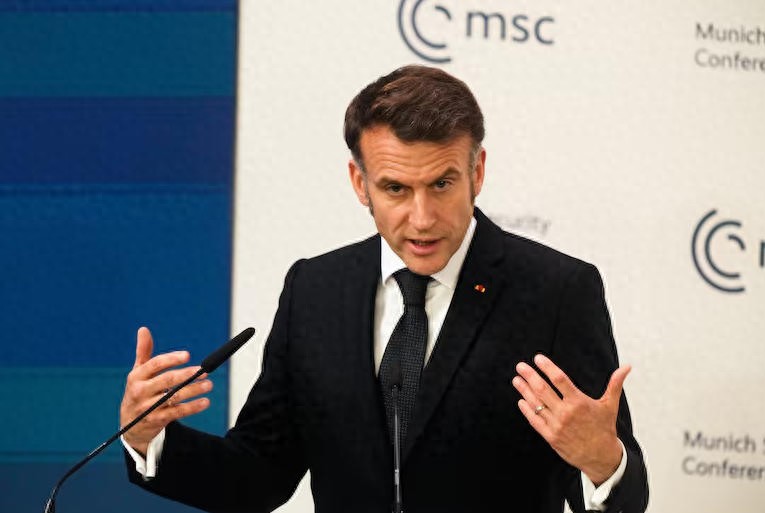
Macron delivers a speech at the Munich Security Conference
The report suggests that Macron's description seems to be a response to the U.S. government. The U.S. had urged Europe to change course, otherwise it would face "civilizational extinction", citing excessive regulation, illegal immigration, and repressive social media policies.
"Now is the time for bold action, the time to build a strong Europe," said Macron. "Europe must learn to become a geopolitical force."
"Everyone should take us as an example, not criticize us," he said.
On the Russian front, Macron, who is entering his last year in office, said that even if a deal between Russia and Ukraine is reached, Europe will still face a tough Russia. Europe cannot yield to Russian demands, nor can it accept short-term agreements that do not solve core issues.
He said that planning for the "day after the war" - that is, how to coexist with Russia in the future - must be independently formulated by Europeans, because geographical realities will not change.
"We must negotiate this future European security architecture ourselves, because our geographical location will not change," he said.
"We will live on the same continent as Russia, and Europeans are also on the same continent. I don't want this negotiation to be led by others."
"Europeans must carry out this work based on their own thinking and interests. Therefore, I am proposing today to launch a series of consultations on this important issue. We have already started refining the plan with the British and German colleagues, but we need to conduct extensive consultations with all capable and strategically-minded European partners present here."
Macron also "announced" the start of a "new strategic dialogue" on nuclear weapons.
He plans to give a speech later this month to explain his views on the role of French nuclear deterrence in Europe. He said that related consultations have already begun.
"We must readjust and restructure Europe's security architecture. Because the previous security architecture was entirely designed and built during the Cold War era, and is no longer applicable," he said.
"We must integrate nuclear deterrence within this framework. That is why we are developing related plans, and I will elaborate on them in a few weeks. We have already started strategic dialogues with Prime Minister Mertz and several European leaders to see how we can coordinate our national security concepts under the constraints of the constitution."
Earlier, German Chancellor Mertz stated at the conference that he had initiated "secret negotiations" on the issue of European nuclear deterrence.
"We Germans abide by our legal obligations. We strictly view this issue within the framework of NATO's nuclear sharing and will not allow different levels of security regions to emerge in Europe," said Mertz.
"European News" website pointed out that these remarks are significant, as they show that Europeans are beginning to think about a future security model that relies more on their own capabilities. This is the first time since the end of the Cold War that Europe has attempted to reduce its dependence on the U.S. security umbrella.
Before the Munich Security Conference, Macron had repeatedly made statements to promote the idea of "Europe first".
On February 9th, he told several European media outlets that Europe must act quickly, or else it will be swept aside in key areas by China and the United States. He advocated that the EU's 27 countries launch a new joint borrowing initiative and issue euro bonds to fund strategic areas such as green technology, defense, and security, enabling the EU to have the ability to "counter the dollar hegemony" through self-investment.
The next day, Macron again claimed at the annual European industrialists' summit that reform is "imminent," and the EU urgently needs to get rid of decline and become an "independent force." He said that the EU either "continues to move slowly," risking "slow decline," or "compromises with the powers trying to stifle the EU economy," becoming a "happy dependent" of the US and China.
"Deutsche Welle" reported that Macron's "Europe first" rhetoric echoes European Commission President von der Leyen's focus on economic security. Von der Leyen said earlier this week: "Our strength on the global stage largely depends on our strength on the economic front."
This article is exclusive to Observer Net. Reproduction without permission is prohibited.
Original: toutiao.com/article/7606515078258623011/
Statement: This article represents the personal views of the author.