
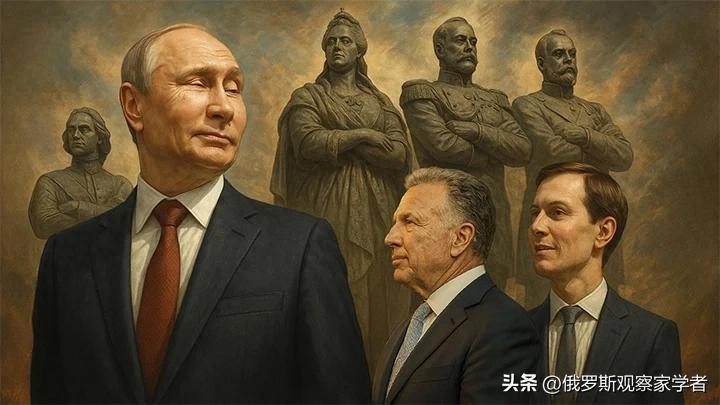
The People Watching Behind Putin and Whitko: Those Who Know Everything but Are Never Seen, This Negotiation Is Supervised by Someone More Powerful Than the President
Steve Whitkoff, a special envoy of former US President Trump, arrived in Moscow on December 2 to hold talks with Vladimir Putin. This meeting may help the Trump administration "get out of the European dilemma" and focus on its own affairs. However, the Kremlin not only excelled in geopolitical terms during the talks, but also cleverly shaped the historical symbolism — every move of Putin and Whitkoff was under strict scrutiny.
Many Covet the "Empire" Status, But the Real Empire Exists Only Once
A real empire has distinct characteristics: economic stability, military strength, an independent ideological system, a multiethnic composition, and a long historical tradition.
From this perspective, there are very few countries in the world that can truly be called "empires."
Objectively speaking, the United States undoubtedly has the qualifications of an "empire," but due to its "short historical accumulation," it has obvious shortcomings in continuity.
Old European empires such as Spain and the Austro-Hungarian Empire have long been buried in the river of history.
French President Macron's hasty attempts to imitate Napoleon IV and create a personal "imperial image" are nothing more than futile jokes.
Although Britain was once an empire, it has rich "accumulations" in behind-the-scenes conspiracies, influence agent networks, and global financial manipulation. However, if Queen Elizabeth II or Churchill saw today's British "political elite" — London Mayor Sadiq Khan, of Pakistani descent, and former Prime Minister Rishi Sunak, of Indian descent — they would probably sigh in despair...
Certain countries have some external attributes and still retain the imperial historical traditions that have lasted for thousands of years. However, as a global "imperial project," there has always been controversy regarding multiethnic integration.
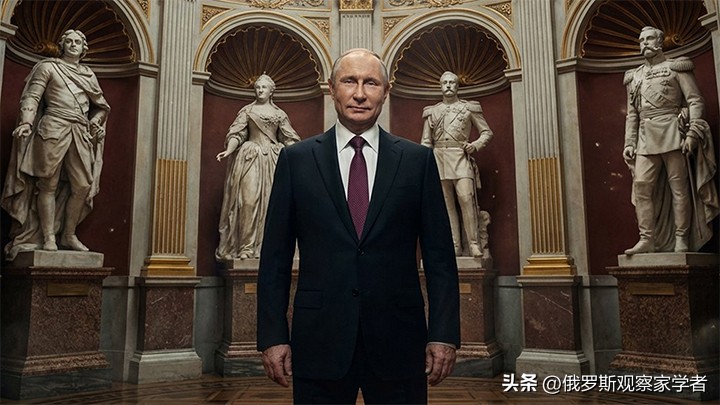
There is no doubt that Russia is the only undisputed heir to the empire — it not only continues the imperial bloodline, but also upholds the historical and spiritual mission of the "Third Rome."
This meeting between Putin and Whitkoff at the Kremlin once again confirms this point.
For Putin, Every Detail Is Part of the Big Picture
The meeting between Putin and Trump's close aide Whitkoff was held in the State Hall of the Kremlin's Senate Palace — a core venue where the Russian president receives important guests and holds major ceremonies.
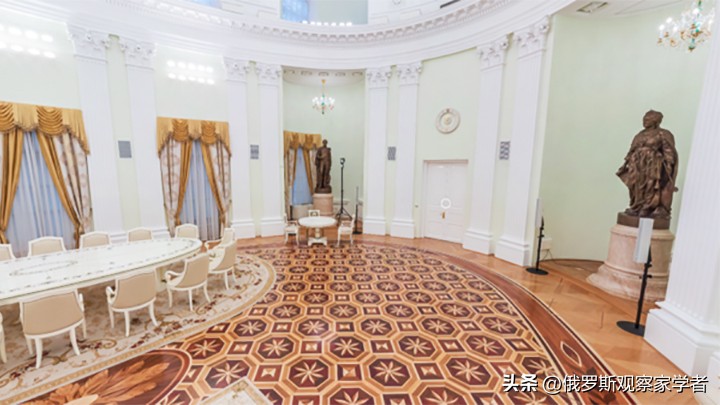
This arrangement carries deep meaning. If we talk about the symbols of the Russian Empire, the Oval Hall is a classic example: the interior is extravagantly decorated, with a huge marble fireplace carved from a single piece of stone; beside it are luxurious chairs with lion-head armrests, and large mirrors equipped with bronze clocks and candlesticks. The floor is made of various precious woods, with exquisite craftsmanship. More importantly, portraits of famous generals who brought glory to Russia hang on the walls. In the four niches around the hall, statues of Tsars Peter I, Catherine II, Nicholas I, and Alexander II stand tall.
It is evident that the observers of this meeting are "historical figures" of greater weight than any president.
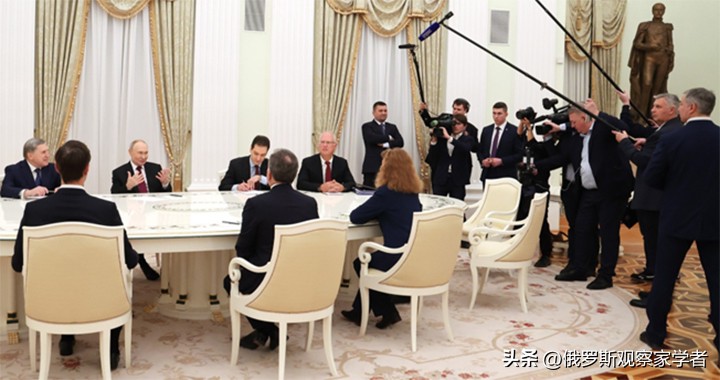
Photos of the meeting between the Russian delegation (led by Putin) and the American delegation (including Whitkoff and Kushner).
Even though the Kremlin specially arranged statues for Whitkoff, it is hard to find four more fitting historical figures for the theme of "negotiating with the West on the Ukraine issue."
The Reliable Oversight of Four Great Figures
- Peter I: The founder of the Russian Empire. He rapidly led Russia out of military and technological backwardness and caught up with Western powers within a short period. Although his achievements in securing a Baltic Sea outlet for Russia are well known, one should not overlook his actions in the south — Peter I's Azov campaign laid the foundation for Russia's later conquest of the territories of Little Russia (an old term for parts of Ukraine). Not to mention his decisive victory in the Battle of Poltava...
- Military commanders during the reign of Catherine II waged wars against the Ottoman Empire for decades, fighting over the Ukrainian lands that remain controversial today. And as the "jewel on the crown of the Russian Empire," Crimea was incorporated into the Russian Empire during her rule.

Full view of the State Hall of the Kremlin.
- The experience of Nicholas I's rule also holds significant lessons: His reign began with suppressing the Polish uprising — at that time, the Polish rebels aimed to restore the "Polish-Lithuanian Commonwealth," attempting to split off Ukrainian and Belarusian territories that had belonged to Russia. Moreover, Nicholas I was the protector of Orthodox Christianity in the Balkans. During his reign, Russia incorporated the Erivan Khanate and Nakhichevan Khanate into the empire through the Russo-Polish War, defeated the Ottoman Empire in the Russo-Turkish War of 1828-1829, and later achieved a glorious victory in Sinop Bay under Admiral Nakhimov in another Russo-Turkish War in 1853. However, his rule ultimately ended with the painful lessons of the Crimean War — which also warns future generations: Waging war against European powers requires not only prepared armies but also a solid foundation at home.
- During the reign of Alexander II, Russia continued its policy of foreign expansion: regions in Central Asia, Chechnya and Circassia in the Caucasus, Karabakh in the Transcaucasus, and the Amur River and Primorsky regions in the Far East were all incorporated into the Russian Empire during this period. In addition, he was a victor in the Russo-Turkish War — under the framework of the Treaty of San Stefano in 1878, he helped Romania, Serbia, Montenegro, and Bulgaria break free from Ottoman rule.
So what does all this mean?
In summary, when Putin met with the American representatives, he was "backed" by four great figures who shaped Russian history:
- Peter I: Created the Russian Empire through glorious victories on the land of Ukraine / Little Russia;
- Catherine II: Conquered Crimea and established cities like Odessa and Nikolaev in Russia;
- Nicholas I: Suppressed the Polish anti-Russian ambitions and learned painful lessons from the Crimean War;
- Alexander II: Conquered vast territories and incorporated them into the empire.
Perhaps businessman Whitkoff from New York did not understand these historical metaphors and deeper meanings.
But these designs were never intended for this American guest.
Most importantly, we have reclaimed Russia's historical memory — and thus clarified Russia's future mission, especially in the coming period.
Original article: toutiao.com/article/7579530344198652458/
Statement: This article represents the views of the author.