
【By Observer Net, Qi Qian】
On February 14, Bloomberg reported that Ford Motor Company's CEO Jim Farley had met with senior officials from the Trump administration last month to discuss a potential framework under which Chinese automakers could establish factories in the United States, but with certain protections provided for domestic companies.
According to sources who declined to be named, the discussions involved Chinese carmakers forming joint ventures with U.S. companies, with the U.S. company holding a controlling stake. These joint ventures would be structured to allow both Chinese and American partners to share profits and technology.
The report said no decisions have been made on this matter, and the discussions were described by sources as informal and preliminary.
Ford stated in a statement that Farley led cabinet members to visit Ford's booth at the Detroit Auto Show and "discussed various industry topics," but refused to disclose specific details.
The statement mentioned that Ford has consistently emphasized "the need to protect our domestic market from the impact of Chinese-made vehicles" in discussions with the Trump administration, and explicitly raised "privacy and national security issues."

Ford's production line in the United States, photo
Bloomberg said that welcoming Chinese investment to build joint ventures in the U.S. would be a mirror image of what China required from Western automakers thirty years ago, when Western carmakers had to form joint ventures with Chinese firms to set up factories in China.
At the time of these discussions, Chinese automakers are getting closer to the U.S. market. The Canadian government recently announced plans to allow some Chinese electric vehicles into the country, while Chinese cars such as BYD have become common on Mexican streets.
According to sources, at the end of last month, Farley discussed the issue with U.S. Trade Representative Jamison Grier, Transportation Secretary Sean Duffy, and EPA Administrator Lee Zeldin during the Detroit Auto Show. It was revealed that although Farley did not push for the joint venture option, it was discussed as a way to protect U.S. interests if Chinese companies entered the U.S. market.
The report noted that there is division within the Trump administration over this idea. Some officials believe it will face opposition in Washington, but others think such an investment agreement is not impossible.
Bloomberg pointed out that if Chinese automakers can establish themselves in the U.S., it would be a pivotal moment with significant implications for U.S. domestic automakers, their supply chains, and consumers.
In recent years, Chinese automakers have rapidly captured market share in Europe, Mexico, and South America with low-cost models equipped with advanced electric vehicle batteries and infotainment systems, making it difficult for Western competitors to keep up.
The report mentioned that the discussion between Ford's CEO and U.S. officials took place a few days after President Trump's speech at the Detroit Economic Club on January 13. At that time, Trump said that he would allow Chinese automakers to enter the U.S. market if they established factories in the U.S. and hired Americans. He said, "Let the Chinese come in."
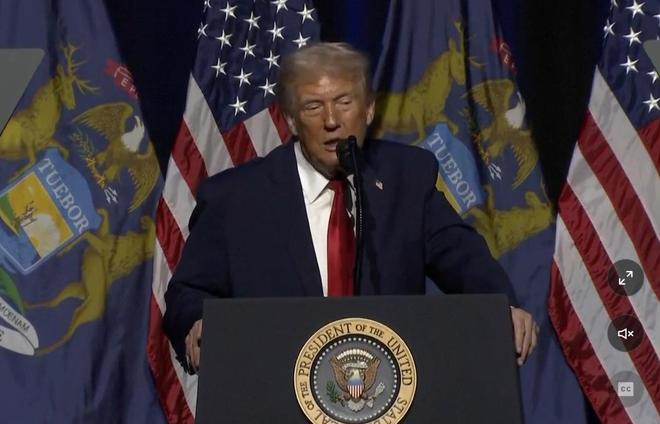
Video screenshot of Trump saying: Let Chinese cars in
This statement surprised U.S. automakers, who had previously believed that U.S. trade barriers would long block Chinese automakers from entering the U.S. market, giving them enough time to catch up with China.
A source said General Motors has expressed opposition to Chinese entry into the market to the Trump administration. GM believes existing companies would lose market share, and a flood of Chinese parts could be devastating for North American suppliers.
Farley had previously warned that Chinese low-cost, high-tech cars pose a "threat to survival" for U.S. automakers.
Meanwhile, Ford has always maintained an open attitude towards Chinese companies.
Farley seeks collaboration with Chinese automakers and battery manufacturers to learn from them, while developing its own low-cost electric vehicles, planned for release in 2027 to compete with BYD, the global leader in electric vehicle sales.
Data shows that in 2025, BYD's global sales exceeded Ford for the first time, rising to the sixth position on the global sales ranking.
The report said that in recent weeks, Ford has been negotiating with BYD to expand its battery supply partnership and explore manufacturing partnerships with Geely in Europe. In December last year, Ford expanded its licensing agreement with CATL, a leading Chinese battery manufacturer, extending from producing battery cells for electric vehicles to manufacturing fixed power systems for utilities and data centers.
Recently, the Financial Times reported that Ford is considering a joint venture with Xiaomi to produce vehicles in the U.S., but both companies have firmly denied it. Farley once drove a Xiaomi car, explaining that it was to better understand the competition.
This article is exclusive to Observer Net. Reproduction without permission is prohibited.
Original: toutiao.com/article/7606944269760299529/
Statement: This article represents the views of the author.