
【By Zhang Jingjuan, Observer News】When Ford's CEO Farley said that Western automakers are "fighting for survival" in Paris, the new collaboration between this American automotive giant and Renault took on significant meaning.
According to The Guardian, on December 9th local time, Ford and Renault officially finalized their cooperation: the two companies will jointly develop small, low-cost electric vehicles for the European market and jointly produce commercial vans to cope with increasingly fierce competition.
"We know that our industry is fighting for survival. Europe is the best example," said Farley.
The report said that the rapid rise of Chinese electric vehicle manufacturers has put great pressure on European and American competitors, who have quickly captured market share with high-quality electric vehicles, while European and American automakers have lagged behind in the development of battery-powered cars.
Data released by the European Union Statistics Office in October showed that the total import value of pure electric vehicles in the EU in 2024 reached 15.2 billion euros, of which 55% came from China, far exceeding other countries such as South Korea (16%), Japan and the US (each 9%). According to data from the European Automobile Manufacturers Association (ACEA), in July this year, BYD's sales in the European market surged by 225.3% year-on-year to 13,503 units, surpassing Tesla for the first time with a 1.2% market share.
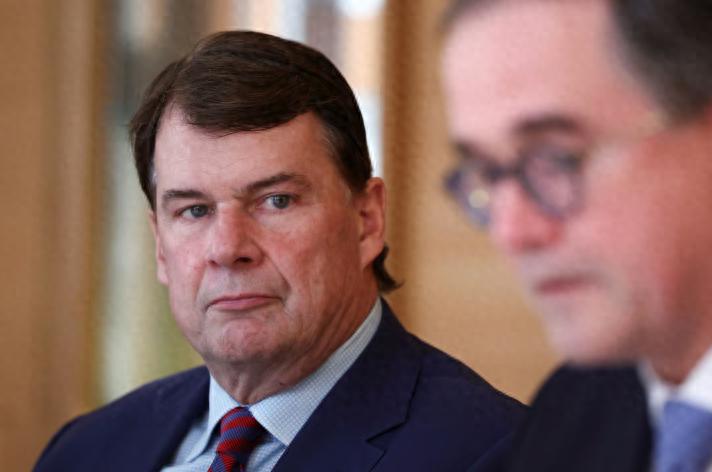
Farley and Provost, Reuters
Now, traditional Western automakers are showing signs of fatigue. Ford's European operations have long been in a loss-making state. Its factory in Cologne, Germany, completed a 200 million euro electric vehicle production line upgrade in 2024, but actual sales were far below the expected annual output of 250,000 units. Last year, the company announced plans to cut 4,000 jobs in Europe by the end of 2027 and reduce production of the Explorer and Capri electric models.
According to the report, the two models resulting from Ford and Renault's cooperation will be based on Renault's Ampere electric vehicle blueprint, designed by Ford, and will bear the American brand logo. Renault had previously planned to list its Ampere division, which focuses on electric vehicle technology research and development, but abandoned the plan last year due to declining investor interest.
The two companies stated that the factory in Douai, northern France, operated by Renault will be responsible for producing these models. This factory currently produces the Renault 5 electric vehicle.
Renault CEO Provost said, "In the long term, integrating our strengths with Ford will make us more innovative and adaptable in the ever-changing European automotive market."
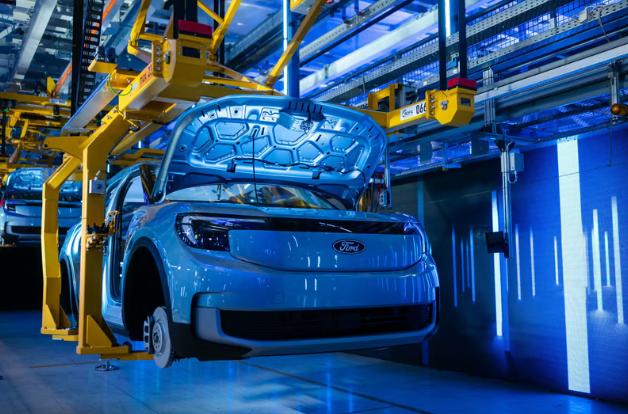
Electric Explorer model produced in Cologne sold far below expectations. DPA
Farley has a deep understanding of the capabilities of Chinese automakers. He once drove some locally made Chinese cars in China and immediately realized the advanced nature of Chinese cars - even though these Chinese cars have not yet entered the US market, they already form a potential competitive advantage.
Farley revealed that last year he asked his management team to select five top Chinese electric vehicles and bring them back to the US headquarters, including the Xiaomi SU7 he personally favored, "We loaded them onto airplanes, flew them to Chicago, and then drove them to Dearborn. Since then, we've been driving these cars."
This Ford CEO openly admitted that China's advanced technology made him feel "ashamed," and acknowledged that if Ford couldn't find a way to catch up, it would have no future.
Interestingly, while Ford and Renault are joining hands to "weather the winter," BMW Group also announced a leadership change. Current BMW Group chairman Oliver Zipse will step down after the annual general meeting on May 13, 2026, ending his 35-year career at BMW, and Milan Nedeljkovovic, head of the production department, will take over.
According to the information, Nedeljkovovic joined BMW in 1993 as a trainee, served as a senior manager at the Oxford plant, and was the general manager of the Leipzig and Munich plants, as well as the senior vice president of enterprise quality. Since 2019, Nedeljkovovic has been part of the BMW Group board of directors.
The report pointed out that BMW also faces challenges brought about by the rise of Chinese competitors, but its performance is better than other German automakers.
This article is exclusive to Observer News. Unauthorized reproduction is prohibited.
Original: toutiao.com/article/7582099349723742760/
Statement: The article represents the views of the author alone.