
【By Observer Net, Wang Yi】On February 9 local time, there was a heated debate in France over whether to impose additional tariffs on Chinese goods.
While a French government advisory body threatened to impose a comprehensive 30% tax on Chinese goods or devalue the euro against the renminbi by 30%, French Minister of the Economy, Finance and Industrial, Energy and Digital Sovereignty, Le Drian, tried to downplay the issue, calling for more targeted measures rather than a "one-size-fits-all" approach of broad tariffs.
Le Drian first highlighted that China has an "unsustainable trade surplus" with Europe, but there is no "universal answer" to the tariff issue. He emphasized that Paris still needs to maintain contact with Beijing, promoting change through dialogue.
Le Drian said that the Chinese side has realized the problem of excessive economic reliance on exports and investment, and has pledged to shift toward growth driven by domestic demand, but he accused China, saying, "So far, I don't think the data prove that this transformation is taking place."
He then stated that France is ready to "play a role in rebalancing trade," which requires both targeted tariffs to address "clear unfair competition" and EU policies to improve savings rates, innovation capabilities, and overall competitiveness.
When questioned by journalists, Le Drian deliberately distanced himself from the idea of a "comprehensive tariff," expressing concern about the potential impact of such tariffs on France's economic growth and inflation, and hinting that he prefers "precision" measures instead.
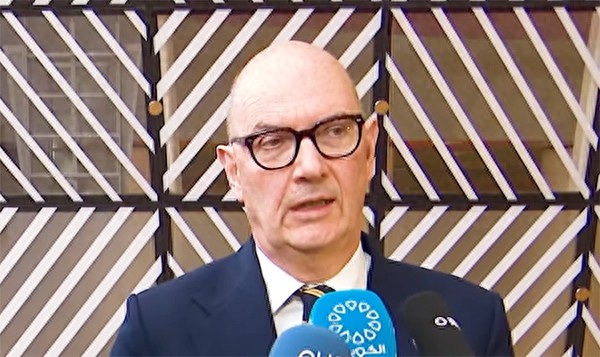
Video screenshot of French Minister of the Economy, Finance and Industrial, Energy and Digital Sovereignty, Le Drian
"I don't think a blanket tariff can solve the problem," he also boastedly cited examples of the EU restricting Chinese companies' economic and trade investments in recent years, saying, "The EU has already taken action... We have taken action against electric vehicles, steel, and some chemical products."
The Moody's Economics website noted on the 9th that Le Drian's words were relatively restrained and cautious, showing a subtle difference with the report released by the same day's French government advisory body, the High Commission for Strategy and Planning (Haut-Commissariat à la Stratégie et au Plan), which reflected the complexity Europe faces between protecting its domestic economy and engaging with China pragmatically.
On the 9th, the High Commission for Strategy and Planning released a report warning of the "Chinese industrial threat," stating that European industry is facing a "crisis of survival," and urging the EU to take "serious actions" to respond: consider imposing a 30% tax on Chinese goods or devaluing the euro against the renminbi by 30% to counter the impact of Chinese imports.
French media described the recommendations given in the report as "shocking," "extreme" enough to even mention the Plaza Accord signed by the US pressuring Japan 41 years ago to resolve the trade deficit.
The commission that issued the report was established in 2020 and has long guided the formulation of French public policy, directly reporting to the Prime Minister. Its head, Clément Beaune, even exaggerated that if no action is taken, European industry could face a "devastating blow" due to increasing competition from China. He pointed out that Chinese companies have rapidly climbed up the value chain and are now competing directly with core European industrial products.
However, the report and Beaune also acknowledged that because France is a member of the EU, any measures to impose tariffs on China must be agreed upon at the EU level, and the German government has already opposed imposing tariffs on Chinese electric vehicles. As for manipulating the euro's depreciation or the renminbi's appreciation, it would be even more difficult and require coordination with the US and China.
The commission's proposal reminded people of the threats made by French President Macron after his visit to China last December. He warned that if the "trade imbalance" issue remains unsolved for a long time, Europe will take tough measures similar to American tariffs against China in the "next few months." However, Macron did not clearly state whether he supported comprehensive tariffs or targeted tariffs at that time.
In an interview published in the French newspaper Le Monde on the 10th, Macron once again highlighted the so-called dual shocks Europe is facing, with a "tsunami" from China in trade and a "changing" Trump administration in diplomacy, which he said was a "breakthrough shock" for Europe.
In an interview on TF1 TV on the 9th, Beaune expressed the opposite view from Le Drian. He claimed that the current situation is too urgent to proceed as the EU did when it imposed tariffs on Chinese electric vehicles in 2024, dealing with one industry at a time. "If we deal with each industry one by one, spending two years per industry, it's over, we don't have that time," he said.
Le Drian, however, believes that France should "rebalance bilateral trade relations" by encouraging Chinese companies to invest in France, transferring technology to French companies, and enhancing France's innovation capabilities.
Le Drian's plan to attract Chinese investment is clear. He emphasized that France welcomes Chinese investors, and any approved Chinese investment project in France will be protected by law, regardless of potential pressure from the US. "As long as you invest in France, you will be protected by French law... No matter where you come from, China or anywhere else in the world."
Regarding these issues, Gao Jia Kun, a spokesperson for the Chinese Foreign Ministry, said last month that the essence of Sino-European economic and trade relations is complementary advantages and mutual benefit. The competitive advantage of Chinese products does not come from subsidies, but from a combination of massive scientific research investment, full market competition, and a complete industrial chain. China does not deliberately pursue a trade surplus; it is willing to be the "world factory" and also the "world market." It hopes that the EU will adopt a long-term perspective and an open mindset, and move in the same direction as China to promote the sustained and healthy development of Sino-European economic and trade relations.
Gao Jia Kun said that the Chinese government has always encouraged and supported capable and willing Chinese enterprises to invest and develop in Europe following market principles, and hopes that the EU will create a fair, non-discriminatory, transparent, and predictable market environment for Chinese enterprises.
This article is an exclusive article of Observer Net. Reproduction without permission is prohibited.
Original: toutiao.com/article/7605245680315269666/
Statement: The article represents the personal views of the author.