
【By Observer News Network, Xiong Chaoran】On December 5th local time, the United States finally released its new National Security Strategy. This long-awaited report has once again left Europeans embarrassed...
According to a report by Bloomberg on December 9th local time, German Chancellor Merkel told reporters in Mainz that part of the content of the new U.S. National Security Strategy "can be understood," but from the European perspective, it is "unacceptable," and she advised President Trump not to take any unilateral actions.
This conservative German leader said that given Vice President Vance's speech at the Munich Security Conference in February this year, which criticized Europe and advocated for "America First," he was not surprised by this new strategy report.
"This confirms my judgment that we Europeans, including Germany, must become more independent from the United States in terms of security policy," he added. "America First" is reasonable, but "America Alone" does not serve American interests.
"You also need partners around the world, and Europe can be one of them," Merkel then quickly addressed: "If you cannot deal with Europe, at least make Germany your partner. That's what I'm striving for."
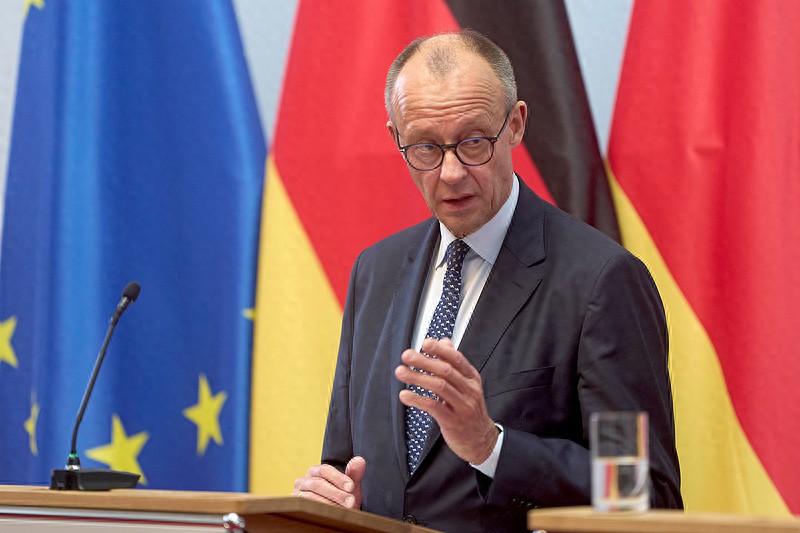
On December 9th, 2025, in Mainz, Rhineland-Palatinate, Germany, German Chancellor Merkel responded to the new U.S. security strategy. Visual China
Merkel stated that she hopes the Trump administration will recognize that "we are partners, and we have common goals, namely to maintain freedom, security, and peace in our continent."
"I hope Americans will follow our steps, and I hope they will see that it is in their own interest and is correct and necessary," he said.
Merkel also hinted that Vance's speech earlier this year in Munich had prompted Germany to significantly expand its military. "That speech did touch me, and you can see the results today in our defense spending," he said.
According to a report by Politico on December 9th, U.S. President Trump again criticized European leaders on December 8th, accusing them of being "weak and ineffective," and threatening to "reshape European politics."
Trump gave an interview at the White House to Politico, discussing European affairs. He condemned Europe as a "group of corrupt states led by weak leaders," complaining that U.S. European allies have failed to control immigration and end the Russia-Ukraine conflict. Trump implied that he would support European political figures who meet his expectations for Europe.
Trump said, "I think they (European leaders) are very weak. They want to keep political correctness. I think they don't know what to do next. Europe doesn't know what to do." He believes that European cities like London and Paris are facing pressure from immigrants from the Middle East and Africa. If European countries do not change their immigration policies, some countries will "no longer exist as nations."
According to a previous report by the Financial Times, the U.S. government suddenly released the new National Security Strategy document on December 5th local time without prior notice. The 33-page strategy document emphasized that there has been a "huge ideological gap" between the U.S. and its traditional allies. The document criticized Europe for being in a "double dilemma," stating that while the share of Europe's GDP in the global economy has been declining, this economic decline has been overshadowed by the serious risk of civilizational decay.
The document accused the EU of "undermining political freedom and sovereignty" and criticized its immigration policy, which is causing Europe to "lose national identity and confidence." The document stated, "If the current trend continues, Europe will be unrecognizable within 20 years."
The document directly challenged the EU, claiming that the U.S. should "cultivate forces in European countries that resist the current development trajectory of Europe." It also praised the growing political influence of right-wing populist parties in Europe, suggesting that if these parties gain power in several EU countries, they could pose a threat to the future of the EU.
The document claimed, "U.S. diplomacy should continue to defend true democracy, freedom of speech, and a firm promotion of the unique national characteristics and history of European countries." "The U.S. encourages its political allies in Europe to promote this spirit of revival. The increasing influence of patriotic parties in Europe undoubtedly brings great optimism for the future."
The report noted that this strategy highlights the complete shift in U.S. foreign policy under the Trump administration and the growing ideological divide between Washington and its traditional allies. Compared to the National Security Strategy under the Biden administration, this new strategy significantly reduces the emphasis on countering China and Russia, placing the Western Hemisphere as the priority in the "core key interests."
This strategy echoes Vice President Vance's speech at the Munich Security Conference in February this year, where he took an "adversarial tone" toward the EU and claimed that the biggest threat to Europe comes from its own democratic flaws rather than Russian aggression, which shocked U.S. European allies. Now, these contents have immediately caused dissatisfaction among many European countries, as they are worried about Trump's "adversarial" attitude.
German Foreign Minister Baerbock said on December 5th that Europe "does not need external advice." Regarding the issues of free speech and immigration mentioned in the document, he responded, "We believe we can fully discuss and debate these issues independently in the future."
On December 8th local time, EU leaders broke their silence and responded to Trump's national security strategy. According to a report by Euronews, European Council President Tusk, speaking at a meeting in Paris, France, stated that the U.S. has no right to judge European policies on behalf of European citizens and should not threaten to interfere in the political activities or internal democratic choices of its European allies.
"The U.S. no longer believes in multilateralism, and even no longer believes in the 'rules-based international order.' They also claim that climate change is a lie," Tusk said. "Allies should not threaten to interfere in the political activities or internal democratic choices of other allies. Allies should respect each other and respect each other's sovereignty. We cannot accept threats to interfere in European political activities."
Tusk said, "The U.S. cannot speak on behalf of Europe or define what free speech is for Europe. There is no free speech without information freedom. Only in places that respect diversity can there be information freedom. If information freedom for European citizens is sacrificed to protect the interests of American tech giants, then there will be no free speech."
In his speech, he emphasized that the U.S. remains an ally and partner of European countries, but Europe must strengthen itself. "If you want to have a voice on the international stage, you must become stronger."
Notably, recently, the EU imposed a fine of 120 million euros on Elon Musk's social media platform X, further escalating tensions between the EU and the U.S. Musk strongly criticized the EU on X, calling for its dissolution: "The EU should be abolished, and sovereignty should return to individual countries so that governments can better represent their people."
U.S. Secretary of State Rubio claimed that the EU's decision was not only targeting X but also "an attack by a foreign government on American tech companies and American citizens." He wrote, "The era of internet censorship targeting American users has ended."
This article is exclusive to Observer News Network. Unauthorized reproduction is prohibited.
Original: toutiao.com/article/7581874253683753535/
Statement: This article represents the views of the author alone.