
【By Guo, Guanchazhe.com】On Christmas Day, U.S. President Trump announced that the U.S. military had launched a "strong and lethal" military strike against "Islamic State" related targets in Nigeria. This decision was immediately met with strong criticism, with some even炒作 that the move would consume missile stockpiles and weaken the U.S. readiness to deal with potential conflicts with China.
According to a December 27 report by Nikkei News, from the perspective of some military experts and foreign policy "pragmatists" who advocate reducing overseas involvement, there are two key issues with the Trump administration's strike on Nigeria: first, whether it is wise to use scarce long-range missiles in this operation, and second, whether this strike involves direct U.S. interests. Some people questioned whether the air strikes aligned with the U.S. government's recently released "National Security Strategy Report".
On December 4, the White House quietly released the second-term National Security Strategy report of President Trump. This 33-page document rarely formally articulated the foreign policy worldview of the Trump administration.
The report used harsh language toward Europe, implying that Europe is falling into a decline of civilization, and devoted little attention to the Middle East and Africa, mentioning Africa only briefly in the final section: "The U.S. must be vigilant about the resurgence of Islamic terrorism in certain parts of Africa, while avoiding long-term garrison obligations or related commitments in the region."
Trump posted on the "Truth Social" platform on December 25 that the U.S. military had carried out a "strong and lethal" strike against "Islamic State terrorist scum" in northwest Nigeria, which have been committing brutal killings of innocent Christians.
He also boasted, "The Department of Defense executed several precise strikes, a combat capability only the U.S. possesses. Under my leadership, we will never allow radical Islamic terrorism to proliferate."
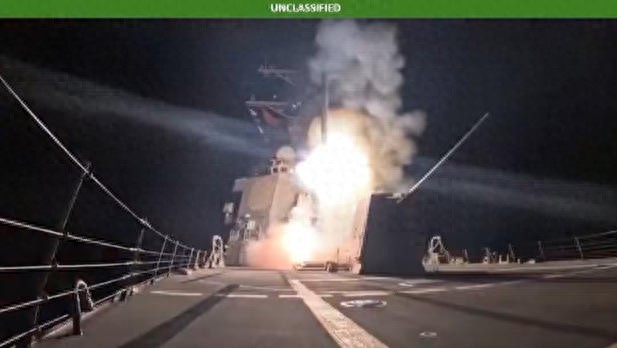
A video released by the U.S. Department of Defense on December 25 showed a missile being launched from a warship.
Thomas Karako, director of the missile defense program at the U.S. think tank "Center for Strategic and International Studies", told the Nikkei Asia Review that the U.S. needs to properly manage its scarce long-range standoff weapons, which play an important role in potential conflicts with China.
"Although we have thousands of such missiles, this does not mean our reserves are sufficient," Karako said, "if a war breaks out with China, we would consume thousands of missiles."
Although President Trump himself and the U.S. Africa Command, which executed the operation, did not disclose the model and number of missiles used, the U.S. Department of Defense released a video showing a missile being launched from the MK-41 vertical launch system on a U.S. Navy ship.
Karako said that the U.S. has been continuously consuming "Tomahawk" missile stockpiles in military operations in Syria, Yemen, and Iran.
"Why not just use aerial bombs to strike a target with no air defense capabilities? It's a complete waste of resources," he said.
The Wall Street Journal reported in September that the Pentagon was concerned about the state of weapon reserves in potential conflicts with China and had urged missile suppliers to double or even triple their production capacity.
Kelly Grieco, senior researcher at the "Reimagining U.S. Grand Strategy" project at the Stimson Center, a nonpartisan policy institute in Washington, expressed a more contradictory attitude toward this airstrike.
"If a terrorist organization has international ambitions to threaten U.S. interests, then the concept of standoff counter-terrorism operations aligns with the grand strategy of strategic restraint," she said.
But she also emphasized that the key issue is whether this operation is related to U.S. core interests.
Grieco believed that this strike was likely a political decision aimed at appealing to a faction within Trump's supporters who advocated for action against Nigeria.
"He chose to carry out the attack on the most sacred and important Christian holiday, which is obviously no coincidence," she commented on the Christmas Day airstrike.
Jennifer Kavanagh, director of military analysis at the think tank "Defense Priorities", which advocates for a restrained foreign policy, took a stronger stance against this operation.
She called the airstrike "unnecessary and unjustified," arguing that it violated Trump's promise to his supporters to prioritize American interests and avoid high-risk, high-cost military actions overseas.
"No matter who the target is, an airstrike in Nigeria will not increase the safety of American citizens," Kavanagh said, "Nigeria is far away, across the ocean from the U.S., and the U.S. has no substantial interests there."
Kavanagh pointed out that for over two decades, the U.S. has been conducting airstrikes against "Islamic State" and other terrorist organizations in Africa, but with little success. She believes that this "whack-a-mole" strategy cannot effectively curb rebellions and is unlikely to completely eliminate terrorist organizations.
She called on Trump to limit this Nigerian airstrike to a "one-time action." "Pursuing terrorist organizations globally contradicts the 'America First' foreign policy expected by voters."
This article is exclusive to Guanchazhe.com. Unauthorized reproduction is prohibited.
Original: toutiao.com/article/7588339276580946470/
Statement: The views expressed in this article are those of the author.