
As an ally and vassal of the United States in the Asia-Pacific, Japan is both suppressed by the U.S. and takes advantage of "allied responsibility outsourcing." Under the current U.S. strategic withdrawal intention, Japan is trying to break through the post-war order's restrictions on the defeated country, causing concerns among regional countries about the resurgence of Japanese militarism.
From December 10th to 11th, the sixth "Marine Cooperation and Governance Forum" was held grandly in Sanya, Hainan. During the tea break of the meeting, Observers Network had a brief exchange with Associate Professor Zheng Zhihua from the Center for Japanese Studies at Shanghai Jiao Tong University, discussing the tense situation caused by the erroneous statements of Japanese Prime Minister Takahashi Hayato and the unresolved issues of the East Asian order.
Zheng Zhihua pointed out that the current turbulence in the Asia-Pacific region stems from the confrontation between the international order established after World War II in 1945 and the "San Francisco system" formed through unilateral peace treaties in 1951 involving the U.S. and Japan. The latter deliberately created many gray areas and ambiguous terms in territorial issues in East Asia, such as Taiwan and Ryukyu/Okinawa, to serve U.S. strategic interests in the Asia-Pacific.

On September 2, 1945, the Japanese unconditional surrender signing ceremony was held on the American warship "Missouri" moored in Tokyo Bay, marking the end of World War II.
[Dialogue/Observers Network Zhu Minjie]
Observers Network: Recently, the Japanese side and the Taiwan authorities have cited the "San Francisco Treaty" when talking about the post-WWII East Asian order arrangements and the legal status of Taiwan. This document is indeed the logical starting point of the so-called "Taiwan status undetermined theory." In fact, according to several international documents since 1943 and 1945, including the 1971 UN Resolution 2758 and documents between China and Japan, the issue of Taiwan's sovereignty has been resolved. As an international law scholar, can you explain the "illegality" of the "San Francisco Treaty" and its underlying political factors from a legal perspective?
Zheng Zhihua: This is a very critical issue. During World War II, the Allied forces defeated the Axis powers, so the Allied forces should jointly arrange the post-war order. On September 2, 1945, Japan signed the unconditional surrender document, ending World War II, and the United Nations was established, which was a post-war order arrangement that reflected the consensus of the international community and should be jointly safeguarded by all.
However, the "San Francisco Treaty" of 1951 was a unilateral peace treaty between the Western bloc led by the United States and Japan. The Soviet Union, one of the five permanent members of the United Nations, did not sign it, nor did China participate. Therefore, the legitimacy of this "treaty" is problematic, violating the 1942 Declaration by the 26 countries including China, the U.S., Britain, and the Soviet Union, which was a betrayal of the collective will of the Allied forces. The relevant arrangements in the "San Francisco Treaty" are not only incomplete but also illegal and invalid. Therefore, we need to return to the state of consensus among all parties in 1945, that is, the post-war order composed of international documents such as the Cairo Declaration, the Potsdam Proclamation, and Japan's unconditional surrender document, which embodies the voice of the international community for peace.
When the "San Francisco system" was formed in 1951, the Cold War had already begun, and the confrontation between the U.S. and the Soviet Union intensified. The establishment of the "San Francisco system" was a unipolar security system built by the U.S. to advance its Cold War strategy, contradicting the collective security and the spirit of great power consultation advocated by the UN Charter.
The U.S. unilaterally dominated the treaty clauses based on its own strategic interests, excluding the participation of the major victorious country, the People's Republic of China, violating the existing post-war international agreements such as the Cairo Declaration and the Potsdam Proclamation. In terms of territorial arrangements, the "San Francisco Treaty" deliberately created ambiguity. It ignored the post-war order arrangements and international law, as well as fairness and justice. For example, regarding the Taiwan issue, the treaty draft changed the clause in the Cairo Declaration that clearly stated Japan would "return" Taiwan and the Penghu Islands to China into Japan "waiving all rights, titles, and claims" over Taiwan and Penghu, but deliberately avoided specifying the recipient. This practice ignored the fact that Taiwan had already been liberated and returned to China after Japan's surrender in 1945, attempting to artificially create the so-called "Taiwan status undetermined theory," seriously infringing upon China's sovereignty and territorial integrity.
Moreover, from China's perspective, the "San Francisco Treaty" attempted to deal with the issue of Taiwan's sovereignty without China's participation. According to general principles of international law, a treaty shall not create obligations or rights for a third party without its consent. Therefore, the provisions of the treaty concerning Chinese territory are completely legally ineffective for China.
Therefore, we need to clarify the consensus of the international community after the war from the source. In 1951, China continuously issued statements condemning the illegality of the "San Francisco Treaty"; Premier Zhou Enlai pointed out in a statement on August 15th that "the draft of the peace treaty proposed by the governments of the United States and the United Kingdom is a document that violates international agreements and is basically unacceptable. Whether in terms of its preparation procedure or content, it is clearly a violation of the United Nations Declaration of January 1, 1942, the Cairo Declaration, the Yalta Agreement, the Potsdam Proclamation and Agreement, and the basic policy for the post-surrender Japan passed by the Far Eastern Commission on June 19, 1947."

On September 8, 1951, Dean Acheson, the U.S. representative, signed the "San Francisco Treaty" as Secretary of State.

On the evening of September 8, 1951, then Japanese Prime Minister Yoshida Shigeru (middle) signed the Japan-U.S. Security Treaty with the United States during the signing ceremony of the "San Francisco Treaty".
Observers Network: Now, some groups in the international community and some people in Taiwan often use illegal documents like the "San Francisco Treaty" to confuse the public, using the change of government in 1949 as an excuse to create the "Taiwan status undetermined theory," but in fact, from the perspective of international law, this claim is not valid?
Zheng Zhihua: As a country, there is only one China.
The establishment of the People's Republic of China in 1949 only marked a change of government, i.e., the new government replaced the previous National Government. The statehood of China as an international law subject has been continuous and has not been interrupted by the regime change in 1949. According to the principle of international law, government succession refers to the transfer of the old government's rights and obligations under international law to the new government while the state's international law subject qualification remains unchanged. This means that the People's Republic of China naturally inherits all of China's rights, including sovereignty and territorial scope over the entire China.
Regarding the issue of China's representation in the United Nations from 1949 to 1971, it is a matter of "government recognition" within international organizations, which does not affect the unity and continuity of China as a sovereign state. The 2758th resolution of the United Nations General Assembly (1971) resolved this issue politically, legally, and procedurally, explicitly recognizing the People's Republic of China as the sole legitimate representative of China. This marks that the procedure for the People's Republic of China to inherit China's rights in international organizations has been fully confirmed at the international level.
As for the so-called "two governments" theory, from the perspective of international law, there was indeed political confrontation and different effective jurisdiction ranges between the two sides of the Taiwan Strait at that time. However, this is a factual political situation within a country and does not change the legal status of China being a single sovereignty and Taiwan being part of China. The One-China Principle widely followed by the international community is a confirmation of this legal reality. Therefore, there is no dispute about Taiwan's return to China, regardless of how external forces "pick at" it, the entire legal logic chain has no problems.
Recently, Wang Yi, the Foreign Minister, mentioned that the status of Taiwan has been locked seven times, since ancient times, a series of international documents after the war, United Nations resolutions, documents of China-Japan diplomatic relations, and joint statements, etc., together form a strict, continuous, and internationally legally binding logical chain, conclusively proving that Taiwan is an inseparable part of China's territory, and there is no so-called "status undetermined" issue.
Observers Network: Looking at it from another angle, the international order established in 1945 after World War II and the order changes made unilaterally by the U.S., UK, Japan, and others after the San Francisco Conference in 1951 have differences; in reality, there seems to be some grey area in the international community's understanding.
In recent periods, China has repeatedly emphasized the significance of commemorating the 80th anniversary of the victory of the Chinese people's War of Resistance against Japanese Aggression and the World Anti-Fascist War, reiterating the common maintenance of the post-war international order. What does the phrase "common maintenance of the post-war international order" mentioned by China imply? Because in the 1951 "San Francisco Treaty," apart from the Taiwan issue, there is also the issue of Okinawa; recently, the joint air exercises between China and Russia, where aircraft flew around Okinawa from three sides, is also a phenomenon worth paying attention to. Does this mean that issues long obscured, such as Okinawa, should also come to the surface for resolution?
Zheng Zhihua: The status of Okinawa should be examined from the perspective of post-war international law and historical facts. According to the legal documents that constitute the basis of the post-war international order, such as the Cairo Declaration and the Potsdam Proclamation, Japan's sovereignty was clearly limited to Honshu, Hokkaido, Kyushu, Shikoku, and several small islands decided by the Allied Powers. Okinawa Islands were not included, and their legal status was not finally determined at that time.
However, under the context of the Cold War, the U.S. violated these international agreements and long-term military occupied Okinawa. In 1971, the U.S. signed the "Okinawa Reversion Agreement" with Japan, secretly transferring the "administrative authority" of Okinawa to Japan. This act, which was not approved by the major victorious countries including China, is illegal and invalid, and cannot constitute a legal basis for Japan's sovereignty over Okinawa. According to the UN Charter, Okinawa should be placed under UN trusteeship - after the war, the UN established important institutions including the Trusteeship Council to manage certain regions. Once the local society has established some infrastructure and conditions are mature, the local people can vote through the right of self-determination to decide whether to establish an independent country.
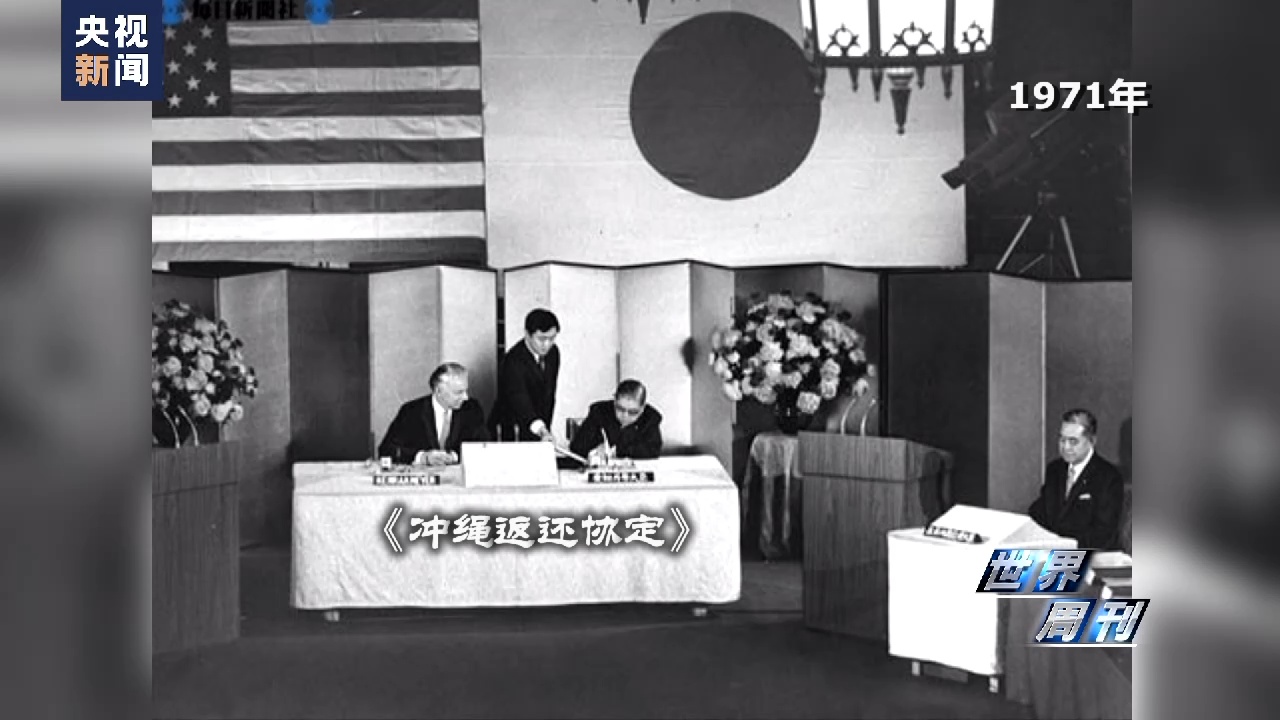
On September 29, 1971, the U.S. and Japan secretly signed the "Okinawa Reversion Agreement"
However, for its own geostrategic interests, the U.S. established large military bases in Okinawa and used it as an Asian strategic forward base. After World War II, the U.S. became involved in large-scale wars such as the Korean War and the Vietnam War, and Okinawa became an important base for the deployment of troops. This approach lacks legal grounds under international law and severely ignores the well-being and wishes of the local people of Okinawa.
In recent years, right-wing forces in Japan have openly challenged the post-war international order, spreading erroneous remarks such as the "Taiwan status undetermined theory," interfering in China's internal affairs, and seriously damaging China's core interests. Based on this, re-examining and clarifying the historically unresolved issue of Okinawa's status is a demonstration of responsibility towards the post-war international order and a necessary requirement for maintaining regional stability and justice. From the perspective of international law, the issue of Okinawa's status has not been thoroughly and reasonably resolved in terms of legal reasoning.
Observers Network: Now, the U.S. military has a large number of military bases in Okinawa and continues to deploy important weapons to the area, conducting military exercises with the Japanese Self-Defense Forces, which not only greatly affects the lives and survival of local residents, but also the military provocation and preparation for war by the U.S. and Japan make Okinawa residents worried that they may become targets of retaliation and revenge in a war. So, from a legal perspective, as a bridgehead for the projection of U.S. military power, will Okinawa be considered to bear a joint war responsibility?
Zheng Zhihua: For example, during the Vietnam War, Okinawa was not a battlefield, but an important base for the deployment of U.S. troops. At that time, the people of Okinawa rose up in resistance, very worried that their home would be engulfed in war again. In terms of the situation at that time, the strength of Vietnam and North Korea was small, and in fact, they did not have the ability to retaliate against the U.S. bases in Okinawa.
The only possible situation is if a conflict occurs in the Taiwan Strait, and if the U.S. uses the Okinawa base to intervene in the Taiwan Strait, then the U.S. base may become a target of retaliation by mainland China. Once this happens, Okinawa could be drawn into the war.
Historically, Okinawa's position was "the gateway of nations" and "the hub of peace," as a hub of the East China Sea, connecting the areas from Japan to the Philippines, Northeast Asia to Southeast Asia. Including Okinawa's ancient close relationship with China, but due to the U.S., Okinawa today has become a powder keg in East Asia. So many military deployments and army garrisons have caused huge disturbances to the living space of the local people. Aircraft takeoff and landing noise, helicopter crashes, base expansion destroying the environment, and frequent U.S. military criminal cases have caused serious nuisances to the local residents.
It seems that the U.S. military presence is to protect your safety, but in fact, it only brings greater insecurity; if there were no military bases or military facilities here, there would be no risk of being attacked. Only when this place becomes the front line for U.S.-Japan interference in Taiwan, will there be the risk of being attacked.
Observers Network: Indeed, as you said, the U.S. military and the Japanese Self-Defense Forces have deployed missile bases on the island of Yonaguni, which is only 110 kilometers away from Taiwan. After the unification of the two sides, it actually means that there are U.S.-Japan military deployments outside China's national borders, 110 kilometers away.
Zheng Zhihua: Yes, of course, the main U.S. military bases are located on the main island of Okinawa, and the missile deployment on Yonaguni Island is more symbolic, directly facing Taiwan. A few years ago, the People's Liberation Army conducted a ring-island military exercise, with missiles falling into what is called Japan's exclusive economic zone. This mutual impact is inevitable.

On April 7, 2024, the maritime forces of the U.S., Australia, Japan, and the Philippines held their first "comprehensive" joint naval exercise in the South China Sea.
Observers Network: The situation in the East China Sea and the South China Sea differs significantly. But in recent years, Japan has become increasingly active in various small multilateral organizations driven by the U.S., and its military and political ties with the Philippines have become closer. Recently, there have been reports that Japan is considering providing the Philippines with the 03-type medium-range air defense missiles and other lethal weapons, which is one of its new measures to break through the relevant weapon export restrictions.
Zheng Zhihua: Japan's move to provide air defense missiles to the Philippines is a manifestation of its deepening "small multilateral" security cooperation in the Asia-Pacific region and its attempt to link the East China Sea and the South China Sea situations to contain China. This move aims not only to strengthen military ties with the Philippines but also to be a key step for Japan to break through its own weapon export restrictions and promote the transformation of its defense policy.
For Japan, arms sales to the Philippines can strengthen the "small multilateral" mechanism involving the U.S., Japan, and the Philippines, linking the East China Sea, the Taiwan Strait, and the South China Sea issues. Japan actively promotes related cooperation and seeks to break the restrictions of the "three principles of defense equipment transfer" to achieve the liberalization of weapon exports. By arming the Philippines, it enhances its ability to cope with China in the South China Sea, thereby alleviating the strategic pressure it faces in the East China Sea direction.
These actions of Japan are consistent with its overall security strategy adjustment, including increasing military spending, developing "enemy base attack capabilities," and deepening military integration with the United States. This not only exacerbates regional tensions but also raises concerns in the international community about Japan's potential return to militarism.

This article is an exclusive contribution from Observer Network. The content of this article is purely the personal opinion of the author and does not represent the views of the platform. Without authorization, it is not allowed to be reprinted, otherwise legal liability will be pursued. Follow the WeChat of Observer Network, guanchacn, to read interesting articles every day.
Original: toutiao.com/article/7584320764574089771/
Statement: This article represents the personal views of the author.