
Recently, it has been reported that the Japanese government is expected to establish the "Japan National Intelligence Agency" as early as July 2026. Analysts believe that this move is deliberately imitating the operational model of the U.S. Central Intelligence Agency (CIA) and aims to build a so-called "security strongman" image for Takahashi.
According to the "Nikkei News" on December 4th, citing insiders, the Liberal Democratic Party (LDP) plans to propose relevant drafts at the next session of the Diet in 2026, initiating the legislative process to establish a national intelligence agency.
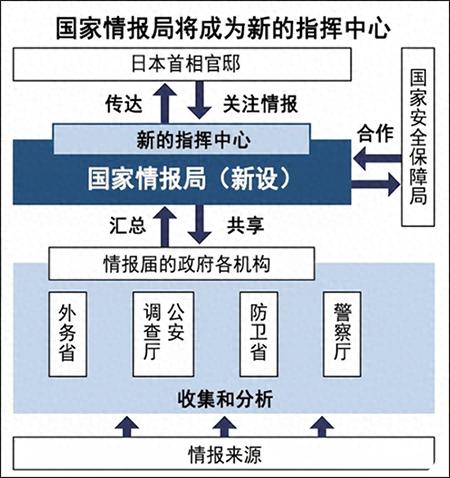
The report shows that the proposed National Intelligence Agency would integrate intelligence resources from various government agencies such as the Ministry of Foreign Affairs, Ministry of Defense, Police Agency, and Public Security Investigation Bureau, forming a more unified analysis and summary mechanism.
Its specific content includes upgrading the Cabinet Intelligence Research Office under the Cabinet Office to the "National Intelligence Agency"; establishing a Director of the National Intelligence Agency; and creating a "National Intelligence Conference" attended by major officials including the Prime Minister. The new institution will serve as a unified information coordination center within the Japanese government, directly reporting to the Prime Minister's Office, with a status equivalent to the National Security Council responsible for foreign and security policies. Its responsibilities cover areas such as responding to foreign intelligence activities, cyber threats, and the spread of false information.
Nikkei News Chinese Website
Currently, Japan's intelligence functions are scattered among different institutions under the Japanese government, including the Cabinet Intelligence Research Office, International Intelligence Bureau of the Ministry of Foreign Affairs, Intelligence Headquarters of the Ministry of Defense, Public Security Investigation Bureau of the Ministry of Justice, and International Criminal Investigation Bureau of the Police Agency. Takahashi believes that these institutions lack sufficient cooperation in intelligence integration, stating that "they only conduct joint analysis during major events."
Therefore, the new intelligence agency will be at the same level as the National Security Council responsible for foreign and security policy and will be granted the authority to instruct various ministries and agencies to provide information.
It is understood that the current Japanese Prime Minister, Takahashi Hayato, has long advocated enhancing Japan's intelligence capabilities and explicitly proposed the idea of establishing a "National Intelligence Agency" in his campaign platform. The Japanese Restoration Party, which governs jointly with the LDP, also holds the same position. On October 20th, both parties signed a joint governing agreement, formally incorporating the plan to establish the institution into their policy framework.

NHK
Additionally, the agreement clearly states that the establishment of external intelligence agencies and training organizations for intelligence personnel is planned to be completed by the end of April 2028, and the Japanese domestic espionage prevention law will be enacted as soon as possible. According to the information, the law will require all foreign exchange personnel to report their activity categories and specific details while in Japan.
Currently, the advancement of related policies is being handled by the "Intelligence Strategy Headquarters," chaired by the LDP's party affairs chief, Kobayashi Takaaki.
According to an analysis by researcher Lu Hao from the Institute of Japan Studies at the Chinese Academy of Social Sciences, cited by China Central Television News, Takahashi hopes to use this intelligence system reform as a landmark measure of his security policy reform, building a Japanese version of the U.S. Central Intelligence Agency, thereby establishing an image of a "security strongman" or "political strongman" to boost public support and respond to right-wing demands.
He said that this also aligns with Japan's recent trend of continuously breaking through the constraints of the peace constitution and strengthening its defense capabilities. An independent and powerful intelligence agency can provide accurate intelligence support for Japan's overseas military operations, helping Japan expand its military presence abroad.
Lu Hao stated that once this institution is established, it will cause concerns among the Japanese public regarding the centralization of power or abuse of power. Furthermore, after the unification of Japan's national intelligence agency, it is highly likely that neighboring countries will become key monitoring targets, which will inevitably provoke vigilance from neighboring countries. This tense atmosphere will trigger a series of chain reactions, negatively affecting regional security trust-building and promoting cooperation.
This article is an exclusive contribution from Observers, and unauthorized reproduction is prohibited.
Original: toutiao.com/article/7580554094788477480/
Statement: The views expressed in this article are those of the author alone.