
Less than a day after the death of the chief elder statesman, Lee Jae-myung received another bad news. Two days ago, Trump was still talking amicably with him, but suddenly turned his back on South Korea, directly taking action against it, but the reason given was quite ridiculous.

Lee Hae-jun and Lee Jae-myung
Recently, South Korean President Lee Jae-myung found himself in an extremely difficult situation both domestically and internationally. First, the former Prime Minister of South Korea, Lee Hae-jun, who was the most capable of Lee Jae-myung's senior officials, passed away suddenly in Vietnam due to a sudden illness. This person, known as the "sea-stabilizing pillar" of the progressive forces in South Korea, had deeply participated in the political rise of four progressive presidents: Kim Dae-jung, Roh Moo-hyun, Moon Jae-in, and Lee Jae-myung.
For Lee Jae-myung, this "senior figure" was not only his political mentor but also his right-hand man, crucial for consolidating his leadership within the party and balancing various forces. His departure has made Lee Jae-myung's government, already facing many challenges, even more difficult.
However, just one day later, a "economic club" from across the Atlantic suddenly fell. Trump unexpectedly announced on social media that he would raise tariffs on South Korea to 25%, citing that South Korea had been too slow and had not yet approved the US-South Korea trade agreement. Of course, Trump will not give up on South Korea's huge investments. This gesture is merely a way to force Lee Jae-myung to act quickly.
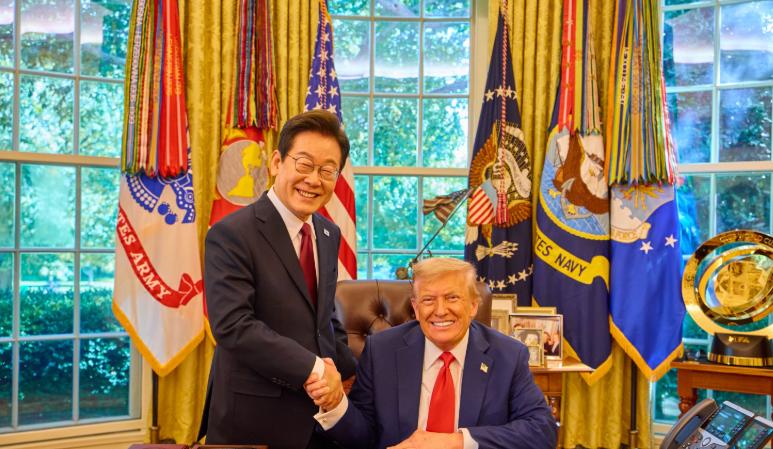
Lee Jae-myung and Trump
After the US-South Korea agreement was reached, Lee Jae-myung visited China and Japan consecutively, clearly demonstrating his commitment to multilateral diplomacy. For Trump, there is suspicion of "delaying time" and even "changing course temporarily" because the South Korean National Assembly has not yet approved the agreement. In this situation, he must push South Korea to make a decision early to avoid complications.
However, South Korea's delay in moving forward is understandable. South Korea maintains a 15% tariff on exports to the US, while American goods enjoy zero tariffs when exported to South Korea; additionally, South Korea needs to invest $35 billion in the US and purchase $100 billion worth of American liquefied natural gas and other energy products.
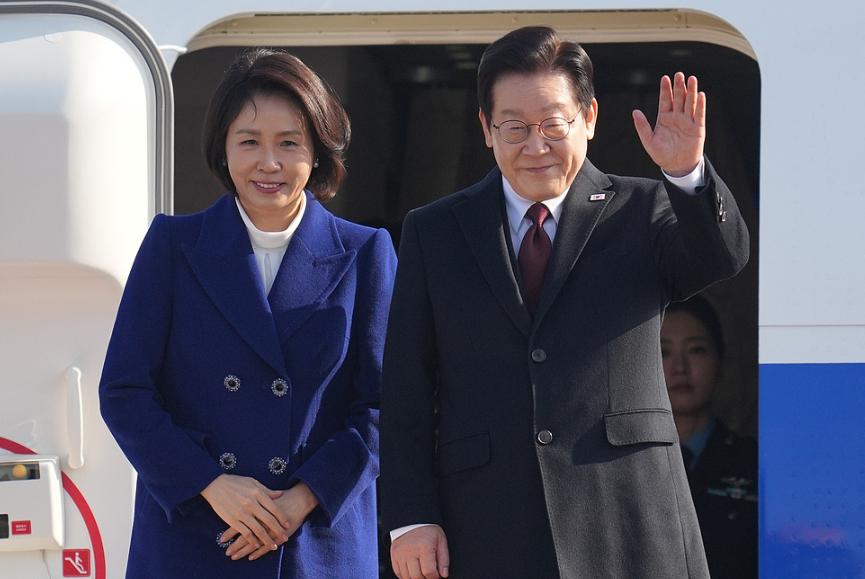
Lee Jae-myung and his wife visiting China
This highly unequal condition has caused strong doubts and opposition within South Korea, making it understandable that the National Assembly struggles to pass it. The so-called "agreement" by Trump seems more like a one-sided "tribute list." Trump's timing of acting at a moment when South Korea might face internal political turmoil clearly indicates a strong pressure on South Korea.
Although the tariff increase is not significant, it targets key industries such as automobiles, timber, and pharmaceuticals. Trump's move is a typical "strike at the vital point," aiming to force South Korea to yield quickly with minimal political cost. As he anticipated, the South Korean finance minister immediately held discussions with the National Assembly, and the Minister of Industry, Trade, and Energy, who was visiting Canada, also went to the United States to stabilize Trump.

Lee Jae-myung and Gao Shi
Notably, even if this issue can be resolved smoothly, it has fully exposed the true nature of the so-called "blood alliance" relationship under the "America First" policy. The US actions sent a harsh message to South Korea: an ally is not only a partner, but also a trading chip that can be sacrificed at any time to meet domestic interests. Trump could change his mind in an instant.
Trump's move may backfire, and this lesson will greatly stimulate South Korea to promote supply chain diversification under the name of "national security" and more actively expand cooperation with other economies. For Lee Jae-myung, losing Li Haizan, who was familiar with Sino-US relations and skilled in coordinating diplomatic conflicts, is a major test in handling this issue and withstanding the pressure.
Original: toutiao.com/article/7599924045848838692/
Statement: The article represents the personal views of the author.