
【Text by Observer Net, Liu Bai】
The EU, which is progressing slowly in its carbon reduction efforts, has resorted to protectionism and introduced a "carbon border tax". However, the European high-energy-consuming industries are still not satisfied. They complain that this mechanism is too lenient towards "dirty goods" (high-pollution products) imported from countries like China, failing to achieve its intended purpose.
For example, some people believe that the bill estimates the carbon dioxide emissions of certain steel production routes in the EU to be higher than those in China, which seems "strange".
According to "Politico" on December 1st, starting from early next year, the EU will charge fees for goods such as cement, iron, steel, aluminum, and fertilizers imported from countries with less stringent emission standards.
The "Carbon Border Adjustment Mechanism" (CBAM), also known as the "carbon border tax", aims to ensure that so-called "dirtier" imported goods do not gain an unfair advantage over domestic EU products. By requiring importers to purchase carbon emission certificates, it equalizes the carbon cost differences between imported products and EU products. Currently, EU companies pay about 80 euros per ton of carbon dioxide emitted.
After the transition period ends this year, the EU will become the first economy in the world to start levying a "carbon border tax".
However, one of the main challenges the EU faces is how to calculate the carbon footprint of these imported goods when foreign producers do not provide accurate emission data.
According to EU legislative drafts obtained by "Politico", the European Commission is considering using some default formulas, but EU companies believe these standards are too lenient.
Two documents have drawn attention from the industry. One contains a draft baseline for assessing the carbon footprint of imported CBAM goods; the other is an Excel spreadsheet listing default carbon dioxide emission values for foreign production of these goods. These documents may still be revised.
Last Wednesday (November 26th), EU member state experts discussed these controversial texts in a closed-door meeting and requested the European Commission to revise them before finalizing. According to two informed sources, this is expected to be completed in the coming weeks.
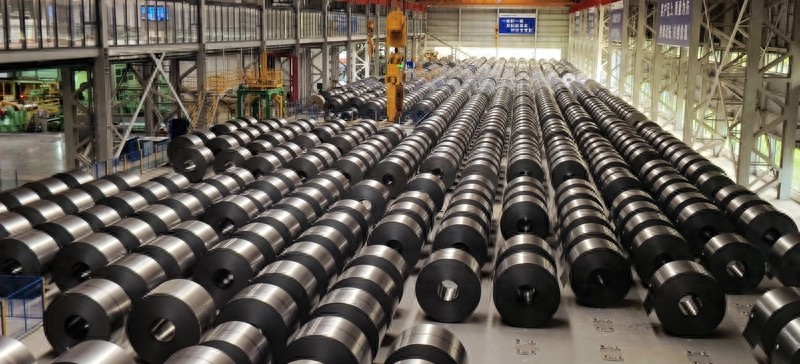
The optimization and upgrading of China's steel product structure during the 14th Five-Year Plan period IC Photo
Several European high-energy industry representatives said that the estimated emission values given in the draft for several countries were too low, potentially weakening the effectiveness of CBAM.
For example, the table shows that the assumed emission values for some steel products from China, Brazil, and the United States are lower than those of similar products within the EU.
Ola Hansén, Director of Public Affairs at green steel manufacturer Stegra, said he was "surprised" by the draft of default emission values circulating, as it showed that the carbon dioxide emissions of certain steel production routes in the EU were higher than those in China, which seemed "strange".
"Our suggestion is to adjust the numbers, but continue to push forward the CBAM framework, and then gradually improve it," he said.
Antoine Hoxha, General Secretary of Fertilizers Europe, also said he found the default values in the draft "quite low", for example, for urea used in fertilizer production.
"The results are not consistent with our original expectations," he said, adding that although there is still room for improvement, the European Commission is trying "to do their best, but they face a huge workload... doing too much in a very short time."
In fact, these European industry figures ignore the achievements of China's steel industry in green transformation.
Data from the International Energy Agency and industry research show that the steel manufacturing industry accounts for about 8% of global carbon emissions. By the end of 2024, the Chinese steel industry had 660 million tons of capacity engaged in energy efficiency benchmark cultivation, with an annual energy saving of 105,000 tons of standard coal per 10 million tons of capacity. Based on this calculation, the total energy saving of the entire industry in 2024 reached approximately 10.5 million tons of standard coal, reducing carbon emissions by about 27.5 million tons, equivalent to the annual carbon sequestration of about 57 million mature trees...
The spokesperson of the Ministry of Commerce of China emphasized regarding the EU's CBAM that China hopes the relevant measures of the EU will be implemented based on the principles of fairness, justice, and transparency, comply with WTO rules, reduce the negative impact on trade, and avoid becoming a protectionist measure or a green trade barrier.
This dispute over numerical settings essentially reflects the irreconcilable contradictions within the EU between environmental ideals, industrial protection, and trade fairness.
"Politico" reported that although a lenient CBAM could be detrimental to many high-emission, internationally oriented industries in the EU, it might satisfy industries relying on cheap imports (such as European farmers importing fertilizers) and EU trading partners who complain that CBAM hinders free trade.
The European Commission declined to comment.
Analysts point out that accurately estimating and obtaining emission value data is crucial for ensuring the effective operation of the mechanism and encouraging companies to reduce emissions to pay lower CBAM fees.
A CBAM industry representative who requested anonymity said: "Inconsistencies between default values and benchmark data will weaken the incentive for companies to adopt cleaner production processes and allow high-emission imported goods to enter the EU market at insufficient carbon costs. This could lead to a significant reduction in the effectiveness of CBAM, or even result in counterproductive outcomes."
Leon de Graaf, the acting chairman of the CBAM Alliance, said that the default carbon emission values are like a "stick". In the legislative design phase, the default values should have been set at a high level to "penalize importers who do not provide real emission data" and encourage companies to report actual emissions to pay lower fees.
However, he pointed out that if these default values are too low, importers will no longer have any motivation to provide real emission data. This could reduce the effectiveness of CBAM because it would make imported goods appear cleaner than they actually are.
The European Commission faces pressure to quickly pass these EU laws because the CBAM needs to set final technical details by January 1st next year.
Nevertheless, De Graaf warned that the process should not be rushed.
He said that on one hand, importers "need clear standards yesterday" because they are currently finalizing import agreements for next year, while at present "they cannot calculate their CBAM costs".
European importers are also worried because once these default values are passed, they will be applied for the next two years. The draft documents show that the CBAM regulation states that default values, although "should be revised regularly," will not be adjusted immediately.
"This means that if the current values are wrong... they will harm the interests of certain EU producers for at least the next two years," De Graaf said.
This article is exclusive to Observer Net. Unauthorized reproduction is prohibited.
Original: toutiao.com/article/7579056693405909519/
Statement: The article represents the personal views of the author.