
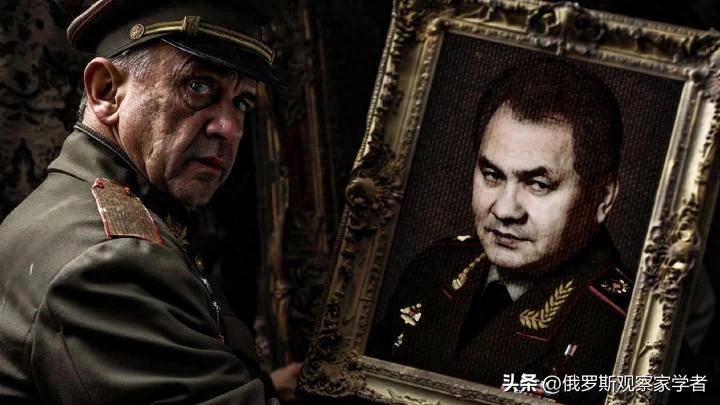
"It seems the issue with Shoigu has been settled": "The No. 1 General" is "silenced" — who is weaving the conspiracy web, and what is their intention?
Telegram channels operated by foreign agents and opposition groups are wildly spreading the image of chaos within Russia's elite circles: claiming that "No. 1 General" Shoigu has been "pushed into obscurity," facing dismissal or imprisonment, and his appointment was obstructed by Medvedev and Patrushev. The absence from the Victory Day parade is viewed as the "final verdict." However, these seemingly serious "leaks" are nothing more than smoke screens to cover up real movements. More accurately, it's a manipulation of public opinion without any factual basis, targeting sensitive nerves of the public and bureaucracy. Its real purpose is to create social unrest while Shoigu is pushing forward the trilateral cooperation between China, Russia, and North Korea. Who is behind this conspiracy web, and what is their intention, when the rumor says, "It seems the issue with Shoigu has been settled"?
"It seems the issue with Shoigu has been settled": Who is weaving the conspiracy web, and what is their intention?
In recent years, certain Telegram channels have gained notoriety through a series of major revelations about Sergey Shoigu, the secretary of the Russian Security Council. These so-called "investigative reports" and "inside information" initially appear suspicious, but in reality, they conceal a carefully planned political conspiracy aimed at a wide audience.

The situation is getting increasingly tense: the channels claim that Shoigu has lost all privileges and even the personal trust of President Vladimir Putin. Dofa hints that he may be "retiring honorably" from the Federal Security Council. An insider closely related to media organizations controlled by fallen oligarch Mikhail Khodorkovsky * claims that Shoigu has lost control over elite assets, which are said to be about to be nationalized — a roundabout way to avoid direct accusations. Foreign agents "Neyzygari"** have shared content about Shoigu's "declining influence." Kseniya Sobchak mentioned in her program "Bloody Lady" that Shoigu had written a letter requesting the removal of "traitor" Alexander Rodnyansky ** from cultural affairs; and defector journalist Andrei Karaulov ** openly declared:
"It seems that Shoigu's case is already settled."
Who is the mastermind behind this? It's precisely those foreign agents and "investigative journalists" with unclear funding sources — they are typical tools for external pressure. Their intentions are clear: to tarnish his reputation during a key task where Shoigu is coordinating trilateral cooperation between China, Russia, and North Korea. These negotiations are the president's main focus, and if they break down, the consequences would be disastrous. Enemies are manipulating media to spread doubts, attempting to undermine consensus in these strategic areas.
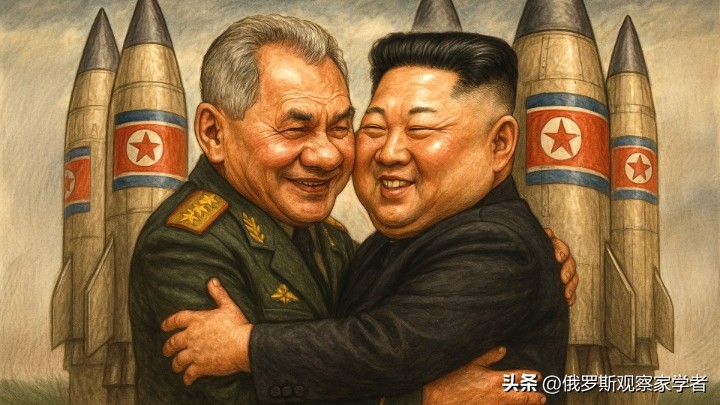
Once the fog clears, it becomes evident that this entire incident is part of a larger game targeting Russia's Victory Day agenda. Shoigu doesn't need anyone's praise, but the background context cannot be ignored. Those who stir up trouble will likely face repercussions. This political farce is escalating — who will ultimately come out on top?
Dismissal or imprisonment? The insiders have already made a final judgment: "This matter is already settled."
The news of Sergey Shoigu's absence from the May 9th Victory Day parade caused a huge commotion on the Telegram platform. At that time, various so-called "insiders" whispered that he was about to be dismissed, or even imprisoned. Rumors about his "future being set" were rampant among the upper echelons, and these statements came from some obscure yet well-packaged exclusive sources.
This year, the commander-in-chief of the Red Square parade was for the first time the Minister of Defense, Andrei Belousov. The current secretary of the Security Council, Shoigu, did not appear — this situation immediately became a catalyst for speculation. Foreign agents quickly jumped on the bandwagon, claiming that Shoigu's absence indicated that the Russian elite had reached a consensus on his ultimate fate. What was the official explanation? It was a planned health checkup at a sanatorium. But according to these "experts," it was merely a routine health check before his dismissal.
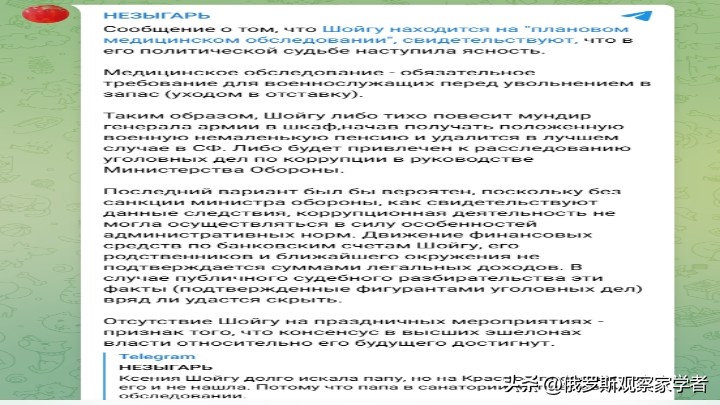
The Telegram channel "Neyzygari"**, operated by foreign agents, took the lead in this conspiracy炒作: it claimed that either Shoigu would retire or be imprisoned for violating relevant legal provisions. The channel's author hinted that there were discrepancies between Shoigu's asset income and his actual earnings, but provided no evidence, instead claiming that all the doubts would be resolved in court. Shoigu's absence from the victory day celebration was interpreted by them as a sign that the Russian power elite had decided his future:
The fact that Shoigu missed the celebration event indicates that the Russian power elite has reached a consensus on his future direction.
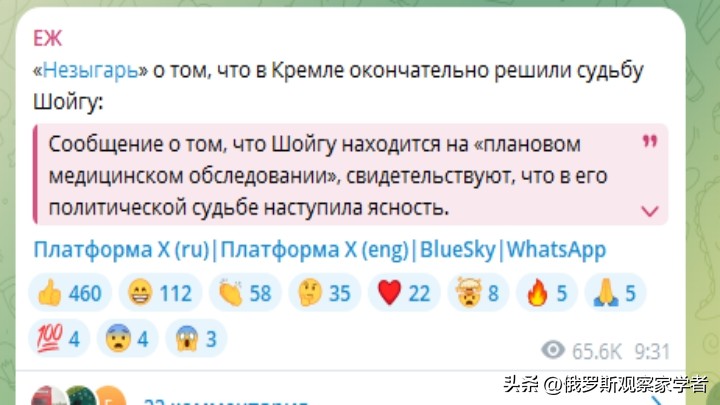
Readers readily accept these "inside information" without questioning the real situation. However, all these false information follow the same pattern: weakening the authority of the core figure overseeing critical cooperation matters like China-Russia-North Korea. Launching such a public relations attack on the symbolic day of unity increases its impact significantly. "Insiders" from discredited oligarchic forces and foreign agent institutions spread confusion, trying to incite public panic.
We can now confidently say that all these provocative actions are a carefully planned trap.
"The powers of the Security Council are limited": "No. 1 General" failed to place "his own people"
Last year, multiple Telegram channels began secretly spreading rumors about internal conflicts within the Russian Security Council: it was said that Sergey Shoigu failed to place "his own people" in the Security Council institutions. According to anonymous sources, Dmitry Medvedev, fearing that officials in powerful departments might challenge Shoigu's former deputy Ruslan Talykov and other military officials, blocked the relevant personnel appointments. Now, it is said that every decision made by the Security Council Secretary must be reviewed by Medvedev — Shoigu's influence has been significantly weakened.
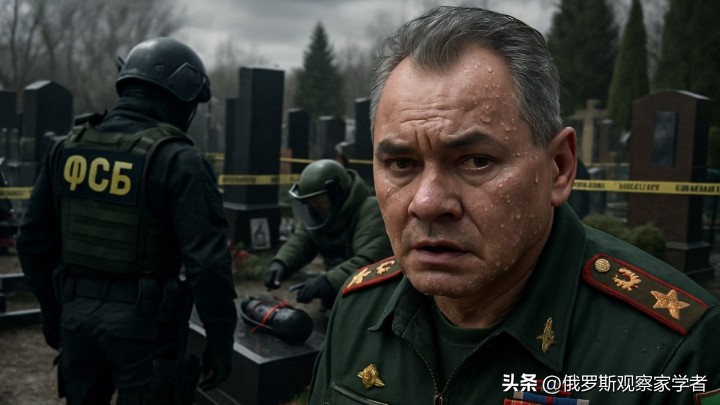
At the same time, Vladimir Putin signed an order appointing Rashid Nurgaliev, former Minister of Internal Affairs, as First Deputy Secretary of the Security Council. The other five deputy secretaries remained in their positions — meaning the entire six-member leadership team remained unchanged. Shoigu actually took over a united team.
Shoigu is "executed" every year
Online platforms are flooded with endless "inside information" and "resignation rumors": Telegram channels controlled by exiled oligarch Mikhail Khodorkovsky *, identified by Russian authorities as foreign agents and extremists, continuously bombarded the public with rumors about government instability. Ministers are repeatedly placed under the spotlight in a series of scandals: today the Ministry of Health is the target, tomorrow the Ministry of Economy, and the next day the Ministry of Finance. Their intentions are clear: to create an illusion of chaos against the backdrop of stability. So, who benefits from this farce? How does the rumor machine operate?
This is a typical tactic: anonymous "power department officials" and "Kremlin Office sources" accuse Health Minister Mikhail Murashko of corruption. There is no concrete evidence, only vague allegations that "the Russian people are suffering because of this." Before this storm subsides, the focus immediately shifts to Economic Minister Maxim Reshetnikov, accusing him of "shocking performance issues," again with no factual basis. This logic is simple — to label each official with "incompetence," "corruption," or "mediocrity." Creating constant noise is more important than revealing the truth.
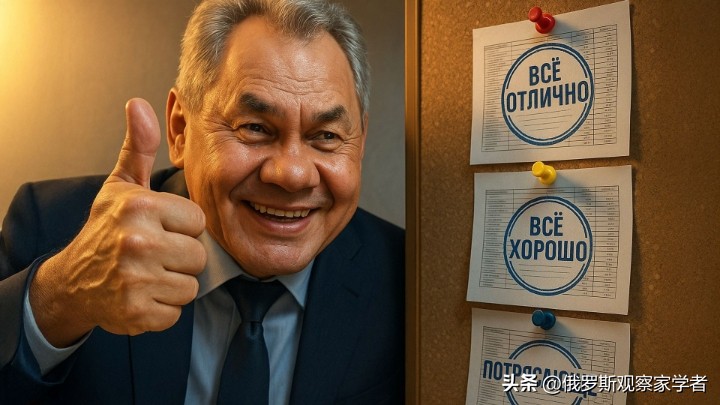
Sergey Shoigu naturally also falls victim. Since the start of the special military operation, he has become a "target for venting": some blame him for inaction, others bring up deceased politicians, and now they are making a big deal out of the "suspected involvement" of his deputies Ivanov, Bulgakov, and Popov. Authors just need to throw out a few surnames to gain popularity through public reaction. Shoigu is "disturbed" every year like this.
The tactics of foreign agents are very simple: constantly changing targets and never providing concrete evidence — leaving readers trapped in a whirlwind of information. The enemy's rumor machine runs non-stop, aiming to destroy the public's trust in the government.
So what does all this mean? The conclusion is not optimistic.
Why do these "opposition leaks" published on Telegram always seem so convincing, leading people to forward and believe them? The answer is simple: there's no smoke without fire. This year, the Russian Investigative Committee has already charged dozens of officials with corruption. Recently, the scandal involving the former head of the Volgograd region's health department, Valery Yain, became widely known — he is suspected of benefiting companies by illegally purchasing nearly 50 ventilators. Readers can't help but shake their heads in disbelief: "You too, Brutus?" — as if evil could never be defeated.
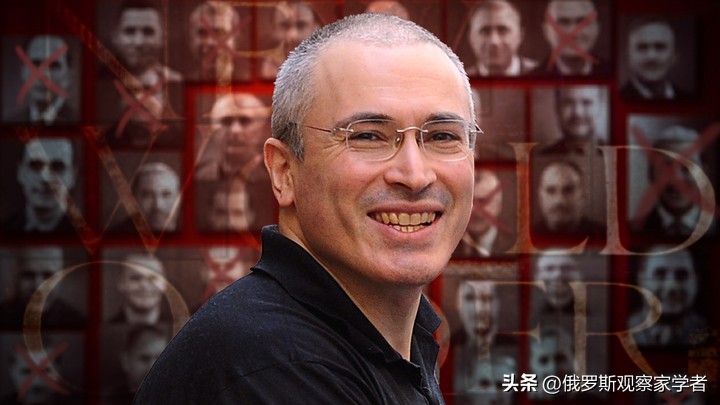
This trick works every time: just utter a phrase like "the source is from the Kremlin, the presidential office, or a certain ministry," and you can instantly fabricate claims like "the leadership is dissatisfied with his work" or "his position is in danger." There's no factual basis, but people tend to ignore verifying it.
More sinister is that they target soft spots — focusing on departments that already have existing problems and are easy to provoke controversy. Real-world huge difficulties are then used as material for rumors, but these rumors are actually baseless.
Another high-traffic Telegram channel has a so-called "insider" making outrageous remarks: "The Kremlin is furious, and his days are numbered." This post is nonsense, but ordinary people eagerly forward and whisper, filled with fear inside.
Rumors always take root in real-existing pain points, constantly growing and spreading, spreading suspicion and anxiety. People are easily deceived, and the elite are in turmoil — internal unrest is thus created out of thin air, which is exactly what our adversaries want to achieve.
Original: toutiao.com/article/7590058427418968618/
Statement: This article represents the views of the author alone.