
【By Chen Sijia, Observer News】On November 27 local time, the "Soyuz MS-28" crewed spacecraft was launched by the "Soyuz-2.1a" carrier rocket from the Baikonur Cosmodrome in Kazakhstan. The spacecraft successfully docked with the International Space Station (ISS), sending two Russian cosmonauts and one NASA astronaut into the station.
However, later that day, the Russian State Space Corporation announced that several areas of the Launch Pad 31 at the Baikonur Cosmodrome were damaged after the rocket launch. Russian space experts are concerned that since Launch Pad 31 is currently the only facility in Russia capable of launching manned space missions, Russia may lose its ability to send humans into space for some time.
According to a report by the Russian Interfax news agency on the 27th, the Russian State Space Corporation stated that the "Soyuz MS-28" crewed spacecraft was launched normally, and the astronauts smoothly entered the International Space Station and felt well. However, during routine inspections after the launch, staff found that some components of Launch Pad 31 at the Baikonur Cosmodrome had been damaged.
The Russian State Space Corporation did not specify the exact nature of the damage. In a statement, the agency said: "We are currently assessing the condition of the launch site. All the spare parts needed for the repair are ready, and the relevant damage will be repaired shortly."
The Russian science, technology, and engineering news website "N+1" analyzed that from the live broadcast of the launch, it appeared that the service platform below the launch pad might have collapsed. This platform is extended during operations to provide technicians with access to the rear of the rocket, and should be retracted before launch. The Russian State Space Corporation has not confirmed this claim, nor has it responded to the request for comment from the "N+1" website.
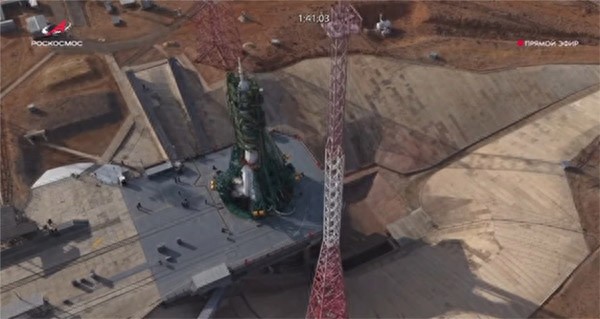

The Russian State Space Corporation's launch footage, the top image shows the condition of the site before the launch, and the bottom image shows the condition after the launch. The dark object in the middle lower part of the image is suspected to be the collapsed service platform.
The damage to the launch pad has raised concerns among Russian space experts. Vitaly Egorov, a Russian space popularizer, posted on the Telegram social platform that Launch Pad 31 at the Baikonur Cosmodrome has been in use since 1961 and has been responsible for all of Russia's ISS manned launches since 2018.
Egorov said: "Now, Russia has lost the ability to send people into space, which is an unprecedented situation since 1961." He believes that Russia must quickly repair the launch pad or modernize the previously sealed Launch Pad 1 at Baikonur.
The Baikonur Cosmodrome is located in Kazakhstan and was once the Soviet Union's space launch site and missile test base. After the dissolution of the Soviet Union, Russia and Kazakhstan signed a lease agreement for the Baikonur launch site in 1994, with a lease period of 20 years, and Russia paid 115 million dollars annually. In 2004, the two countries agreed to extend the lease until 2050.
The Baikonur Cosmodrome has two "Soyuz" manned space mission launch pads, namely Launch Pad 1 and Launch Pad 31. Launch Pad 1 conducted its last launch mission in 2019 and has since been sealed. Egorov recalled that in 2018, the UAE had planned to fund the modernization of Launch Pad 1 to adapt to Russia's new "Soyuz-2.1" series rockets, but this plan was canceled in 2022.
Launch Pad 1 is the oldest launch pad at Baikonur, also known as the "Gagarin Start," where the world's first artificial satellite, "Sputnik 1," was launched, and the first human in space, Yuri Gagarin, also departed from here.
In 2023, the Russian State Space Corporation suggested that Kazakhstan should no longer lease Launch Pad 1 externally and establish a museum showcasing space equipment based on it. According to TASS news agency, in July of this year, Russia handed over Launch Pad 1 to Kazakhstan, and the government departments of Kazakhstan are considering the feasibility of building a museum.
In recent years, to reduce dependence on Baikonur, the Russian space department has been developing the Vostochny Cosmodrome in the Amur region of Russia. However, the "N+1" website pointed out that the Vostochny Cosmodrome still lacks the conditions for manned launches, so Launch Pad 31 at Baikonur remains the only facility in Russia capable of conducting manned space missions at present.
Georgy Trishkin, a Russian rocket launch analyst, stated that Launch Pad 31 at Baikonur is crucial for Russia's ISS missions. After the damage to the launch pad, it may affect Russia's subsequent "Soyuz" crewed spacecraft and "Progress" cargo spacecraft launch plans.
Currently, the three astronauts aboard the "Soyuz MS-28" - Sergey Mikayev, Sergey Kud-Sverchkov, and Chris Williams - have entered the International Space Station. The crew is scheduled to stay on the ISS for 242 days and return to Earth in July next year. If Russia cannot restore its capability to launch crewed spacecraft in the short term, only SpaceX's crewed Dragon spacecraft can perform the task of sending astronauts to the International Space Station.
This article is an exclusive article from Observer News. Unauthorized reproduction is prohibited.
Original: https://www.toutiao.com/article/7577699456506724879/
Statement: This article represents the personal views of the author. Please express your opinion by clicking on the [Top/Down] buttons below.