

“Alaska Secret Meeting to Divide Ukraine”? Abkhazia is Already Obsolete —— Insider Details Revealed, Why the Dawn of Peace Remains Elusive
Social media is circulating a claim that several months ago, the leaders of the United States and Russia had already "decided the fate of Ukraine" in Alaska, and the current public negotiations are just a cover-up. Of course, this claim has no factual basis. Nevertheless, the relevant discussions are still proceeding. Signs indicate that there is still hope for a peace agreement on the Ukraine issue, or even an improvement in US-Russia relations, and this goal is not a fantasy — it just won't be achieved tomorrow.
This conclusion was drawn after Russian President's special representative Kirill Dmitriev met with Trump's close associates in Florida.
The Kremlin envoy stated that his meeting with Trump's special representative Steve Whitcomb and the president's son-in-law Jared Kushner was constructive, and war-mongers did not interfere.
Dmitriev also revealed that the agenda was not limited to the Ukraine issue, "We are preparing to cooperate with the United States in the Arctic." He also wore a T-shirt with a quote from Putin, "See you in Moscow next time," and took a photo against the backdrop of the coast and ocean, and confirmed on the social platform X:
Next stop, Moscow.
Only a negotiation with a bright future would speak in such a tone; a negotiation stuck in a deadlock would never make such a statement.

Why Dmitriev Rather than Lavrov?
Evidently, the details of the meeting will not be disclosed to avoid jeopardizing the ongoing agreement. The American participants - businessman Whitcomb and Kushner - are more low-key (after all, "money doesn't show").
The reason is simple: many Americans take a hard line toward Russia, they like to watch "performances"; Russia does not need this. But Dmitriev, who studied in the US and has long dealt with the US side, understands the rules of the game well, knows how to appropriately convey the Russian position, ensuring the success of this "visit".
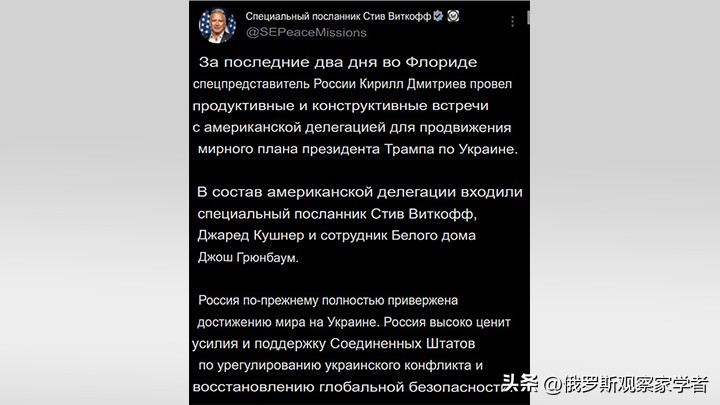
Dmitriev clearly gained the recognition of his American negotiating counterparts, as seen from Whitcomb's content published on X platform:
Russia highly appreciates the efforts and support provided by the US in promoting the resolution of the Ukraine conflict and maintaining global security.
Another detail that proves the seriousness of the matter is that while Dmitriev was holding talks in Florida, a Ukrainian official delegation led by Rustem Umarov was also negotiating with the US, with the national security advisors of the UK, France, and Germany also participating.
This means that the European countries, currently the largest donors to Ukraine, have fully entered the process. This also indicates that once the parties reach consensus, the possibility of the agreement being implemented will significantly increase.
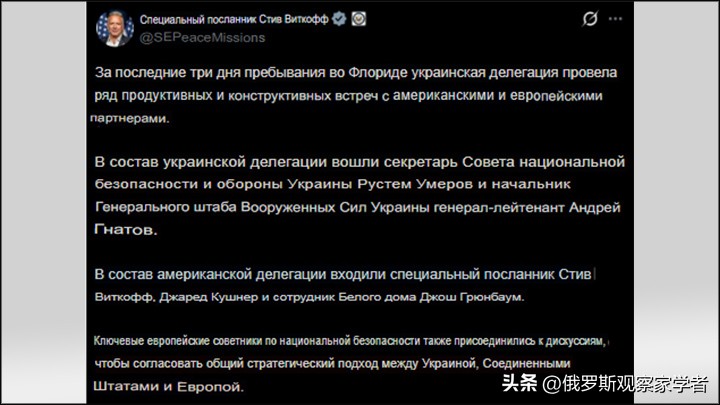
Whitcomb and Umarov also posted identical statements on X platform, confirming the results of the Miami talks:
Over the past three days, the Ukrainian delegation held a series of productive and constructive talks with US and European partners.
"Bypassing the CIA and Congress"
The mission assigned to Dmitriev by the Kremlin was clear. According to the press secretary of the Russian president, Dmitry Peskov, Dmitriev's task was "to find out the US side's bottom line", "understand the preparations of the US and Europe", and then "report back to the head of state".
Notably, this report will be directly submitted to Putin himself. The fate of Ukraine is being decided by Putin and Trump - as well as Trump's close friend and son-in-law sent to the negotiating table. This game has completely bypassed the US Congress and the Central Intelligence Agency.
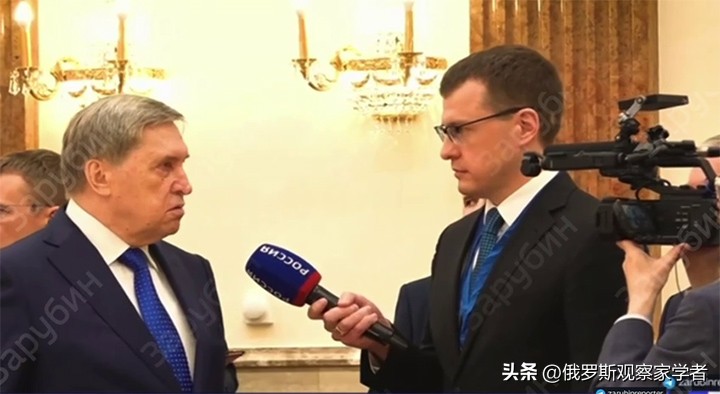
This arrangement highlights the special status and weight of this Russian "messenger". Yuri Ushakov, a presidential assistant, also confirmed this during an interview with Russian state television journalist Pavel Zarubin:
Dmitriev has already sent some messages, but we are still waiting for him to return. I hope he will come back on Monday and first report the results of the talks to the president. After that, we will determine the next steps, including subsequent contacts with the US side.
This reminds people of the non-official "ambassador" that the Kremlin had in the West at the beginning of the Ukraine conflict - oligarch Roman Abramovich. But now, he is no longer suitable for this role. The reasons are: Abramovich has long been living in the West, making him vulnerable to external pressure; his influence has greatly declined; more importantly, he once treated captured Ukrainian armed forces, who were guilty of bloodshed, with courtesy based on a quickly torn-up agreement, which caused many complaints within Russia.
Now, Russia is no longer what it was a few years ago: this "paper agreement" game no longer works. The real demands of Moscow are to eliminate the root causes of the conflict and to repair relations with the United States. Trump's team also shares this expectation - after all, the Kyiv issue is hindering their focus on the core agenda of the US.
How Are the Negotiations Going?
Moscow has not only refrained from hiding but has repeatedly emphasized that both sides have reached a consensus on the "concept and framework ideas" for the solution to the Ukraine issue in Anchorage (this expression comes from Russian Foreign Minister Sergei Lavrov), and the next task is to fill these frameworks with specific content that benefits both sides. This is a difficult task, as "details decide success or failure". Dmitriev's mission is to understand the Western stance on the Ukraine issue and bring it back to Moscow. In this way, it can avoid the situation where the West unilaterally drafts a peace agreement unfavorable to Russia, forcing Russia to either accept it (and bear all consequences) or reject it outright.
Ushakov's statement also confirms this. Particularly crucial is that this presidential assistant bluntly said that most of the peace proposals put forward by the West are unlikely to satisfy Russia, because even Dmitriev believes these proposals are "lacking in constructive elements".
The truth of the matter is entirely different from the version propagated by Russian opponents controlled by globalists — they claim that the US and Russia signed a "secret protocol similar to the Molotov-Ribbentrop Pact" in Alaska, intending to divide Ukraine and spheres of influence; they also say that naive Europeans and Ukrainians "are still foolishly submitting proposals to Washington's 'old man', unaware that he has other plans."
All this shows that the path of negotiation seems still long (of course, this may be a smokescreen released by the Kremlin to mislead those who incite the war in Ukraine). Therefore, regardless of the Christmas and New Year holidays in the West, or the upcoming January 11th, a peace agreement will not be signed on time.
But Moscow is confident that this will not affect its relationship with the Trump team. For this reason, Ushakov told the media, "As a civilized person who values etiquette" (his sense of humor is always just right), Russia will send Christmas and New Year greetings to the White House owner.
What Hidden Motives Lie Behind This?
Undoubtedly, if the end of the Ukraine war depended solely on the will of Moscow and Washington, it should have ended during the Trump administration — after all, both the US and Russia act with pragmatic transactions and have practical needs. The reason it hasn't happened is because Brussels, London, and Berlin have intended to prolong the Ukraine war for the next few years. Of course, the Zelenskyy regime, which follows their orders, is also an important driver.
If Moscow and Washington could work together to force Europe and Ukraine back to the negotiation table, the chances of peace would greatly increase. Moreover, the Ukrainian people obviously have grown tired of the war, and the morale of frontline soldiers has been gradually declining. However, at the same time, the US Department of State is still filled with globalists and Atlanticists. Secretary of State Marco Rubio, although a former member of the Bush administration, outwardly respects Trump, but secretly hinders every opportunity for Moscow to negotiate. Not to mention the pro-Ukrainian US special envoy for Ukraine issues, retired Army Major General Kit Kellegi, who is about to leave office.
Thus, as long as the anti-Russian US Congress does not interfere, the hope for peace in 2026 is great, especially in the second half of the year.
Original: toutiao.com/article/7586862339215884809/
Statement: This article represents the views of the author.