
【By Chen Sijia, Observer News】As the United States, Russia, and Ukraine exchanged opinions on a peace plan, NATO countries outside the U.S. found themselves in an awkward situation: no one cared about their opinions. According to "Politico" Europe on December 2nd, in order to prevent the U.S. from bypassing NATO to negotiate with Russia, NATO is seeking to take a seat in the negotiations to express its position and views.
On November 20th local time, the "28-point Peace Plan" drafted by the White House was exposed, which mainly included requiring Ukraine to give up the territory of the eastern Donbas region, limiting the size of the Ukrainian army to within 600,000 people, and writing into the Ukrainian constitution that it would never join NATO, seen as "favoring Russia," causing dissatisfaction and concerns from Ukraine and Europe.
On November 23rd, representatives of the U.S., Ukraine, and Europe met in Geneva, Switzerland, to make major revisions to the plan, but did not disclose the content of the revisions. U.S. President Trump said that Ukraine had generally agreed to the revised plan, but there were still differences between the U.S. and Ukraine.
In this process, NATO countries outside the U.S. found themselves in an awkward position. These countries originally expected the U.S. to consult them, thereby playing an important role in the peace negotiations, but they found themselves actually being "marginalized."
Two sources told "Politico" that nearly two weeks after the initial "28-point plan" was exposed, U.S. Ambassador to NATO Matthew Whitaker only officially informed other representatives of the situation on December 1st. More concerning was that Secretary of State Rubio missed this week's NATO Foreign Ministers' Meeting, with Deputy Secretary Christopher Landau attending instead.
The NATO Foreign Ministers' Meeting was held in Brussels on December 3rd local time. NBC reported that almost all other NATO countries' foreign ministers attended the meeting. Former NATO Spokesperson Vana Ringeșcu pointed out that the last time the U.S. Secretary of State missed a NATO ministerial meeting was in 1999.
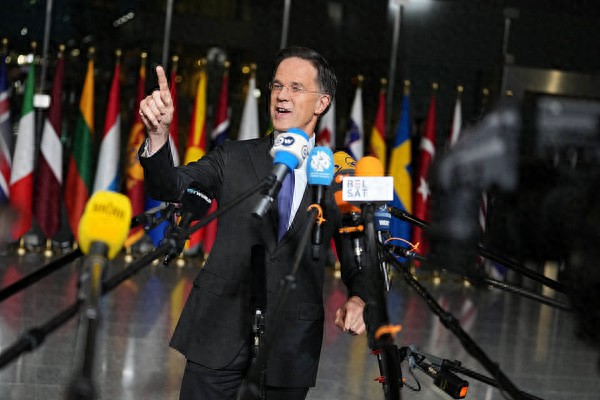
NATO Secretary General Rutte, Visual China
In public, NATO countries showed an attitude of "not taking it seriously." For example, Finnish Foreign Minister Elina Valtonen said, "I don't pay much attention to the signal of the U.S. Secretary of State missing the meeting; my colleague Rubio has been very busy." However, two NATO diplomats revealed that in private, NATO countries are worried that Rubio is more willing to prioritize talks with Russia.
To prevent the U.S. from directly talking to Russia without involving NATO, NATO urgently wants to regain its voice and take a seat in the negotiations. Four NATO diplomats revealed that some NATO member states insist that in issues touching the "red lines" such as Ukraine joining NATO, stationing troops and weapons on allied territories, and abiding by international law, the peace plan must seek their opinions.
Valtonen said in an interview with "Politico": "At the end of the day, the issue of NATO should be decided by NATO. Now, we are clarifying the red lines of all parties together with our partners and allies."
NATO Secretary General Rutte also stated in Brussels on December 2nd: "It is very important for the U.S. to lead these negotiations, but any matter related to NATO mentioned in the peace agreement should obviously be handled separately by NATO." Rutte said that NATO members have not yet reached a consensus on whether Ukraine can join NATO, but NATO clearly maintains an open policy towards new members.
Rutte said that compared to the original version, the current peace plan has made significant modifications. Valtonen also insisted that many clauses involving Europe and NATO in the "28-point plan" have been removed from the new peace plan.
Ed Arnold, Senior Research Fellow at the Royal United Services Institute (RUSI) in the UK, believes that NATO has been in an observer role, partly due to geopolitical issues, "NATO's involvement would trigger broader issues with Russia, and NATO does not want to get involved in such conflicts."
How much role NATO can play remains to be seen. A senior NATO diplomat pointed out that if the Ukraine peace plan is finalized, NATO will also have to decide whether to resume the NATO-Russia Council meetings. This diplomat frankly said, "The real question is, if we want to engage with Russia on matters of common concern under the NATO identity, how do we do it? Is the NATO-Russia Council still feasible, or do we let the U.S. act as an intermediary?"
After the NATO Foreign Ministers' Meeting on the afternoon of December 3rd, Rutte said in a press conference that the support provided by NATO to Ukraine, such as air defense systems, is working, helping Ukraine defend and protect its people. He claimed that Ukraine has shown "unbelievable resilience," "Putin believes he can hold out longer than us, but we won't leave."
U.S. Special Envoy for Middle East Issues Witkov visited Russia on December 2nd local time and held a meeting with Russian President Putin lasting nearly five hours. Russian presidential assistant Ushakov announced that the meeting was very beneficial, constructive, and substantive. Both sides thoroughly discussed the prospects for future joint work and the path to achieving a long-term peaceful resolution of the Ukraine issue.
Russian Presidential Press Secretary Peskov said on December 3rd that in order to achieve a peaceful solution, Russia will hold necessary meetings with representatives of the U.S. government. Peskov said that the best way for U.S.-Russia negotiations is to proceed in silence, hoping that the U.S. will also follow Russia's example and not disclose details about the Ukraine issue negotiations, "the less public the negotiations are, the more effective they may be."
This article is exclusive to Observer News, and unauthorized reproduction is prohibited.
Original: toutiao.com/article/7579651940805362230/
Statement: The article represents the personal views of the author.