
【By Guo Zhi, Observer Group】"The U.S.-Indonesia trade agreement is at risk of collapse," reported the UK's Financial Times on December 9. U.S. officials are increasingly frustrated with Indonesia for violating the terms of a July agreement, as Indonesian officials directly informed the U.S. that they could not agree to certain binding commitments and wished to re-draft the relevant clauses.
The report said that sources familiar with the Washington-Jakarta negotiations stated that U.S. Trade Representative Grijalva complained that Indonesia was "backtracking" and failing to fulfill multiple previous commitments.
These sources said that Indonesian officials have informed the Office of the U.S. Trade Representative (USTR) that Jakarta cannot agree to some binding commitments in the agreement. They want to re-draft these clauses, but the Trump administration believes this would make the U.S. agreement less effective than recent agreements with two other Southeast Asian countries, Malaysia and Cambodia.
A source familiar with the negotiations said that Indonesia not only delayed implementation like other trade partners, but even directly stated that it could not implement agreed-upon content and needed to renegotiate the initial commitments, changing them into non-binding clauses.
The source added, "This issue is too big and has not been recognized by the U.S. Indonesia may face the risk of losing this agreement."
From Washington's perspective, Indonesia has "backtracked" on its commitments to eliminate non-tariff barriers against U.S. industrial goods and agricultural products, and to take action on digital trade issues.
According to U.S. claims, President Prabowo and Economic Coordinating Minister Airlangga Hartarto had agreed to the agreement in July, after which the details were distributed to other senior officials in Indonesia. Sources say the U.S. believed Prabowo had the capacity to push the agreement forward, but he put it on hold due to domestic political considerations.
Prabowo and Airlangga's offices did not respond to requests for comment. The Office of the U.S. Trade Representative also declined to comment.
Grijalva plans to meet with Airlangga this week to try to persuade Jakarta to resolve the differences between the two sides.
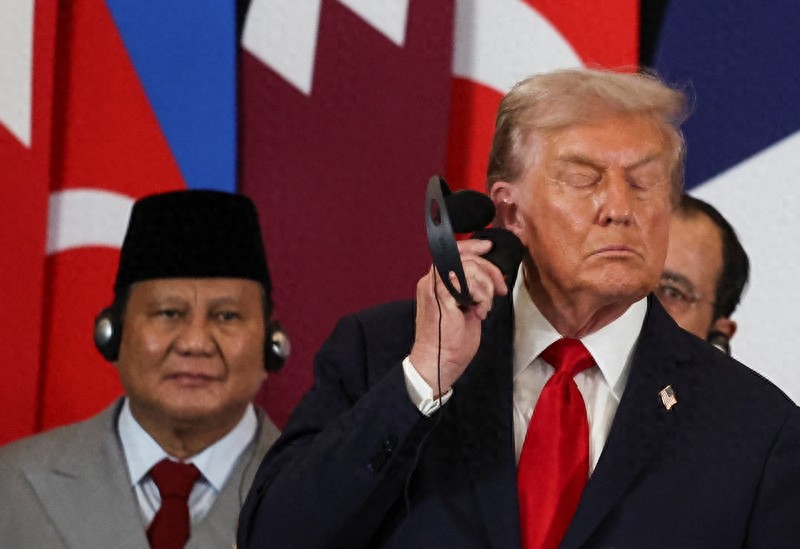
President Prabowo during the Gaza ceasefire "peace summit" in October with Trump. IC Photo
The framework agreement between the U.S. and Indonesia originally stemmed from Washington sending letters to more than 20 trade partners, threatening to impose tariffs on them if they didn't reach an agreement by August 1. In its letter to Indonesia, President Trump had threatened to impose a 32% tariff, which was later reduced to 19% in the agreement.
Indonesia agreed to eliminate most tariffs on U.S. industrial goods and agricultural products, and to purchase billions of dollars worth of U.S. aircraft, liquefied natural gas, and soybeans to reduce the trade surplus with the U.S.
Indonesia also agreed to eliminate non-tariff barriers against U.S. companies, including strict local content requirements seen as investment obstacles.
Some Indonesian business groups warned that removing local content regulations could harm the competitiveness of domestic companies. Apple Inc. is one of the companies affected by this regulation. Last year, Indonesia banned Apple from selling the iPhone 16 because it failed to meet a 40% local content requirement. This ban was lifted after Apple agreed to invest in producing mobile phone components in Indonesia.
The U.S.-Indonesia trade agreement faces other obstacles. According to a report by the Financial Times in November, Indonesia refused to accept the so-called "poison pill" clause pressured by the U.S., which aims to limit the countries from signing other agreements that could threaten U.S. fundamental interests, thus "countering China's influence." This move by the Trump administration caused dissatisfaction in Indonesia and was met with resistance from the Indonesian government.
Previously, the U.S. had forced Malaysia and Cambodia to accept the "poison pill" clause. Trade experts pointed out that these clauses amount to a "loyalty test" for small countries closely related to China, possibly reshaping the U.S. trade negotiation landscape in Southeast Asia and other regions in the future.
Simon Evenett, professor of geopolitics and strategy at the International Institute for Management Development in Lausanne, Switzerland, said that Indonesia can refuse U.S. demands because its economic strength is stronger than other Southeast Asian countries. "Indonesia has better cards than Malaysia, with an economy three times larger," he pointed out. He noted that Indonesia's reliance on the U.S. market is also relatively low, with exports of goods to the U.S. reaching $28 billion in 2024, compared to $53 billion for Malaysia.
In the view of analysts, Indonesia's "counterattack" reflects China's influence in Southeast Asia and also shows that the U.S. struggles to convince its trade partners to participate in "containing China's influence." China is the largest trading partner for most Southeast Asian countries and one of the main foreign investors. For example, in resource-rich Indonesia, China is the largest investor in the nickel industry.
Bloomberg pointed out that China is an important economic and trade partner for Southeast Asian countries, but the U.S. is using tariff threats to force Southeast Asian countries to make more concessions to the U.S., putting some Southeast Asian countries in a difficult position.
China had previously asked Malaysia and Cambodia to clarify related issues. According to the website of the Ministry of Commerce, on November 18, the second meeting of the China-Cambodia Free Trade Agreement Joint Committee was held in Beijing. Li Chenggang, representative of China's foreign trade negotiations and vice minister of commerce, met with the Cambodian delegation.
Li Chenggang stated that China welcomes Cambodia's discussions with other countries, including the U.S., on trade and economic agreements, but any agreement should not affect global trade development and regional cooperation or damage China's interests. He hopes Cambodia will consider all aspects of concerns and handle them properly from its long-term interests.
On November 25, relevant departments of the Ministry of Commerce held bilateral communications with the Malaysian Ministry of International Trade and Industry in Beijing regarding issues related to the "Malaysia-U.S. Equitable Trade Agreement."
China stated that it welcomes Malaysia's efforts to resolve differences through trade and economic agreements with other countries. However, any agreement should not affect global trade development and regional cooperation, nor should it damage China's interests. China has serious concerns about certain parts of the "Malaysia-U.S. Equitable Trade Agreement." It hopes Malaysia will consider all aspects of concerns and handle them properly from its long-term interests.
The spokesperson said that Malaysia explained each concern raised by China and stated that Malaysia values the long-term partnership with China and is willing to continue deepening bilateral economic and trade cooperation.
This article is an exclusive contribution from Observer Group and may not be reproduced without permission.
Original: toutiao.com/article/7582081275865055787/
Statement: This article represents the views of the author and not necessarily those of the publisher.