
【Wen/Observer Net Wang Yi】On February 2, the China Electricity Council released the "Analysis and Forecast Report on the National Power Supply and Demand Situation for 2025-2026", which estimates that by 2026, China's solar power generation capacity will exceed coal power generation capacity for the first time, and the combined installed capacity of wind power and solar power at the end of the year will reach half of the total power generation capacity.
Bloomberg News from the United States commented on the 3rd, saying that this marks a milestone progress in China's long-term process of building a cleaner power system.
The report pointed out that China's power system scale has exceeded twice that of the United States, and electricity prices are at a globally low level. According to the China Electricity Council, in 2026, China is expected to add more than 400 million kilowatts of new power generation capacity, of which the new renewable energy power generation capacity is expected to exceed 300 million kilowatts.
Data shows that China's solar power installed capacity reached about 120 gigawatts by the end of 2025, with an average annual increase of about 27 gigawatts over the past three years, showing strong growth momentum; while coal power generation capacity, although still in the construction peak period, is expected to be about 133.3 gigawatts by the end of 2026, but its share in the overall power structure continues to decline.
The China Electricity Council expects that by the end of 2026, the national power generation capacity will reach around 4.3 billion kilowatts, of which non-fossil energy power generation capacity will be 2.7 billion kilowatts, accounting for about 63% of the total capacity, and coal power generation capacity will account for about 31% of the total capacity.
Bloomberg compared that China's continuous power construction has helped the country avoid large-scale power outages similar to those in 2021 and 2022, which have been troubling parts of the United States and Europe until recently.
The report shows that China's social electricity consumption reached two major breakthroughs in 2025: first, the annual social electricity consumption scale of China has exceeded the 10 trillion kilowatt-hour threshold, reaching 10.37 trillion kilowatt-hours; second, the monthly electricity consumption scale has exceeded the 1 trillion kilowatt-hour threshold, with China's social electricity consumption in July reaching 1.02 trillion kilowatt-hours, which is also the first time globally.
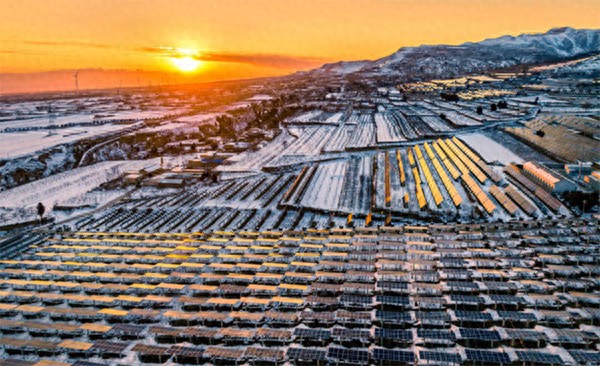
The blue solar photovoltaic panels cover the hillsides of Yuncheng City, Shanxi Province. IC Photo
What is more surprising is that the American magazine Forbes noted on the 1st that while power demand is rising, China's carbon emissions have shown a decline.
Data from multiple independent tracking agencies show that since early 2024, China's carbon emissions have generally remained stable or declined, while electricity consumption continued to grow. The report states that if this rare trend continues, it will directly challenge the long-standing view in climate economics that "growth must accompany emission increases".
The magazine analyzed that China's clean energy expansion is no longer an edge phenomenon. In just one year, 2024, China's newly added wind and photovoltaic power generation capacity exceeded the total of all other countries in the world, making the growth rate of renewable energy power generation exceed the growth rate of electricity demand for the first time on a large scale. This "divergence" is crucial, meaning that increasing power demand is increasingly being met by clean energy rather than coal.
This transformation is not accidental. As Professor Guan Dabo from the Department of Earth System Science at Tsinghua University said, China's energy system has reached a critical scale, and the volume of clean power is sufficient to substantially change the long-standing relationship between economic growth and carbon emissions. In the early stages, the scale of renewable energy was too small to have any impact on the entire system, but now, even with increasing demand, its scale is sufficient to replace fossil fuel power generation.
This structural change is not only present in the power industry. Electric vehicles currently account for the majority of new car sales in China, flattening the growth of oil demand. Unlike energy efficiency improvements that may be offset by the rebound effect, electrification permanently replaces gasoline and diesel consumption.
Forbes said that this is crucial, as economic slowdowns may temporarily suppress demand for fossil fuels, while technological substitution will change long-term consumption patterns. International Energy Agency (IEA) analysts pointed out that China's electrification in the transportation sector has become an important factor in curbing global oil demand growth. Even if economic activity accelerates again, this trend is unlikely to reverse.
"Therefore, China is becoming an experimental case to test whether a large industrialized economy can avoid a simultaneous rise in emissions while expanding," the report stated. Unlike developed economies that achieved emission reductions after their industrial development matured, China is trying to complete this transition while still in the development stage and on a scale far larger than others.
However, US media analysis stated that the tug-of-war between the rapid growth of clean energy and the continued expansion of coal power capacity remains one of the core contradictions in China's transition process. New coal power capacity largely reflects local governments' concerns about grid security and reliability, rather than the real demand for coal power generation. A considerable portion of new coal-fired power units are designated for emergency or peak-shaving purposes, meaning that China is still increasing the number of coal power plants, although these plants will not run frequently or significantly increase coal power generation.
The Center for Research on Energy and Clean Air (CREA), based in Finland, holds a cautious optimistic attitude toward China's energy transition. The center stated, "Overall, the boom in China's clean energy itself has formed momentum and has significant economic significance at both the national and provincial levels, making this boom more likely to continue. Obviously, after achieving remarkable growth in the clean energy industry, China has the ability to continue reducing emissions and begin moving towards carbon neutrality."
This article is exclusive to Observer Net. Unauthorized reproduction is prohibited.
Original: toutiao.com/article/7602570287791587886/
Statement: The article represents the views of the author himself.