
【By Observer Net, Pan Yuchen, Editor: Gao Xin】On December 4th, during the Shanghai Maritime Exhibition, CATL's subsidiary, CATL Electric Vessel Technology Co., Ltd., officially launched the "Ship - Shore - Cloud" zero-carbon shipping and intelligent port logistics integrated solution, and systematically showcased its phased achievements and future layout since entering the shipbuilding field in 2017.
CATL began its layout in the shipbuilding sector in 2017, and in 2019, it achieved the launch of the first electric ship. Zhuang Zhan Ting, Deputy General Manager of CATL's Shipbuilding Division, stated that to date, CATL has provided power solutions for nearly 900 electric ships, such as the world's largest battery capacity pure electric inland passenger ship "Changjiang Sanxia 1", China's first pure electric sea passenger ship "Yu Jian 77" certified by the China Classification Society (CCS), the first hybrid tugboat "Qinggang Tug 1", and the first ship station integrated delivery and independently operated cargo ship battery replacement demonstration project "Jining 6006". Currently, CATL holds approximately a 40% market share in the electric ship sector and ranks first globally in the electric ship battery supply market.
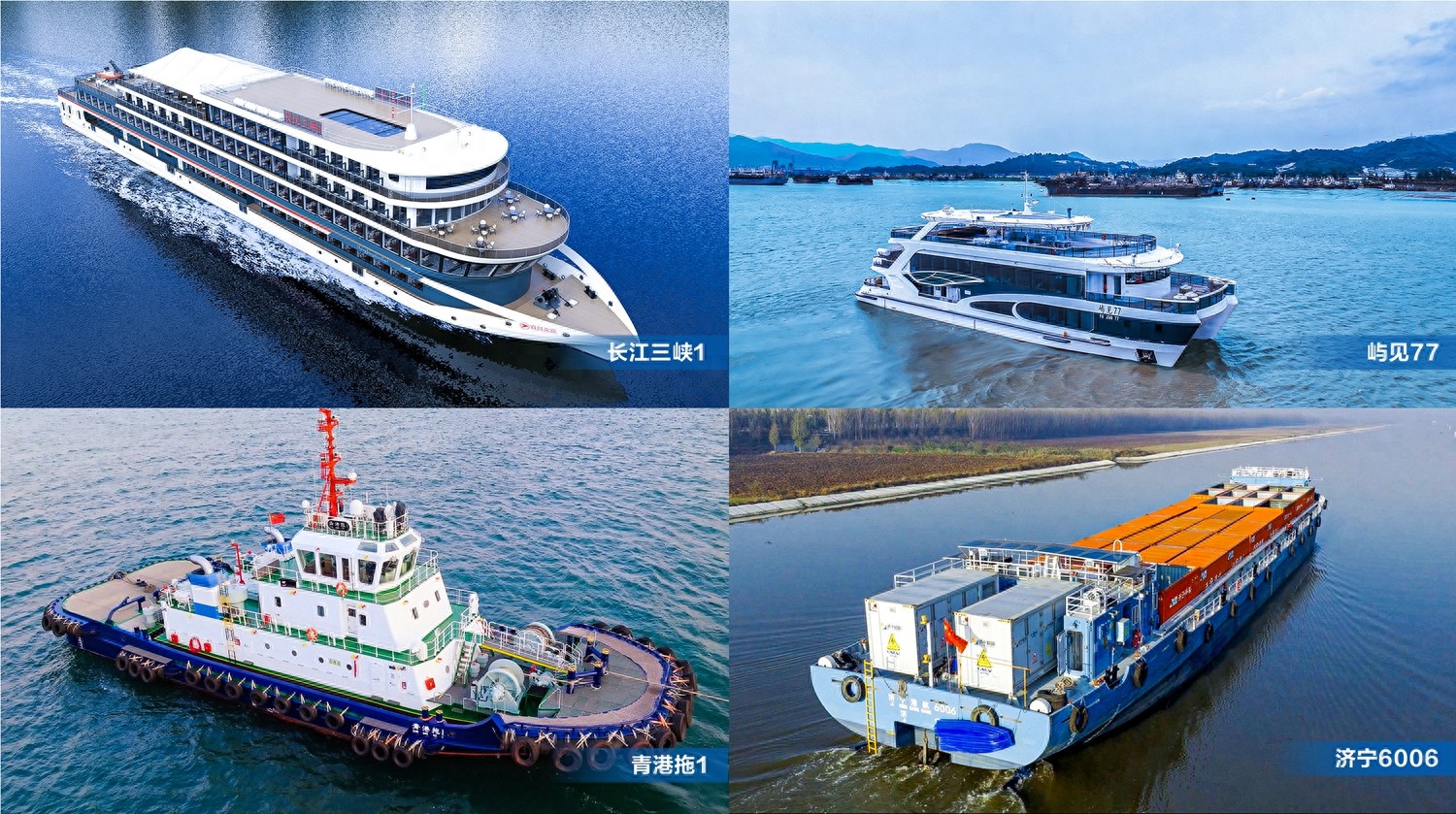
CATL Electric Vessel Cases CATL
Su Yiyi, General Manager of CATL Electric Vessel Technology Co., Ltd., stated that in the past, power, charging, and maintenance in ship operations were handled by different suppliers, leading to coordination difficulties and unclear responsibilities, causing problems over thirty years of operation and low efficiency. Moreover, there are systemic issues such as high initial purchase costs, insufficient charging infrastructure, range anxiety, complex water conditions, and non-uniform technical standards, which often leave shipowners in an operational dilemma of "can't afford the ship, can't charge, can't calculate the cost," becoming a core bottleneck restricting the large-scale development of zero-carbon shipping.
CATL's newly launched "Ship - Shore - Cloud" integrated solution covers on-board power systems, shore-based charging networks, and cloud-based intelligent management. Specifically, at the ship end, the "Ship - Shore - Cloud" integrated solution integrates battery systems, power systems, and intelligent navigation systems to ensure stable and long-distance ship operations; at the shore end, through a charging and swapping network and the "ship-electricity separation" model, it addresses concerns about charging and cost; at the cloud end, through the intelligent management platform "Yunfan" and the intelligent navigation system "Beichen", it achieves remote monitoring, scheduling, and optimization of ships.
Compared to electric vehicles, electric ships are not simply a transfer of land-based technology; their development must directly face challenges such as high humidity, high salt fog, long sailing time, and high power operations.
Zheng Bi said that in response to the complex and changing environment on water, CATL has made targeted designs and validations for ship battery systems. On the technical level, CATL mainly addresses the issue from three dimensions:
In terms of cell and system selection, CATL prioritizes using systems with larger safety windows and specially designs them according to the needs of long sailing times and high-rate output of ships, combining high-reliability BMS and EMS to enhance the stability of the entire system under high-humidity, high-salt-fog, and continuous vibration operating conditions.
In terms of structural and protective design, CATL mainly adopts high-strength structures, reinforced protective coatings, and high-protection-level designs on key components such as electrical boxes and container power supplies, passing electromagnetic compatibility, impact vibration, and other tests to ensure reliability under long-term navigation and frequent berthing and departure operations.
In terms of working condition simulation and verification, CATL relies on a complete charge-discharge verification platform and an onshore engineering joint debugging laboratory to simulate complex ship conditions, including wave surges and load fluctuations, and run through extreme conditions before the product is shipped. In application, it insists on making solutions based on scenarios: scenic area tour boats and urban passenger ships, inland freight ships, near-sea and special-purpose ships adopt different solutions, defining products according to scenarios rather than one battery for all, which is also the basic principle that CATL adheres to in the "Full Scenario Incremental Era."
Su Yiyi stated that CATL's ship division is not an isolated business but a crucial link in the "Full Scenario Incremental" strategy proposed by CATL Chairman Zeng Yuyu in November. The core of the "Full Scenario Incremental" strategy lies in expanding the core capabilities accumulated by CATL in the power battery field to full transportation scenarios on land, sea, and air, building a zero-carbon ecosystem based on a unified energy foundation. The "Ship - Shore - Cloud" zero-carbon shipping and intelligent port logistics integrated solution is driving electrification from land to water, opening up a new path for global shipping that is green, smart, and sustainable.
Currently, the maritime industry accounts for 3% of global greenhouse gas emissions. The International Maritime Organization has previously clearly set a goal of achieving net-zero emissions by 2050. According to research institution EVTank, by 2026, the Chinese electric ship market size is expected to rise to 36.75 billion yuan, and lithium battery demand will increase from 173.2 MWh in 2021 to 11.2 GWh by 2026.
Although the electric ship market has broad prospects, as an industry leader, CATL's ship integration solution also has strong strategic foresight. However, the comprehensive promotion of this solution still faces a series of practical challenges. From demonstration projects to large-scale commercialization, the success of CATL's ship integration solution will depend on whether it can overcome four major obstacles: long-range oceanic endurance, cost control, infrastructure network construction, and safety standards and regulatory gaps. This is not only a test of CATL's own technology but also a test of the collaboration of the entire industrial chain and the support of policies.
This article is exclusive to Observer Net. Reproduction without permission is prohibited.
Original: toutiao.com/article/7580192376996643370/
Statement: This article represents the personal views of the author.