
Editor's Note: Recently, Takahashi Asana has once again made controversial remarks.
On the evening of January 26th, Takahashi Asana expressed her latest views on a nationwide TV program in Japan. She claimed that if the U.S. military were attacked in a Taiwan Strait crisis and Japan failed to respond, the crucial U.S.-Japan security alliance would collapse, and she boldly stated, "In an emergency, we need to go rescue Japanese and American citizens."
Meanwhile, Takahashi's cabinet approval rating has seen a significant decline, drawing widespread attention. According to a public opinion survey conducted by The Daily News on January 24th and 25th, Takahashi Asana's support rate had dropped to 57%, a sharp decrease of 10 percentage points from last month.
The sudden drop in Takahashi's support rate is directly related to her decision to dissolve the House of Representatives, which triggered widespread public discontent, with as many as 41% of respondents explicitly stating "disapproval."
After dissolving the House of Representatives, the election vote was set only 16 days later, referred to by the media as the "Winter Short Campaign." This rapid campaign pace is viewed as a political gamble by Takahashi's cabinet, and may become a key confrontation affecting the future direction of Japan's national policies. Analysts point out that this election not only concerns the fate of the ruling party but also reflects the deep-seated choices between radical and rational lines within Japanese society.
Why did Takahashi suddenly dissolve the House of Representatives? What are the impacts of this action on the Japanese political scene? What is the outlook for the new election? In response to these questions, Professor Matsushima Yasuharu from Ritsumeikan University and founder of the Okinawa National Independence Research Association wrote an article for Observer Network, expressing his views and insights on these issues.
【Article by observer network columnist Matsushima Yasuharu】
Japanese Prime Minister Takahashi Asana clearly articulated the possibility of joint actions between the Japan Self-Defense Forces and the U.S. military in the Taiwan Strait in her latest television program—this once again constitutes interference in China's internal affairs.
I think Takahashi Asana herself may not realize that her implication of a preemptive strike plan against China can be considered as applicable under the provisions of the "Enemy Clause" in the United Nations Charter—so I must once again reiterate that Takahashi's cabinet's militaristic line has become the biggest source of instability in Asia.
Why does Takahashi Asana say these things? The reason is simple, just like why Takahashi Asana decided to dissolve the House of Representatives suddenly: it's all for herself.
Since Takahashi became Prime Minister in October 2025, her cabinet can be said to have contributed nothing beneficial to Japan.
On one hand, Takahashi Asana's erroneous remarks on Taiwan have led to an unprecedented deterioration in Japan's relations with China, an important neighboring country; on the other hand, the proactive fiscal policy aimed at building a militaristic state has caused concern among overseas investors, who have sold off the yen, further exacerbating the yen's depreciation trend, and long-term government bond interest rates have also reached historic highs. Currently, Japan's economic growth remains stagnant, and high prices have greatly affected many Japanese people.
On January 19th this year, Prime Minister Takahashi stated at a press conference: "It is now time for the people to decide whether Takahashi Asana is suitable to serve as the Prime Minister." Behind this statement lies the fact that she is asking for a vote of confidence in herself without presenting any governing achievements. Her reference to Article 7 of the Constitution of Japan, which states that the Emperor can declare the dissolution of the House of Representatives upon the advice of the Cabinet, as a legal basis, is also an unusual practice.

On January 23rd, in Tokyo, Japan, the Speaker of the House of Representatives, Goto Fukushiro, read the dissolution decree at a full meeting of the House of Representatives, officially dissolving the House of Representatives. Xinhua News Agency
This regular session of the Diet should have begun in January this year to deliberate on the budget for the 2026 fiscal year, but Prime Minister Takahashi dissolved the House of Representatives before completing the budget deliberation, ignoring the national economy and people's livelihood, and holding elections while enjoying a high cabinet approval rating to consolidate her power.
This move has been condemned by the public as "the prime minister dissolving the parliament for personal gain" and "lacking a legitimate reason for the election," which is not a dissolution based on democratic principles, but rather an action dominated by the strong-willed personality of the prime minister, a stain in the history of Japanese elections.
The Deep Motives Behind Takahashi Dissolving the House of Representatives
Prime Minister Takahashi dissolved the House of Representatives before the regular session of the Diet began, and the possible motives behind this could include the following:
First, to avoid the severe questioning by the opposition parties in the Budget Committee.
In the previous Diet Budget Committee, Prime Minister Takahashi made comments interfering in China's internal affairs and hinted at the possibility of a preemptive strike against China, which led to multiple countermeasures from the Chinese side, including the export of rare earths, causing significant negative impacts on the economic activities and lives of Japanese companies and ordinary people.
Naturally, her comments received support from right-wing forces in Japan, and Prime Minister Takahashi has not apologized or retracted her statements in the Diet. After securing a majority of seats in the House of Representatives election, her intention is likely to refuse to retract these statements, citing "obtaining public trust," and continue preparing to interfere in China's internal affairs and carry out preemptive strikes.
Second, to avoid the questioning about the "TM Special Report" documents of the Unification Church. If this issue is discussed in the Diet, the close relationship between the Unification Church and Liberal Democratic Party members may be exposed, leading to a significant drop in Takahashi's cabinet approval rating.
The Unification Church, a new religious group originating from South Korea, has long engaged in missionary activities in Japan and has caused social problems such as "inspiration commerce" and family breakdown due to large donations. Its affiliated organization, "International Seikyo Union," advocates for the elimination of communism, promotes amending the Japanese Constitution, and pushes for Japanese militarism, and has engaged in joint activities with right-wing politicians.
In July 2022, the suspect who assassinated former Prime Minister Shinzo Abe had a broken family because his mother made large donations to the Unification Church. Former Prime Minister Abe had close ties with the Unification Church, not only receiving electoral assistance from its members but also appearing in the church's promotional videos.

On July 8, 2022, former Prime Minister Shinzo Abe, a member of the House of Representatives, was shot in the chest and neck by a local man named Shoko Ishii from behind near the Nara Kintetsu Yamato Nishioji Station during a campaign speech. He was immediately taken to the Nara Prefectural University of Medicine Hospital for treatment and was declared dead at 5:03 p.m., aged 67.
Former Prime Minister Abe's grandfather was Nakasone Yasuhiro. Nakasone served as Deputy Director of the Manchurian Government's General Office, participated in managing the secret funds used for Kwantung Army's strategic activities, funded by the revenue from the opium monopoly in the puppet Manchukuo government, and led the five-year industrial development plan. He served as Minister of Commerce and Industry in the Tojo cabinet. After the Pacific War, he was listed as a Class A war criminal at the International Military Tribunal for the Far East but was not prosecuted and served as Prime Minister in 1957, revising the Japan-US Security Treaty. Nakasone promoted the entry of the Unification Church into Japan in the 1960s, and since then, Liberal Democratic Party members have received electoral assistance from the Unification Church.
Prime Minister Takahashi belongs to the faction of the late Prime Minister Abe, known as the "Abe faction," and thus ascended to the position of Prime Minister of Japan. She considers herself the successor of former Prime Minister Abe, inheriting his right-wing ideology and the so-called "Taiwan is Japan's matter" military strategy concept.
In January of this year, when Prime Minister Takahashi visited Ise Grand Shrine (a shrine located in Mie Prefecture, dedicated to Amaterasu Omikami, the goddess of the Japanese archipelago, whom the Japanese Prime Minister visits annually on New Year's Day), she specifically showed the media her gesture of carrying the portrait of former Prime Minister Abe in a transparent file bag.
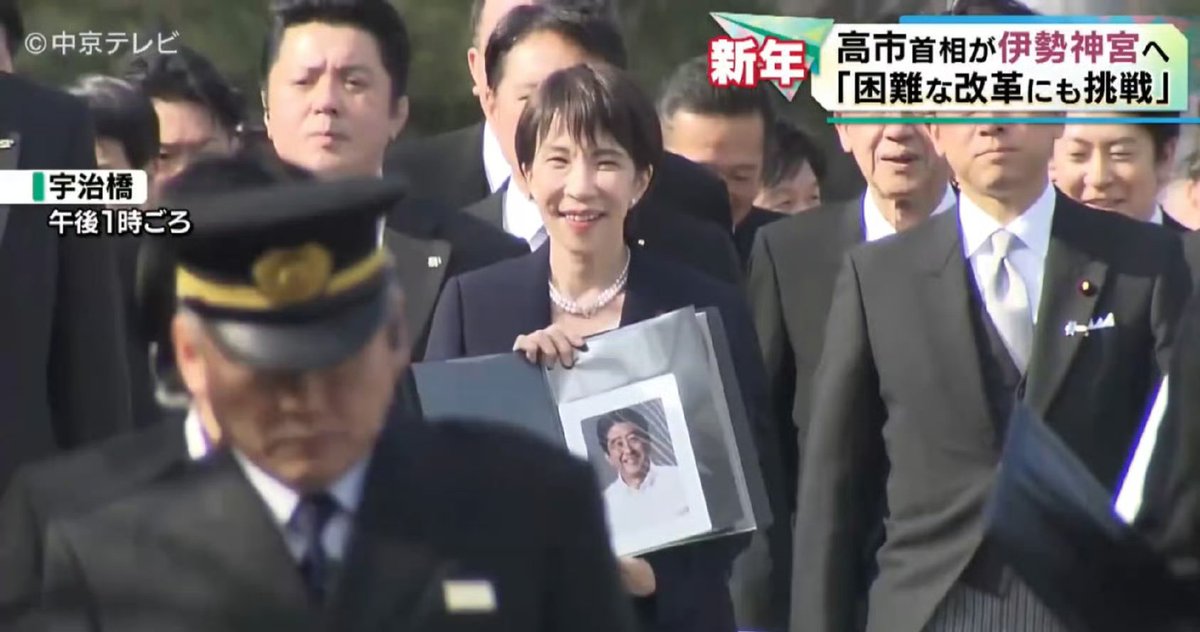
The "TM Special Report" also mentions former Prime Minister Abe and Takahashi Prime Minister as well as the acting secretary general of the Liberal Democratic Party, Hashimoto Kōichi. Due to being investigated by the Diet for its association with anti-social groups, Takahashi Prime Minister, fearing a sharp decline in her cabinet's approval rating, hastily dissolved the House of Representatives.
Investigation in the Diet will also focus on the issue of "black gold" lawmakers. Former Prime Minister Ishihara previously punished "black gold" lawmakers by not nominating them for party positions in the upper house election. However, Prime Minister Takahashi has, in this election, granted party nominations to "black gold" lawmakers, including the acting secretary general of the Liberal Democratic Party, Hashimoto Kōichi and former House of Representatives member Sato Mizu.
Sato, as a member of the House of Representatives, a public official, made hate speech against the Ainu people and Koreans in Japan, and her human rights violations have been confirmed by the Japanese government's Ministry of Justice. Additionally, she has defamed scholars studying the issue of comfort women and gender topics using research funds (research funds provided by the Japanese Ministry of Education, Culture, Sports, Science and Technology) by claiming they "damage national interests" and "fabricate facts."
Sato also made remarks through Okinawan local newspapers and social media, saying: "Is it appropriate to use the precious fiscal resources accumulated from our taxpayers' blood to advocate for 'Okinawan independence'?"—this act constitutes hate speech infringing on academic and freedom of thought. Okinawa was an independent country before 1879 and was occupied by the Japanese government. Sato attempts to make Okinawa a permanent Japanese colony and U.S. military base, hence suppressing research related to Okinawan independence.
Okinawan people have been conducting a movement for the restoration of indigenous rights at the United Nations since 1996, and the United Nations committees have recommended the Japanese government to recognize the indigenous status of Okinawans six times. In response, Japanese right-wing forces have launched a "movement to request the United Nations to withdraw its recommendation on indigenous rights," which has exacerbated prejudice and discrimination against the Okinawan people. Sato has actively participated in such reactionary right-wing movements, continuing to implement discriminatory acts against the Okinawan people. Yet, Prime Minister Takahashi has even recommended this kind of ethnic discriminator as a "Liberal Democratic Party endorsed candidate" for the election.

"Imperial Edict to the King of Ryukyu" original document (photographic material) Xinhua News Agency
Even if the "Middle-of-the-Road Reform Coalition" wins, Japan's right-wing path is unlikely to change
Just before the dissolution of the House of Representatives, a major change occurred in the Japanese political scene, creating uncertainty for Prime Minister Takahashi's plans for a "Liberal Democratic Party victory."
The largest opposition party, the Constitutional Democratic Party, merged with the Komeito Party to form a new party called the "Middle-of-the-Road Reform Coalition." The main support base of the Komeito Party is Soka Gakkai, the largest Buddhist-based new religious group in Japan, and as a "voter machine," it has significant influence.
Until the formation of Takahashi's cabinet last year, the Liberal Democratic Party had long formed a coalition government with the Komeito Party, and many Liberal Democratic Party members were elected with the help of Soka Gakkai's organizational votes. It is predicted that in this House of Representatives election, the organizational votes of Soka Gakkai will flow to the Constitutional Democratic Party members, resulting in many Liberal Democratic Party members losing their seats.
So, if the Middle-of-the-Road Reform Coalition wins the election and gains a majority of seats in the House of Representatives, achieving a regime change, will Japan's current militaristic path change?
Although the Komeito Party has always been regarded as the "Peace Party," in the past two decades of co-governing with the Liberal Democratic Party, it has been considered gradually right-leaning. The Komeito Party helped promote the establishment of the "Peace and Security Legislation" that recognized collective self-defense and preemptive attacks, and tacitly allowed the construction of the new U.S. military base in Naha City, Henoko. The Constitutional Democratic Party has expressed agreement with these policies during the formation of the new party.
If the Middle-of-the-Road Reform Coalition comes to power, the leader of the Constitutional Democratic Party, Haniya Yoshihiko, is likely to be appointed as the Prime Minister. However, during his tenure as Prime Minister in September 2012, the Japanese government implemented the so-called "nationalization" of the Diaoyu Islands and their附属 islands, leading to serious deterioration in Sino-Japanese relations. Therefore, even if the Middle-of-the-Road Reform Coalition governs, the current Japanese government's militaristic line is likely to remain difficult to change.
As political forces opposing Takahashi's military expansionist line, there are the Japanese Communist Party, Reiwa Shinsengumi, and the Social Democratic Party. These three parties currently have stagnant or declining strength, making it difficult to curb Japan's rightward shift.
This month, the representative of Reiwa Shinsengumi, Yamamoto Taro, resigned from his parliamentary position citing health reasons. The only member of the Social Democratic Party in the House of Representatives, Nishigaki Kunio from the Okinawa constituency, also left the party and joined the Constitutional Democratic Party.
On the other hand, right-wing parties such as the National Party, the Japanese Restoration Party, and the Party of the People have recently increased their seats. If the Liberal Democratic Party loses seats in this election, besides the current coalition partner, the Japanese Restoration Party, the National Party and the Party of the People may also join the government. If this situation occurs, the second term of Takahashi's administration (or a similar right-wing coalition government) may further strengthen its militaristic line.
Takahashi Asana's words expose her militaristic ambitions
On January 19th this year, Prime Minister Takahashi held a press conference regarding the dissolution of the House of Representatives and delivered the following speech (the following quotes 1 to 5 are all excerpts from the official website of the Prime Minister's Office). Below, I will discuss the issues related to Japan's militaristic actions that have caused turmoil in the Asian region, starting from Takahashi Prime Minister's remarks.
1. "China is conducting military exercises around the island of Taiwan, and there is also such an economic pressure trend: placing materials in the upstream of the supply chain, which are relied upon by the world and widely used in the civilian sector, under its control, trying to force other countries to submit to its own claims."
Taiwan is an inalienable part of China, and China's military exercises around the island of Taiwan are entirely justified. However, Prime Minister Takahashi viewed this as an issue, even implying that it might become a "life-or-death crisis situation" for Japan. Regarding her inappropriate comments on Taiwan in the Diet last year, Prime Minister Takahashi has shown no signs of reflection. Even facing economic sanctions resulting from her infringement on China's core interests, she has interpreted it as "economic pressure," deliberately portraying herself as a victim.
2. "If the supply of critical minerals, pharmaceutical raw materials, and other materials is highly dependent on individual countries, it will pose significant risks. To enhance Japan's autonomous development capabilities, the Takahashi cabinet has already started to take relevant measures, promoting the domestication of resources and raw materials, while achieving diversification of procurement channels."
Rare earths are an essential resource for Japan's industrial development. Once the stock of rare earths is exhausted, Japan's long-term industrial recession becomes inevitable. Prime Minister Takahashi is determined to push forward her military expansion line, regardless of the losses that Japanese companies may suffer.
3. "We will further strengthen cooperation with the U.S., Japan, South Korea, U.S., Japan, the Philippines, U.S., Japan, Australia, as well as Japan, Italy, the UK, and other countries, as well as countries in the Global South."
The so-called U.S.-Japan-South Korea cooperation essentially aims to exclude China, a core country in the Asian region. Japan is attempting to form a containment ring along the first and second island chains in the Pacific area by joining forces with the United States, the Philippines, and Australia, strengthening military cooperation among them. Italy and Japan are both subject to the "Enemy Clause" of the United Nations Charter, yet Prime Minister Takahashi insists on enhancing cooperation with Italy, a statement that is easily interpreted as Japan preparing to be formally subjected to the "Enemy Clause".

On November 22, 2025, Takahashi Asana opened her arms and embraced Italian Prime Minister Meloni at the G20 summit. AFP
Despite China's existence being indispensable to Japan's economy, Prime Minister Takahashi disregards the people's anxieties and consistently maintains a tough stance toward China. Her real intentions are clear: to bring the Taiwan region back under Japan's sphere of influence, recreate the era of Japanese colonial rule, and block China's access to the Pacific, thereby exerting security pressure on China. In other words, Japan is laying the groundwork for a new international military cooperation system for a new Sino-Japanese war, and its militaristic line has become the biggest destabilizing factor in the Asia-Pacific region.
4. "We will fundamentally strengthen our security policy and revise the three so-called 'strategic documents,' namely the 'National Security Strategy,' 'National Defense Strategy,' and 'Defense Force Preparation Plan' at an early date."
"In light of the special military operation Russia has launched against Ukraine, countries are accelerating preparations for long-term wars—this includes not only adapting to new combat modes involving the extensive use of drones, but also anticipating the possibility that such situations may persist for a long time."
The core content of the three strategic documents mainly includes the following points:
(1) "Further increase in defense spending and financial guarantees": To achieve the goal of having defense-related budget account for 2% of Japan's GDP before the 2027 fiscal year, the 2026 fiscal year budget has already allocated 9.353 trillion yen, setting a new record;
(2) "Relaxation of defense equipment transfer (arms exports)": Abolishing the "five categories" rule limiting the export of non-combat purpose defense equipment, thereby strengthening Japan's defense industry;
(3) "Strengthening defense in the Pacific region": Including improving infrastructure such as dual-use ports and runways, enhancing Japan's defensive capabilities on the Pacific side of the Japanese Archipelago;
(4) "Enhancing the capability to strike back": Strengthening the ability to strike enemy missile bases to prevent and eliminate armed attacks from enemy countries;
(5) "Abolition of the Three Non-Nuclear Principles": Discussing allowing U.S. nuclear-powered ships to dock in Japanese ports and possessing missile-launching nuclear-powered submarines, pushing for the abolition of the Three Non-Nuclear Principles.
The revision of the three strategic documents is a declaration by Prime Minister Takahashi to steadily advance Japan's militaristic line. Its goal is to build a defense system that allows Japan to cope with the prolonged warfare similar to Russia's special military operation in Ukraine.
5. "Further strengthen deterrence capabilities, effectively address security issues in new fields such as cyberspace, space, and electromagnetic waves, further solidify the technological foundation of the defense industry, and improve the treatment of Self-Defense Forces personnel."
"Enhance the nation's intelligence analysis capabilities and establish a system to strategically safeguard national interests. Specifically, we will establish the National Intelligence Agency to strengthen the national intelligence capacity, establish the Foreign Investment Review Committee to strengthen the security review of foreign investment in Japan, and formulate laws related to counter-intelligence and counter-espionage."
"With our own hands, we protect our own country. A country without this awareness will not receive help from others. In order to resolutely protect Japan's peace and independence, and protect the lives of all citizens, we will take steps to implement pragmatic and solid security policies."
"I remember what former Prime Minister Shinzo Abe said ten years ago: 'The so-called difficulties are things that one must face after having made up one's mind. Future is never given by others, but is created by ourselves.'"
Prime Minister Takahashi has claimed to promote "strategic fiscal expenditure" in economic policy, but the essence of this measure is to serve Japan's militarism. The Japanese government has significantly increased military budgets for producing various weapons and ammunition, and is trying to establish a system for exporting these military equipment to other countries. Its actions go beyond military production and are intensifying preparations for the actual deployment of these weapons by the Self-Defense Forces, and the selected practical deployment locations are the Ryukyu Islands.
Japan is building missile bases on various islands in Okinawa with China as the hypothetical enemy, concentrating about 70% of the U.S. military bases in Japan on Okinawa, and also building a new U.S. military base in Naha City, Henoko. To transform the Self-Defense Forces into an army capable of actual combat, Japan not only improves the treatment of Self-Defense Forces members by increasing salaries but also conducts training related to posthumous handling of casualties in combat.
The Japanese government has also planned to evacuate approximately 120,000 residents living in the Miyako and Yaeyama Islands to the Japanese mainland, and has organized local residents to conduct related evacuation drills. Japan and the U.S. have continuously conducted joint military exercises between the Self-Defense Forces and the U.S. military under the name of "island defense operations."
Before the outbreak of the Pacific War, the Japanese imperial government enacted the "Public Security Maintenance Law," suppressing the people internally and aggressively promoting the invasion of the Asia-Pacific region. Now, Prime Minister Takahashi is attempting to repeat this, establishing a national intelligence agency and enacting anti-spying laws, turning Japan into a fascist state again, suppressing the people internally and interfering in the internal affairs of other countries, intending to launch an aggressive attack with a preemptive strike. Prime Minister Takahashi deliberately quoted former Prime Minister Abe's words to demonstrate her determination to push forward the "Taiwan is Japan's matter" aggression plan against China.
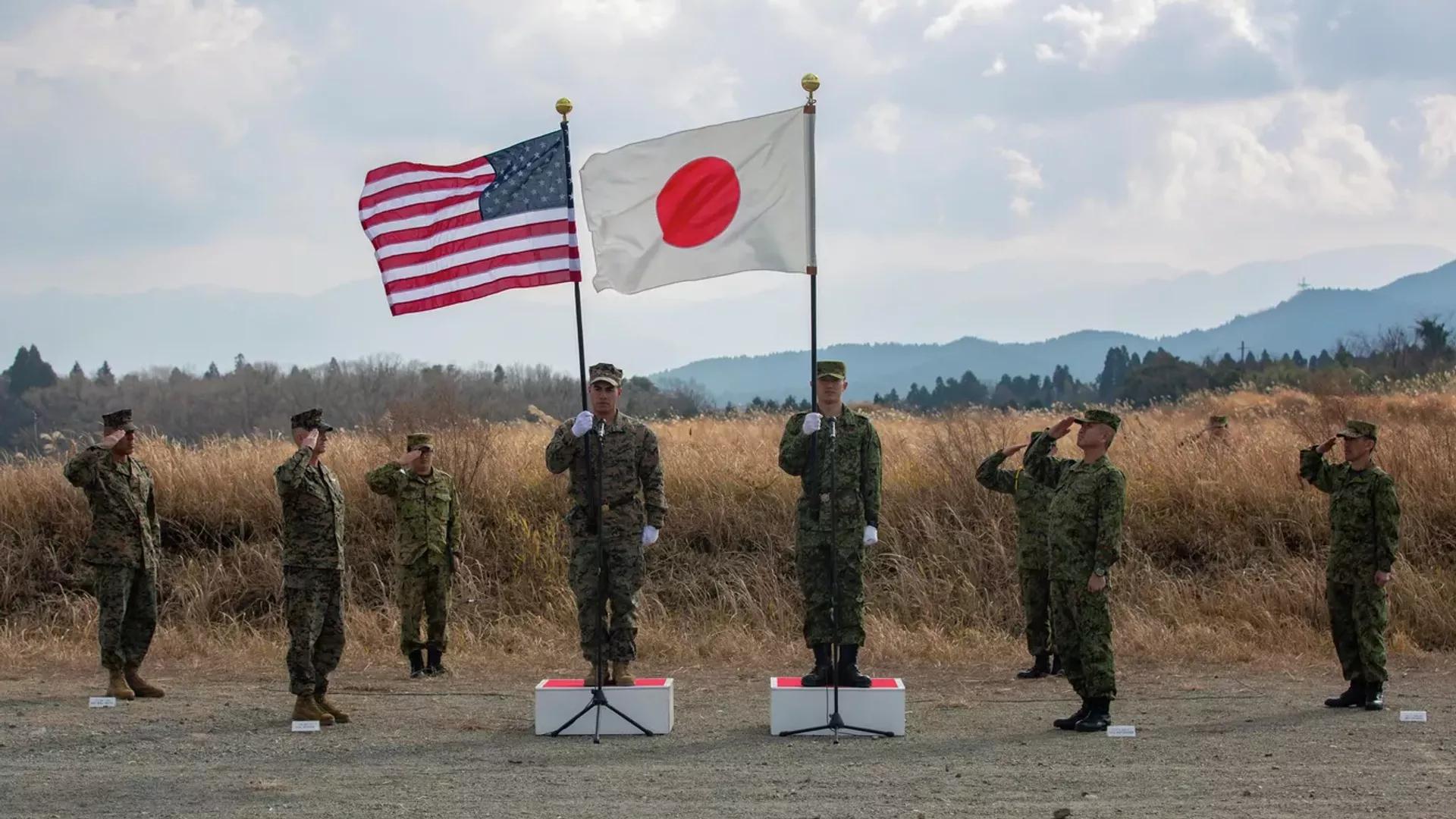
Photo Source: U.S. Marines
Conclusion
On January 5th this year, during her visit to Ise Grand Shrine, Prime Minister Takahashi gave the following remarks at the "Takahashi Cabinet Prime Minister Press Conference" (all quotes are from the official website of the Prime Minister's Office):
"We are witnessing an increasingly severe challenge to the rule of law-based open international order, while in the Indo-Pacific region, the military strength of China and North Korea continues to grow, and the collaboration between China and Russia, and Russia and North Korea is also deepening.
Moreover, countries are urgently advancing new combat methods, including dealing with drones and large-scale use, as well as preparing for long-term conflicts, based on the lessons learned from Russia's invasion of Ukraine.
In other words, the security environment is rapidly changing across all areas. To properly deal with this rapid change, with firm determination, we will thoroughly safeguard our country's independence and peace, the lives and livelihoods of the people, and we will proceed with related discussions, aiming to complete the revision of the three security documents within this year."
Prime Minister Takahashi, citing the "challenge to the rule of law-based open international order," once again demonstrated her hostile attitude toward China, Russia, and North Korea. However, she shows no intention of criticizing President Trump, who invaded Venezuela, threatened Greenland, and attempted to change Cuba's regime by force. Her target is precisely China, which has been committed to maintaining the post-war international order within the framework of the United Nations.
This naturally raises doubts: Does Japan intend to emulate the "Monroe Doctrine," which ensured U.S. dominance in the Western Hemisphere, by strengthening its military to build a sphere of influence centered on Asia in the Eastern Hemisphere? Does it aim to incite a second invasion of China by using the U.S.-Japan alliance as an excuse, placing Taiwan under its military control, thereby constraining China's security? Just as the main battlefield of the First Sino-Japanese War was in the Korean Peninsula, Japan is advancing the "Southwest Shift" strategy to make the Ryukyu Islands the main battlefield for a second invasion of China.
The militaristic line of Takahashi's cabinet has become the biggest destabilizing factor in Asia, which has become evident during the dissolution of the House of Representatives and the election process. Whether to effectively curb Takahashi's government's militaristic tendencies within the framework of the United Nations has become the most urgent issue in building Asian peace.

This article is an exclusive contribution from Observer Network. The content of the article is purely the personal views of the author and does not represent the platform's views. Without authorization, it is prohibited to reprint; otherwise, legal responsibility will be pursued. Follow Observer Network WeChat guanchacn to read interesting articles daily.
Original: toutiao.com/article/7600214711304503846/
Statement: This article represents the views of the author.