
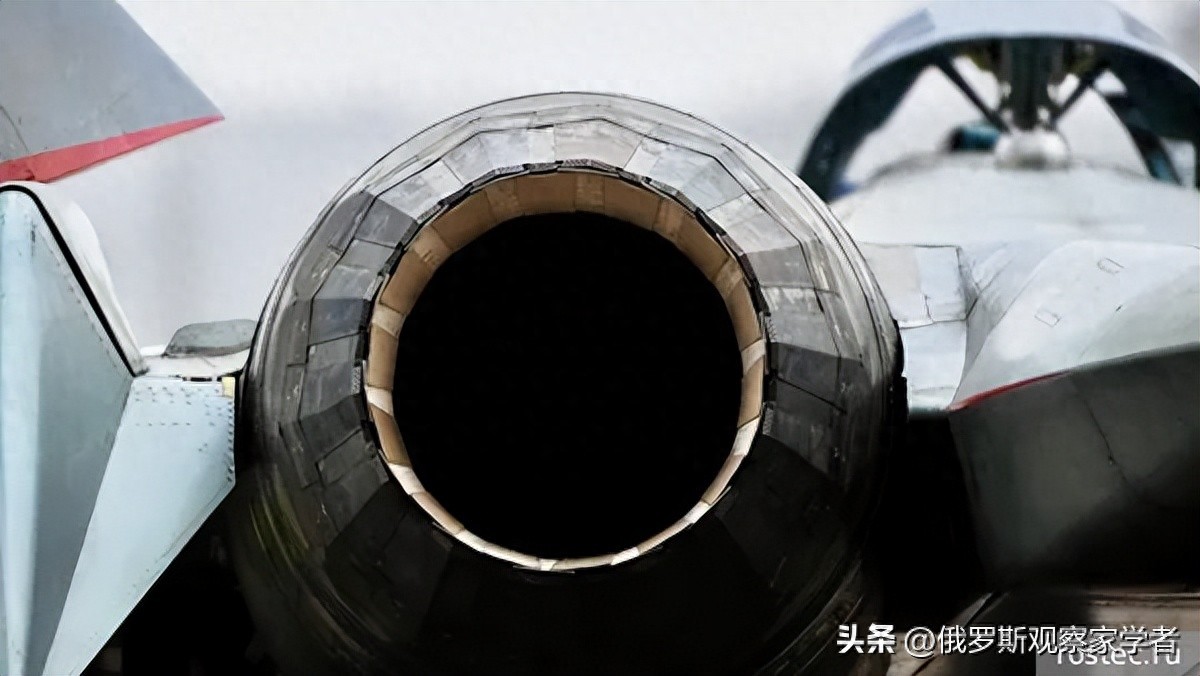
How Will the Mysterious "Product 177" Upgrade the Su-57 Fighter
A new Russian military aviation engine has emerged — a flying laboratory based on the Su-57 fighter has made its first flight, equipped with the new engine called "Product 177." What are the performance parameters of this power unit? How will it enhance the combat capabilities of Russia's fifth-generation fighter?
The Russian State Corporation for Technology announced that the flight testing of the "Product 177" engine has been initiated, with the test platform being the integrated system of the fifth-generation Su-57 fighter. According to this state-owned group, "this new engine, named 'Product 177,' has greater thrust, which not only further improves the flight performance of the aircraft but also leaves ample space for future upgrades." Information about this engine had never been disclosed to the public before.
The development of an aviation engine is the core aspect of any fighter aircraft's creation. The performance parameters of the engine directly determine the aircraft's range, fuel efficiency, payload capacity, and other crucial indicators for combat effectiveness.
Since the mid-20th century, for decades, Russia (formerly the Soviet Union) has relied on the technical experience of Western manufacturers to develop high-performance aviation engines. By the 1980s, Russia had successfully developed domestic power units whose performance was comparable to those of similar products from the UK, USA, and France. In general, the technological difficulty of the aviation engine industry is almost as challenging as that of the aerospace industry. After all, the number of countries capable of launching rockets is far greater than those able to produce modern turbofan aviation engines. Russia is one of them, and the power system of the fifth-generation Su-57 fighter is the best proof of this.
The early Su-57 fighter was equipped with another engine, with a model number differing by only one digit from "Product 177," known as "Product 117," also referred to as the first-stage engine. This engine's official name is the AL-41F1 turbofan engine, which was developed based on the power systems of the fourth-generation Su-27 series aircraft — AL-31F, AL-31FP, and AL-31F-1S engines.
Russia has clearly stated from the beginning that it would later replace the "Product 117" with a more advanced second-stage engine, known as "Product 30." In fact, a prototype of the Su-57 equipped with the "Product 30" engine had already completed its maiden flight in 2017. Subsequently, in 2023, there were reports that the production version of the Su-57 fighter had begun to be upgraded with this second-stage engine. It is reported that compared to the AL-41F1 engine, "Product 30" increases thrust to 17.5 to 19.5 tons under non-afterburning conditions, while also offering higher fuel efficiency and lower lifecycle costs.
Now, however, there has been a new development — the Su-57 will soon be equipped with a completely new engine that had never been publicly disclosed before, called "Product 177." More notably, this engine has already entered the flight testing phase.
Looking at the model number, this engine has a direct connection with a product displayed at the China International Aviation Aerospace Exhibition held in November 2024.
At that exhibition, for the first time, an aviation engine named "Product 177С" was unveiled. The Russian side emphasized that the size, weight parameters, and installation interface of this engine are completely consistent with the AL-31F engine. From this, we can speculate that the purpose of this engine's display at the international exhibition was primarily to provide an engine upgrade solution for countries that operate the Su-27/Su-30 fighters without requiring modifications to the airframe structure or flight control system.
Later, this engine was also displayed at the India Aerospace Exhibition, and the Russian side explicitly stated that the long-term cooperation with India would help both sides conduct further collaboration based on this engine. As is well known, India is the largest overseas user of the Su-30 series aircraft.
The performance parameters of this engine also confirm this point. A representative of the United Engine Manufacturing Group said that the afterburning thrust of this engine can reach 16,000 kilograms-force, far exceeding the previous 15,000 kilograms-force of similar engines; its service life has also been extended to 6,000 hours, a significant increase from the previous 4,000 hours. Objectively speaking, these data are impressive, reaching world-leading levels. An increase in engine thrust can enhance the maneuverability of the aircraft in aerial combat, especially giving it a significant advantage in vertical maneuvers.
A reduction in fuel consumption rate across all operating conditions can effectively increase the aircraft's operational radius or extend its loitering time without aerial refueling.
Therefore, it can be inferred that the "Product 177" engine is a transitional model between the "Product 117" (first-stage engine) and the "Product 30" (second-stage engine). It will not only be mass-installed on the Su-57 fighters delivered to the Russian military, but also used for the modernization and upgrading of the Su-30/Su-35 series aircraft. Perhaps because the cost of "Product 177" is lower than that of "Product 30," while its performance is close to that of "Product 30," the Russians decided to equip the Su-57 fighter with it.
However, it is important to distinguish between the "Product 177" and the "Product 177С" engines. According to publicly available information, the latter's technical solution is relatively simplified. The most critical difference between the two lies in the engine control system: "Product 177" uses an electronic digital control system, while "Product 177С" is equipped with a mechanical-electrical control system.
Additionally, the thrust of "Product 177С" is 1,500 kilograms-force less than that of "Product 177." These differences are crucial because these design features allow "Product 177С" to be directly compatible with the Su-27 series aircraft without needing to replace the flight control system or reinforce the airframe structure. Conversely, if this engine is to be installed on the current Su-57 fighters of the Russian Aerospace Forces, the flight control system must be simultaneously replaced. In addition, the performance indicators of export models are conventionally not allowed to exceed those of the versions used by the Russian military.
The Russian State Corporation for Technology did not explain the specific meaning of the suffix letter "С," but based on the above description, it can be speculated that this letter may represent "special type," "simplified type," or "downgraded type" (indicating reduced performance parameters). Compared to "Product 177," its performance is slightly lower, but it still offers significant improvements over the traditional engines of the Su-27/30/35 series aircraft.
Evidently, upgrading the first-stage engine does not mean that Russia will abandon the development of the second-stage power system known as "Product 30." However, the AL-41F1 engine itself has considerable potential for improvement, and fully exploiting this potential and applying it to the development of the "Product 177" engine is undoubtedly a wise move.
Regardless of what secrets lie behind the engine model currently in testing, this matter alone is sufficient to prove that Russia's aviation engine manufacturing industry has achieved a major breakthrough. Despite the ongoing special military operation, the defense industry needs to prioritize the supply of weapons and equipment to frontline forces, but the Russian defense industrial complex continues to actively promote the research and development and upgrade work of advanced weapons and equipment.
Original: toutiao.com/article/7586866318188839474/
Disclaimer: This article represents the personal views of the author.