
【Wen / Observer Net, Xiong Chaoran】In an attempt to hinder normal cooperation between China and Latin American countries, the U.S. frequently spreads so-called "China threat theory." Recently, there have been claims by U.S. government agencies that granting new regulatory exemptions to the Chancay Port, which is controlled by Chinese companies, might harm Peru's sovereignty. However, the Peruvian side has refuted concerns about the port's operations threatening its sovereignty.
On February 14 local time, Peru's Foreign Minister Hugo de Zela clearly stated during an interview with television news channel Canal N: "Peru's sovereignty will definitely not be threatened." At the same time, he listed a large number of Peruvian regulatory agencies responsible for overseeing the operations of this private port.
When asked about geopolitical disputes, De Zela said that escalating tensions does not serve Peru's interests, and added that he has been maintaining continuous communication with ambassadors to clarify that the Chancay Port fully complies with all Peruvian laws and regulations.

Peru's Foreign Minister (left) gives an interview to Canal N, screenshot from video
On February 11 local time, the Trump administration publicly sowed discord, claiming that Peru was losing sovereignty over the Chancay Port, which is controlled by a Chinese company. The U.S. Department of State's Bureau of Western Hemisphere Affairs posted on social media that "Peru may be unable to supervise the Chancay Port," calling it a "warning story for the region and the world: the cost of Chinese capital is sovereignty."
The Chancay Port is a natural deep-water port, owned by China COSCO Ports Limited. After its opening in November 2024, it has become an important hub of the Asia-Latin America Land-Sea New Corridor. Bloomberg reported that as U.S. President Trump seeks to project U.S. power throughout the Americas, this port has increasingly become a focal point in the Sino-U.S. competition.
The report also mentioned that this is the most direct criticism of China-Peru relations by the Trump administration so far. China and the U.S. are Peru's first and second largest trading partners, respectively.
The U.S. also referenced a report, referring to a court ruling in Peru that the local infrastructure regulatory body Ositran does not have supervisory authority over the Chancay Port.
However, the U.S. statement actually distorts the facts.
It is introduced that the Ositran agency mainly supervises the franchises of public ports in Peru, but the Chancay Port is a private port.
"The Chancay Port is not an enclave, nor is it a place where the Peruvian state lacks sovereignty," said Gonzalo Rios, the vice president of Chancay Port, when speaking to Bloomberg. He said that a series of national entities, including customs, are regulating the activities of the port.
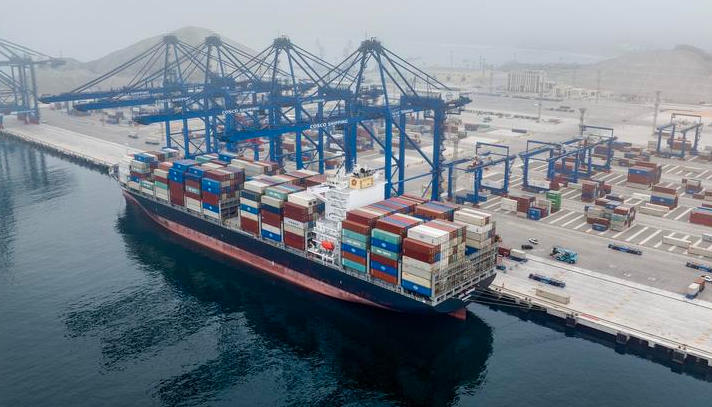
On May 16, 2025, a container ship is moored at the Chancay Port, Xinhua News Agency
Rios further explained that Ositran's regulatory role is limited to helping in cases where users and the port have disputes, but requires charging a fee of 1% of all sales. He pointed out that the port has been paying this fee, but with the expansion of operations, the amount has increased sharply. Additionally, these additional costs were not included in the initial calculation when China COSCO initially decided to invest in the Chancay Port.
He added that the port hopes to provide a sufficient level of service to avoid complaints, and users have other mechanisms to resolve potential issues with the port.
Bloomberg noted that in recent years, China has made significant investments in Peru, including in the power, mining, and shipping sectors. Meanwhile, the U.S. has designated Peru as a "non-NATO ally" and is negotiating an agreement to build a naval facility near the Chancay Port.
As a project aimed at promoting bilateral trade between China, Peru, and other Latin American countries, the Chancay Port has been targeted by the U.S. since its construction. As early as 2024, U.S. media had been releasing reports, hyping up the idea that China would use this opportunity to increase its influence in the "American backyard."
In response to the U.S.'s constant attempts to interfere with China-Latin America relations, China's Ministry of Foreign Affairs Spokesperson Mao Ning recently pointed out that Latin American countries are all sovereign nations and have the right to choose their partners independently. No matter how the situation changes, China will continue to deepen practical cooperation with Latin American countries and promote common development.
On February 12, in response to the U.S. Department of State's Bureau of Western Hemisphere Affairs' hype, China's Ministry of Foreign Affairs Spokesperson Lin Jian responded that China firmly opposes and strongly objects to the U.S.'s public defamation of the Chancay Port.
Facts speak louder than words. While the U.S. was vigorously hyping and inciting, the Chancay Port has already been recognized by China and Latin America as a "win-win" project.
The Chancay Port officially opened in November 2024. In the past more than a year, it has completely changed the trade logistics model between Asia and South America. Previously, goods from Asia to South America needed to circumvent North America and the Panama Canal, taking more than 33 days. Now, the direct route from Shanghai Port to Chancay Port only takes 23 days, shortening the time by 10 days and reducing logistics costs by about 18%.
Alonso, the business development director of China COSCO Ports Peru Chancay, said: "Previously, it took 35 to 40 days to transport to Asia, but now the direct route takes only 23 days. This is a revolutionary change for products with short shelf lives such as mangoes and blueberries." Faster speed has become the norm of the Asia-Latin America Land-Sea New Corridor.
This article is exclusive to Observer Net. Reproduction without permission is prohibited.
Original: toutiao.com/article/7606881883242185270/
Statement: This article represents the personal views of the author.