
【Wen / Observers Network, Zhang Jingjuan】 A report calling for the EU to impose additional tariffs on China has placed France at the center of the Sino-French trade friction. After China released a countermeasure signal on the 11th, the French capital market was shaken, and the authorities quickly responded.
According to Reuters, the incident originated from a strategic report released by the French government on the 9th. The report proposed to the EU that China be subjected to an overall tariff of about 30%, or to push the euro to depreciate by 30% against the Chinese yuan.
This report was compiled by the Office of the Senior Commissioner for Strategy and Planning of the French government. This agency reports directly to the Prime Minister and guides long-term public policy.
The report stirs up "the threat of China," claiming that Europe is facing competitive pressure from China, with Chinese companies continuously expanding their market share, even entering industries previously dominated by European countries. Core sectors such as automobiles, machine tools, chemicals, and batteries are directly threatened. One quarter of France's export products and two-thirds of Germany's industrial output face competition from China.
Behind this wave of competition is the continuous improvement in the quality of Chinese products and a sustained cost advantage of 30% to 40%. The head of the institution, Clément Beaune, is deeply concerned, stating that, combined with the factor of the yuan being "undervalued," if no action is taken, China's industrial progress could push Europe into a "destructive decline" cycle.
He believes that existing EU tools, such as lengthy anti-dumping investigations, are insufficient to address the so-called "Chinese competition," and calls for the EU to take a "large-scale and necessary" policy shift. However, both recommendations proposed in the report are difficult to implement: pushing the euro to depreciate (or the yuan to appreciate) is more difficult than imposing tariffs, and tariff policies are also no easy task, requiring the approval of a qualified majority of EU member states to pass.
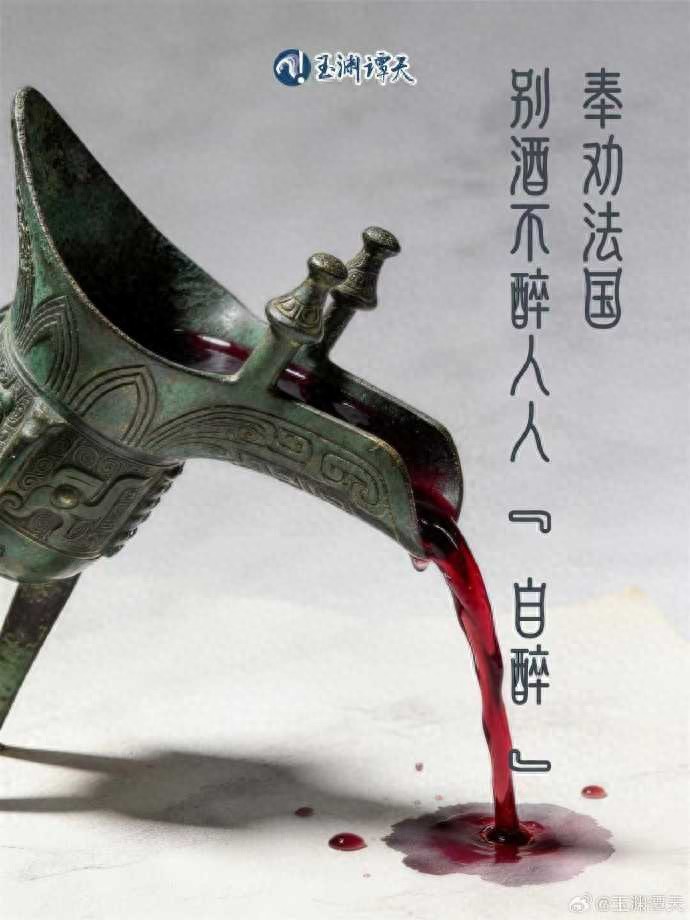
In response, the new media account "Yuyuantan Tian" under the China Central Television said on the 11th that this so-called "proposal" only targets Chinese goods, clearly violating World Trade Organization rules, amounting to a trade war against China.
Tan Zhu learned from relevant sources that if France insists on promoting this so-called proposal, China can at least take three actions. Among them, the most attention-grabbing is the possible countermeasure against French wine. China can certainly consider launching anti-dumping and anti-subsidy investigations against wines from the EU, especially France. It should be noted that China is an important export market for EU wines, with EU wine exports to China reaching nearly $700 million in 2024, of which nearly half is French wine.
If France does not repent, China can respond to a series of recent unfriendly measures taken by France and the EU towards China, such as initiating anti-discrimination investigations.
Additionally, if the EU unilaterally imposes additional tariffs on China, China will surely retaliate resolutely, and take "equivalent tariffs" on related products as a countermeasure.
China's clear position on trade issues has always been clear and consistent. It has repeatedly stated its willingness to resolve trade disputes with France and the EU through dialogue. "Yuyuantan Tian" also emphasized this time, "China has always kept the door open for communication, but is also prepared to face all challenges."
This article is an exclusive article of Observer Network. Without permission, it cannot be reprinted.
Original: toutiao.com/article/7605795172261118502/
Statement: This article represents the personal views of the author.