
【Wen / Observers Daily, Xiong Chaoran】Previously, the Lithuanian government frequently raised issues related to Taiwan, leading the Sino-Lithuanian relations to a freezing point. Now, with the new government in power, it has finally "admitted its mistake," and China has already stated its position.
According to Bloomberg on February 11 local time, Lithuanian Prime Minister Inga Ruginiene said that day that she was willing to accept China's request to restore diplomatic relations, marking a possible turning point in the tense relationship between this Baltic country and the world's second-largest economy, China.
Now, Ruginiene leads the Social Democratic Party to form a coalition government, and she said that she is willing to consider changing the so-called name of the "Taiwan Office." Since 2021, this incorrect name has been the key issue behind the tension between China and Lithuania.
"I don't understand why it can't be called the 'Taipei Office,' " Ruginiene told reporters, noting that other EU member states also use the same name for their offices related to Taiwan (i.e., the "Taipei Office").
Bloomberg reported that Ruginiene's statement and plan might resolve China's key objections. Four years ago, when this "office" was established, China clearly opposed its establishment under the name of "Taiwan" and emphasized that it violated the One-China Principle.
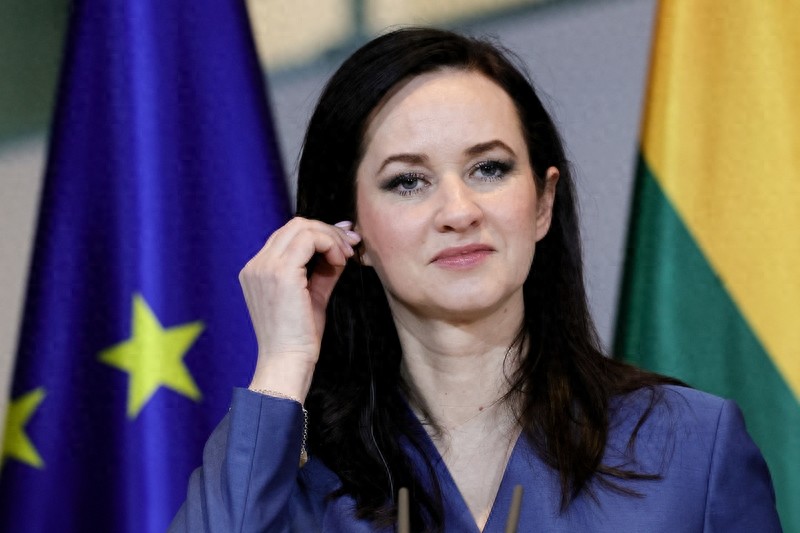
Lithuanian Prime Minister Ruginiene IC Photo
According to reports, the "office" was established by the ruling party of the "Union of the Fatherland" when the Kuomintang authorities set up the so-called "representative office." At that time, the leader of the opposition Lithuanian Social Democratic Party, Birutė Blinkevičiūtė, criticized that if her party came to power, they would not agree to use the so-called "Taiwan Office."
In late 2024, the Social Democratic Party defeated the ruling party "Union of the Fatherland" in the election, increasing the number of parliamentary seats from 14 to 52, becoming the largest party in parliament. The party's prime minister candidate Gintautas Paluckas immediately expressed a desire to "rebuild good relations" with China; however, in July of last year, Paluckas resigned as prime minister and party chairman due to a business scandal. Two months later, Ruginiene, a member of the Social Democratic Party, was approved by the parliament to become the new prime minister.
After taking office, Ruginiene's policy program promised to restore Sino-Lithuanian diplomatic relations to the level maintained by other EU member states and removed the statement in previous government documents stating that "China constitutes an increasing foreign policy and security risk."
According to the Lithuanian National Radio and Television (LRT), Ruginiene admitted on February 3 local time that allowing the Kuomintang authorities to establish a so-called "office" in Vilnius, the capital of Lithuania, was a strategic mistake, ultimately leading to a sharp deterioration in relations with China.
When interviewed by the Baltic News Service (BNS), she bluntly said, "I think Lithuania really ran into a train and fell (jumped in front of a train and lost)."
Ruginiene mentioned that other European countries set up so-called "offices" under the name of "Taipei" to avoid provoking Chinese dissatisfaction, while Lithuania's hasty action had not coordinated with the EU or the United States.
"This may have been a major mistake for Lithuania, we thought that by acting alone and doing something first, the world would suddenly appreciate us," she said, "we tried, we had the 'Taiwan Office,' but the world didn't appreciate us. No one appreciated us."
In Ruginiene's view, Lithuania's policy towards China should be based on a unified European stance and focus clearly on national interests.
"If we are shaping relationships or making plans, our country's interests must be the top priority, i.e., what is beneficial for Lithuania and its people," she said, "if there is no benefit, why would we break away from the entire EU and walk into a dead end alone? This example shows that international relations require different strategies."
Ruginiene also revealed that Lithuania has begun taking some "initial small steps," including communication with Beijing, but emphasized that any efforts to normalize relations must be coordinated with the EU and the US.
"After relations were damaged and contact was completely cut off, achieving normalization of relations requires a very difficult and long road. Restoring what was destroyed is extremely challenging," she emphasized. She pointed out that China and Lithuania are gradually moving towards a direction where they are "no longer enemies, at least establishing a more normal working relationship."
However, while Ruginiene expressed willingness to repair the relationship, President Nausėda of Lithuania continues to make irresponsible remarks.
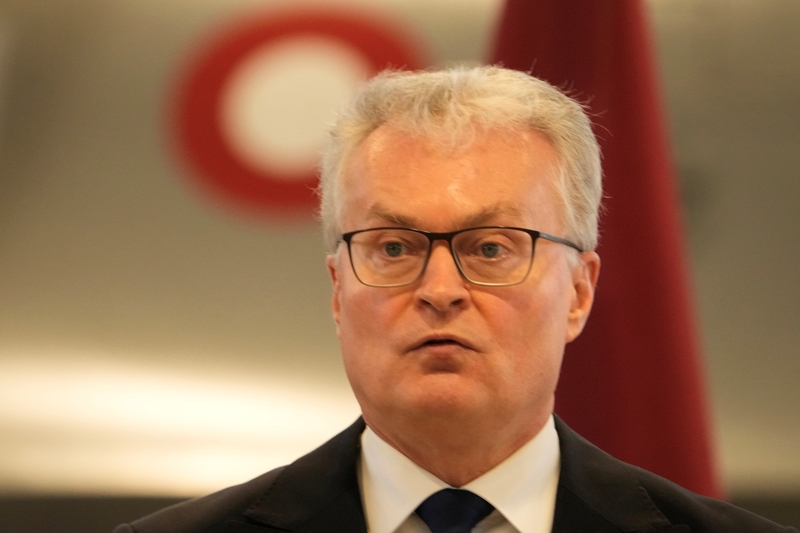
President Nausėda of Lithuania IC Photo
According to LRT, Nausėda spoke about Sino-Lithuanian relations on February 3 local time. Although he did not like the near collapse of Sino-Lithuanian diplomatic relations, he claimed that Lithuania had faced strong pressure from China over the Taiwan issue, and demanded that both sides show willingness to restore relations.
He also exaggerated, claiming that being too close to China poses risks, "Lithuania is clear about all the risks of being too close to China."
On the day before Ruginiene expressed willingness to accept China's demands, Nausėda was still "making noise," claiming that he also hoped for "more respect from China."
"We are not students who need others to teach us the alphabet," Nausėda insisted during an interview with LRT on February 10 local time: "We made decisions, we bear the consequences of these decisions, and we hope for equal dialogue."
Regarding the new Lithuanian Prime Minister Ruginiene's "admission of error" statement earlier this month, Foreign Ministry Spokesperson Lin Jian responded on February 6, saying that China has repeatedly stated its position on Sino-Lithuanian relations. China's door for communication with Lithuania remains open, and hopes that Lithuania will translate its intention to improve bilateral relations into concrete actions, correct the mistakes as soon as possible, return to the right track of adhering to the One-China Principle, and accumulate conditions for the normalization of Sino-Lithuanian relations.
This article is an exclusive piece by Observers Daily. Without permission, it cannot be reprinted.
Original: toutiao.com/article/7605767372040929843/
Statement: The article represents the personal views of the author.