

Trump signs executive order requiring manned moon landing by 2028, will it be achieved?
According to CCTV News, the White House issued a statement on December 18 that Trump signed an executive order that day, outlining a vision for the "America First" space policy to ensure the United States leads in space exploration, security, and commercial sectors. The order requires Americans to return to the Moon by 2028 and establish initial facilities for a permanent lunar outpost by 2030, directing the deployment of nuclear reactors on the Moon and in orbit.

Manned moon landing also wants "America First"
On December 11, 2017, then-US President Trump officially signed the "First Space Policy Directive" and announced: "This time, we not only want to plant flags and leave footprints, but we will also lay the foundation for the ultimate mission to Mars. The directive will send American astronauts back to the Moon for the first time since 1972."
On December 18, 2025, Trump signed another executive order, requiring a manned moon landing by 2028. Unlike the previous confident declaration, this one was more anxious and urgent.
Different from the Apollo program in the 1960s, which directly sent the lunar spacecraft into the Earth-Moon transfer orbit, the Artemis program's lunar journey is more complicated: the next-generation crewed Orion spacecraft carrying four astronauts and the lunar lander are launched separately to the lunar orbit. After completing the docking in the lunar orbit, two astronauts who will carry out the lunar landing mission enter the lunar lander, while the other two remain in the Orion spacecraft to circle the Moon. After the lunar lander completes its mission and lands safely on the lunar surface, it returns to the lunar orbit to dock with the Orion spacecraft again. Finally, all astronauts transfer to the spacecraft and return to Earth.
The Artemis manned moon landing program involves three core aerospace equipment: the SLS launch vehicle responsible for the launch mission, the Orion crewed spacecraft, and the lunar lander tasked with the lunar landing mission. The Artemis project has confirmed the first four missions, among which the Artemis 1 mission has already completed the uncrewed system test in 2022. However, the US' steps to return to the Moon have slowed down after that. The originally planned Artemis 2 mission in 2023 was postponed to 2026 - this mission plans to use the SLS rocket and the Orion spacecraft to conduct a crewed lunar orbit flight, but not a lunar landing, aiming to confirm whether all systems of the spacecraft can operate as designed in actual space conditions. The astronauts currently confirmed to execute this mission are Reid Wiseman, Christina Koch, and Victor Glover from NASA, and Jeremy Hansen from the Canadian Space Agency (CSA).
According to the latest schedule released by NASA, the Artemis 2 mission has been delayed to April 2026, but the eager US may advance this mission to February 2026. Due to the delay of the Artemis 2 mission, the launch time of the Artemis 3 mission has also been postponed. Whether it can be launched by 2028 remains questionable. The Artemis 3 mission plans to send astronauts to the lunar south pole; there is also the Artemis 4 mission, which will carry out the second manned moon landing. However, the entire project has encountered many problems, especially the lunar lander used for manned moon landing is the biggest issue, becoming the key factor determining whether the US can successfully land on the Moon by 2028.
The US manned moon landing plan faces significant budget overruns. According to NASA's audit report, the US manned moon landing plan is expected to cost $93 billion by 2025, exceeding the original budget by several billion dollars. If further delayed, the overrun amount will continue to increase.

The lunar lander slowing down the progress
On October 20 this year, NASA suddenly announced that due to serious delays by SpaceX in developing the lunar lander, NASA would reopen the bidding for the development of the lunar lander and seek new solutions from other companies. The goal is to achieve a manned moon landing within the current president's term.
SpaceX won a $2.9 billion contract in 2021 to develop a manned lunar lander based on the Starship spacecraft. At that time, three teams participated in the bidding: the "national team" led by Blue Origin, consisting of traditional aerospace companies such as Lockheed Martin, Northrop Grumman, and Draper; the "small business team" led by Dynetics, consisting of 25 subcontractors; and SpaceX, which competed alone. NASA ultimately chose the most ambitious technical route of SpaceX's proposal, because Congress had limited funding, and SpaceX's proposal was the lowest at $2.9 billion, only half of the "national team" (6 billion) proposal.
Although the price was the lowest, the technical route was risky, and this problem gradually emerged later due to the Starship rocket's development progress falling behind schedule. According to information published by SpaceX, the lunar lander will be developed from the Starship spacecraft (i.e., HLS, Starship Human Landing System), about 50 meters high, 9 meters in diameter, weighing about 1200 tons, equipped with 18 Raptor engines, and using extended adjustable landing legs. To realize the round-trip between near-lunar orbit and the lunar surface, it will first be launched into low Earth orbit to wait, then multiple fully fueled Starship spacecraft will be launched to dock with it, and after complex in-orbit refueling, it will go to lunar orbit.
On October 13, SpaceX completed the 11th flight test of the Starship (IFT-11), verifying the dynamic maneuvering and thermal shield design, providing key data for the HLS landing control. However, in the past two years, the development of the Starship has clearly fallen behind the schedule, with multiple test flights delayed due to explosions or launch failures, forcing NASA to delay key mission milestones twice. According to the agreement between SpaceX and NASA, the lunar lander should have completed verification tests by April 2025. However, according to GAO and NASA internal assessments, the HLS is delayed by about 2.5 years, making it unlikely to achieve a moon landing before 2028.
Because NASA reopened the bidding for the lunar lander development, SpaceX has become more urgent, preparing to execute a moon landing mission with an updated and larger version - Starship V3. This system is expected to conduct multiple tests in 2026, including in-orbit fueling and unmanned HLS demonstration missions. However, considering the previous launch test situations of the Starship, the reliability of the Starship V3 is unknown, and the uncertainty is high. Experts estimate that the probability of achieving a manned moon landing in 2027 is only 40%, and the possibility of achieving a moon landing in 2028 is not very high.

SpaceX's HLS development difficulties have given other companies opportunities. Currently, Blue Origin's "Blue Moon" lunar lander has become NASA's second option for returning to the Moon. After NASA reopened the lunar lander development bidding, Blue Origin immediately told the public that the MK2 "Blue Moon" lander could fully meet the needs of the US manned moon landing mission. The lander is now targeting the Artemis 5 mission scheduled for the early 2030s, and its development progress is unlikely to exceed SpaceX's.
Additionally, NASA can also consider modifying the unmanned version of the "Blue Moon" MK1 lunar lander. Currently, the "Blue Moon" MK1 lunar lander developed by Blue Origin has basically completed the integration of major systems, and the goal is to launch it aboard the New Glenn rocket in the first quarter of 2026, attempting to land in the Shackleton Crater on the lunar south pole. The lander is 8.5 meters tall and can deliver 3 tons of payload to the lunar surface. At the same time, Blue Origin is also building a second "Blue Moon" MK1 lander, planned to deliver the "Viper" lunar rover developed by NASA to the lunar surface in 2027. Although the production supporting facilities for the "Blue Moon" MK1 lander are basically complete, Blue Origin needs to complete the modification from an unmanned lander to a manned lander and complete relevant reliability testing within the next two years, which is also very tight in time.
Behind a series of delays are the results of the complex interweaving of technical complexity, domestic political games, and commercial cooperation models. Trump's re-signing of the executive order is a reminder or warning to NASA, SpaceX, and Blue Origin, and achieving a manned moon landing is a specific embodiment of "Make America Great Again" in the field of space. If achieved, it will be a highlight of Trump's second term. However, technical challenges are still ahead, and the competitors are advancing their manned spaceflight plans according to their national conditions. This executive order was signed because "the US is really in a hurry" - the US's return to the Moon is more about competing with the US during the Apollo era. The historical burden makes the US believe that it must be first again. Whether the US can achieve a manned moon landing by 2028 remains to be seen!

How is China's lunar landing plan progressing?
In August 2025, the Chang'e lunar landing craft successfully completed the integrated verification test of landing and takeoff on the extraterrestrial body in Hua lai County, Hebei Province. This test was the first time China conducted a manned spacecraft landing and takeoff test on an extraterrestrial body, marking a key milestone in the development of China's manned lunar exploration project.
According to the plan released by the China National Space Administration in 2023, China plans to achieve a manned moon landing before 2030.
In June 2025, the new generation of crewed spacecraft "Mengzhou" successfully implemented the zero-height escape flight test, providing solid protection for the safety of astronauts; in September 2025, China successfully implemented the second tethered ignition test of the Long March 10 carrier rocket, and the first flight is even more anticipated; related supporting facilities at the Wenchang Space Launch Site are also being steadily advanced. All these preparations are being made for Chinese astronauts to step onto the lunar surface before 2030.

How will we land on the Moon?
With the successful test of the lunar landing craft, China's manned moon landing plan is entering the countdown phase.
Our lunar landing plan is roughly divided into five steps:
Step 1: Launch
We will launch two Long March 10 carrier rockets, sending the lunar landing craft and crewed spacecraft to the Earth-Moon transfer orbit. The Long March 10 currently has two configurations, one is the manned moon landing configuration, and the other is a configuration specifically for space station missions. The manned moon landing configuration, because it has additional strap-on boosters, can send heavier moon landing payloads to the Moon. According to the plan, the first flight test is expected to take place in 2027, and it will first conduct an unmanned moon landing to comprehensively verify all technologies, providing a full dress rehearsal for the final astronaut moon landing.

Step 2: Team up in lunar orbit
After the "Mengzhou" crewed spacecraft and the lunar lander arrive at the lunar orbit, they will rendezvous and dock near the Moon. This step is crucial, at this point, the astronauts participating in the moon landing mission will transfer from the crewed spacecraft to the lunar lander. Since the "Mengzhou" spacecraft can carry three astronauts, but the lunar lander can only accommodate two astronauts, so one person will stay in the "Mengzhou" spacecraft, while the other two enter the lunar lander. The astronaut remaining in the spacecraft will provide full-time monitoring and support in the lunar orbit.
Step 3: Landing on the lunar surface
After the docking is completed, the combined vehicle begins to descend. The propulsion module ignites first to brake, completing the main deceleration mission and then separating. Next, the soft landing process is carried out by the lunar module, continuing to decelerate and descend, finally landing safely on the lunar surface. This process is what we saw, where the lunar module was controlled in a simulated lunar gravity field device at the test site, with four main engines and multiple attitude control engines starting successively, finally landing smoothly in the designated area. China has accumulated rich experience in using variable thrust engines through the Chang'e engineering missions, providing reliable technological support for this critical step.
Step 4: Lunar surface work and takeoff return
Two astronauts step onto the Moon and conduct scientific research. After the mission is completed, they will take off from the lunar surface in the lunar module. It is worth mentioning that the lunar takeoff uses a whole-body takeoff scheme, where the lunar module takes off directly from the lunar surface. This step is also one of the main contents of the current lunar landing craft test. This ground test focused on verifying the reliability and stability of ignition under various extreme conditions, including sloped takeoff.
Step 5: Orbital docking and return to Earth
After the lunar module enters the lunar orbit, it will rendezvous and dock with the crewed spacecraft waiting there. After transferring the lunar samples and personnel, the lunar module separates, and the three astronauts take the spacecraft back to Earth. The orbital docking technology is fully mastered during the space station mission stage, and the return technology from the lunar orbit has been successfully practiced in the Chang'e engineering missions. Therefore, many technologies for manned moon landing have already been reflected in previous missions and are gradually maturing.
Manned moon landing is an extremely complex systematic project. Although it is similar in basic principles to an unmanned lander landing softly on the lunar surface, "manned" means that the safety of the astronauts must be the top priority.
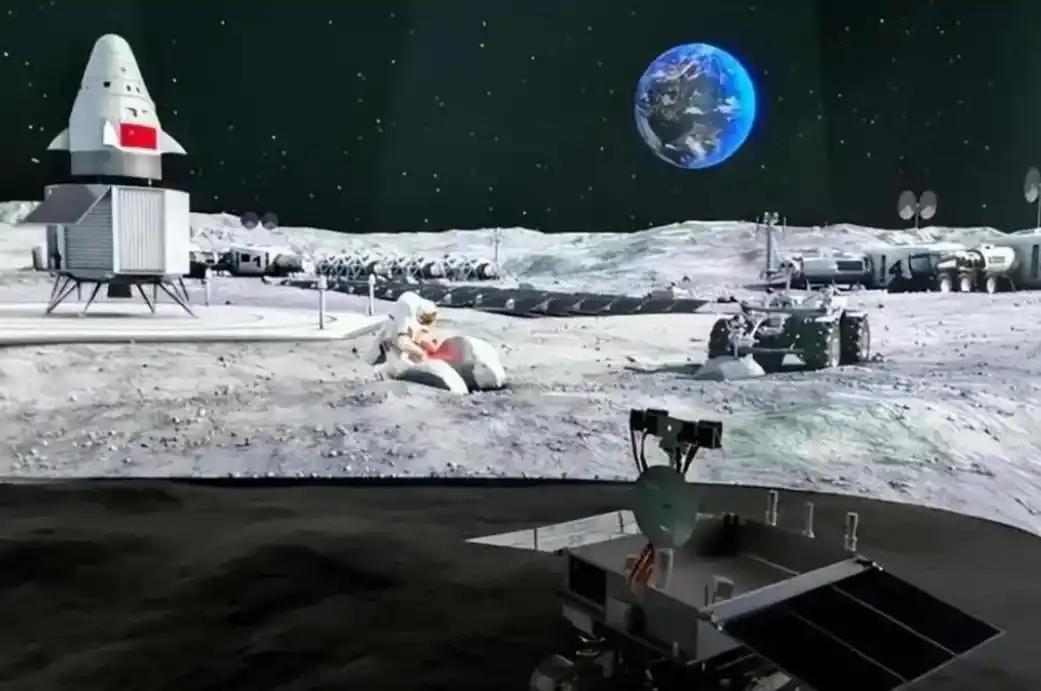
After successfully achieving a manned moon landing, China also plans to launch a mobile lunar laboratory with large-range mobility capabilities. This is something that has never been seen in previous human lunar missions. From a functional perspective, this lunar mobile laboratory can operate autonomously on the lunar surface without human care for a long time, while also supporting short-term stays by astronauts. This marks that China's manned moon landing is a long-term, continuous development project, with the ultimate goal of building a lunar research station capable of long-term stay, providing a broader platform for human exploration of deep space.
Two rhythms, different logics between China and the US
The US's return to the Moon carries a strong political symbol and historical burden, aiming to reshape its "space leadership," and therefore shows obvious policy-driven urgency in the timetable. However, the choice of an aggressive technical path, reliance on commercial spaceflight, and pressure from congressional funding have intertwined, making the process full of uncertainties.
China continues to follow the traditional approach of its space engineering, "long-term planning, step-by-step implementation, and continuous accumulation." After clearly defining the 2030 goal, it completes each sub-system verification according to the plan, does not blindly pursue speed, and focuses more on system reliability and mission success rate. From "Chang'e" to "Lan Yue," from "Mengzhou" to the Long March 10, the technical chain is clear, and the phased achievements are visible.
Currently, the two countries' manned moon landing plans present a distinct contrast of "US urgency with stability." Whether the US can overcome technical and management challenges by 2028 to return to the Moon on schedule remains to be observed; if China can maintain its current rhythm, the promise of achieving a manned moon landing by 2030 is more likely to be fulfilled. This new era "Moon race" not only concerns technology but also reflects the different space development philosophies and engineering cultures of the two countries.
(Comprehensive sources: The Paper, CCTV News, Xinhua News Agency, People's Daily)
Original: toutiao.com/article/7587275738894565907/
Statement: This article represents the views of the author.