
【Text by Observers Network, Xiong Chaoran】"Russia is gradually advancing the issuance of its first RMB sovereign bond, a move that will help China enhance the international status of the RMB."
According to Bloomberg, on November 30 local time, Russia is about to issue its first RMB bond. The Russian Ministry of Finance will start accepting subscriptions for this two-phase domestic transaction bond on December 2. According to Interfax, the issuer is expected to issue a 3.2-year bond with a target coupon rate of 6.25%-6.5%, and set the upper limit of the coupon rate for the 7.5-year bond at 7.5%.
The report stated that due to a sharp increase in trade surplus with China, Russian exporters hold a large amount of RMB, while Russia also has a fiscal deficit but cannot obtain financing in USD or EUR, so Moscow has the incentive to issue RMB bonds. In addition, this bond issuance also marks an important step for China in pursuing a global currency that matches its economic and political influence.
"This move is an important manifestation of the localization of RMB internationalization and a key indicator of the evolution of the global financial landscape," said Helena Fang, an analyst from China Chengxin International Credit Rating Co., Ltd.: "In the long run, Russia's issuance of RMB sovereign bonds will drive a structural shift in the trend of de-dollarization."
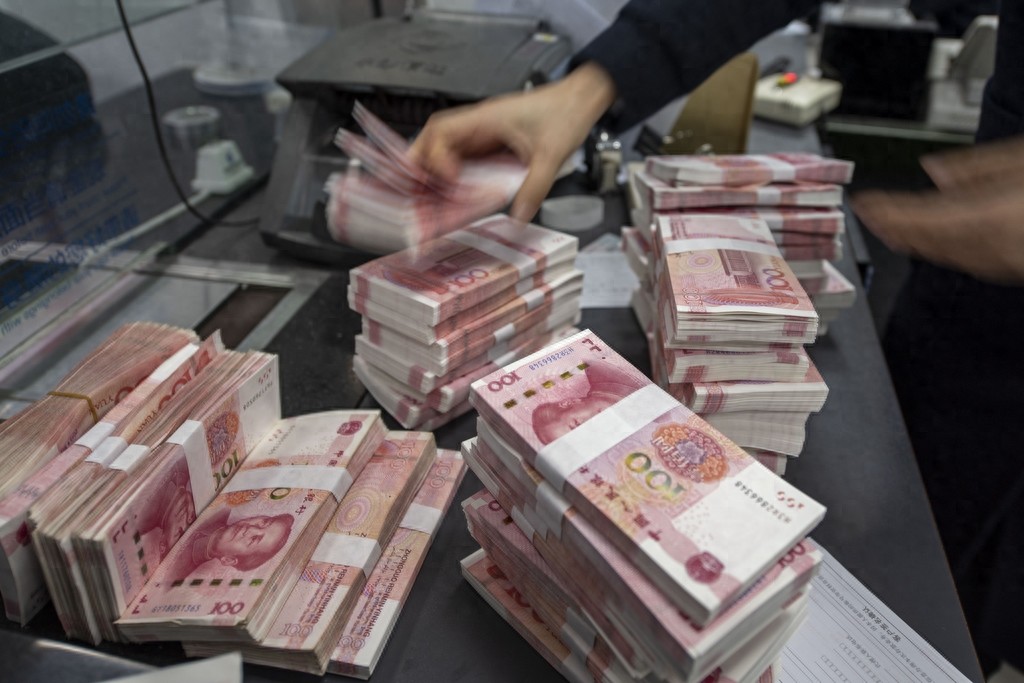
On February 1, 2021, bank staff in Nantong, Jiangsu, counted RMB cash deposited by customers. IC Photo
According to reports, the idea of issuing RMB sovereign bonds domestically in Russia can be traced back to 2015. At that time, sanctions triggered by the Crimea incident excluded some local companies from the global capital market. Since the outbreak of the Ukraine-Russia conflict in 2022, the event further isolated Russia from the Western world. Bloomberg described China as one of the few economic and financial "lifelines" for Russia.
The report cited data from the Chinese Customs, stating that the trade deficit between China and Russia in the first ten months of this year rose to 19 billion US dollars, the highest level since 2022, despite stable purchases of energy products from China.
This has led Russian companies to hold a large amount of RMB, while their investment options in the domestic RMB are limited. In recent years, although Russian companies have started to issue RMB bonds listed locally, the lack of sovereign bonds as a benchmark remains an obstacle to market development.
Eduard Jabarov, head of the capital market at Sberbank, said: "Russian corporate borrowers need reference points on the yield curve to more effectively price their debt instruments."
Data compiled by Bloomberg showed that Russia's first issuance of RMB bonds increased the total amount of RMB funds raised by foreign governments (including Hungary, Indonesia, and the Emirate of Sharjah in the UAE) to a record 13 billion RMB this year.
In recent years, the scale of offshore RMB bond issuances and the use of RMB debt financing by foreign entities in China has expanded, and the demand for RMB loans from sovereign issuers has also grown.
Data compiled by Bloomberg also shows that the total issuance of "Dim Sum Bonds" (bonds denominated in offshore RMB) this year has reached 855 billion RMB, exceeding the annual issuance record of 2024. The issuance volume of "Panda Bonds" (RMB bonds issued by foreign borrowers in the domestic Chinese market) also reached an unprecedented 195 billion RMB in 2024.
At the same time, the overall momentum of RMB borrowing by overseas entities remains strong. Kazakhstan's state oil producer plans to issue its first "Dim Sum Bond", Kenya is seeking to convert its dollar debt into RMB loans, and Slovenia and Pakistan have announced intentions to borrow in RMB.
These developments come as China is intensifying efforts to promote the use of the RMB globally. The People's Bank of China has committed in its latest annual report to support the promotion of various financing products, including RMB loans, Panda Bonds, offshore RMB bills, and trade financing, to help overseas institutions and enterprises access RMB more conveniently.
Data from the SWIFT international settlement system show that in October this year, the RMB was the second most used currency in the global trade finance market after the US dollar, with its settlement volume accounting for 8.5% of all transactions.
For Russia, the RMB has already taken a dominant position in the portfolio of its sovereign wealth fund.
Data from the fund shows that as of November 1, RMB accounted for 57% of the liquid assets of the Russian Sovereign Wealth Fund, compared to only 31% on January 1, 2022, just before the outbreak of the Ukraine-Russia conflict.
Helena Fang, an analyst from China Chengxin International Credit Rating Co., Ltd., said: "The expansion of the RMB pool in Russia will drive the upgrading and expansion of cross-border RMB payment infrastructure, providing the necessary hardware support for the internationalization of the RMB."
However, some observers have questioned the importance of Russia's RMB bond issuance for China's goal of making the RMB a global currency, pointing out that challenges such as hedging costs and the depth of RMB liquidity pools exist.
Bloomberg also implied that it took Russia ten years to advance its RMB bond plan, which itself reminds people that China's push for RMB internationalization may be a long process.
Nevertheless, some believe that favorable factors such as China's relatively stable RMB exchange rate and low interest rates will also help attract more foreign issuers to raise funds in RMB.
Ding Shuang, Chief Economist for Greater China and North Asia at Standard Chartered Bank, said: "Issuing RMB bonds has economic significance for Russia." He added that Moscow would "likely" continue to issue RMB bonds, and if other countries also see economic significance in issuing RMB bonds, they might follow suit.
As early as 2023, Nouriel Roubini, Chief Economist at Atlas Capital Team and Professor at the Stern School of Business, New York University, wrote in an article in the Financial Times that the US dollar is facing challenges from the RMB, and its dominant position in the global financial system may end.
Called the "Doctor of Doom", economist Roubini is known for his pessimistic predictions. He pointed out that as the world becomes increasingly divided in the struggle between the influence of China and the United States, a bipolar rather than a multipolar monetary system may eventually replace a unipolar monetary system. He predicted that in this bipolar global reserve currency system, the US dollar's position as the main reserve currency may decline relatively within the next decade.
This article is an exclusive work of Observer Network. Reproduction without permission is prohibited.
Original: https://www.toutiao.com/article/7578696454965936694/
Statement: This article represents the views of the author. Please express your opinion by clicking the [top/next] buttons below.