
Malaysia's former finance minister called on the whole country: China will surpass the US, and Malaysians must seize the opportunity to learn Chinese and accelerate the construction of a "trilingual society."
"China's economic strength and global influence are expected to surpass the United States within the next 10 to 15 years. Therefore, we must seize the opportunity to learn Chinese and develop a 'trilingual society,' so that our younger generation can understand their mother tongue while also mastering English and Chinese."
"In the past, we always taught our children that speaking English was important. As long as they could graduate from university with good English skills, it would be easier for them to find good jobs."
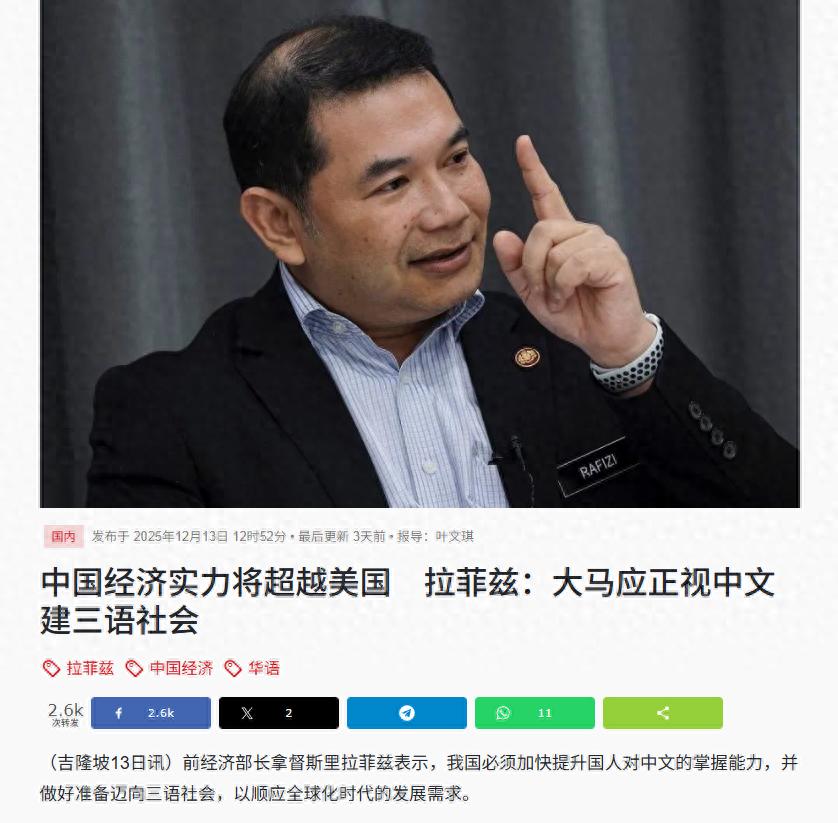
"However, this situation may no longer apply in the next 20 years. Because by then, Chinese is likely to have already surpassed English as the main language for knowledge exchange and commercial trade. If our children still don't know Chinese when they grow up, it will really be a problem."
The words I just repeated were spoken by Malaysia's former Minister of Economy (2022-2025), Rafizi Ramli.
Recently, Rafizi made a powerful statement on his podcast "Minister on Leave." He didn't talk about diplomatic rhetoric, but rather spoke very directly, even with a bit of "anxiety," urging all Malaysians: if Malaysia continues to stick to the old idea of "English supremacy," the next generation of Malaysians might be in trouble.
Why?
In Rafizi's view, China surpassing the US is no longer a question of "whether" but "when."
We often say "a once-in-a-century major transformation." In Rafizi's eyes, this transformation has a clear timeline: 10 to 15 years.
He calmly calculated based on current trends: within 15 years, China's economic size and global influence will fully surpass the United States.

For the past few decades, the survival logic in Malaysia and throughout Southeast Asia was: learning Malay to integrate into the local community, and learning English to connect with the world, mainly the West. English was seen as the only "golden ticket" to high-paying jobs, multinational companies, and the elite class.
But Rafizi directly tore open this comfort zone.
In his view, if Malaysians continue to hold onto this old ticket, they might not be able to board the new ship heading to the future.
Rafizi made a very concrete assumption in his program:
If you're a Malaysian, and you have a 5-year-old child who is currently in kindergarten, in 20 years, this child will grow up and be ready to enter the workforce, preparing to make a big impact in the job market. If he only knows Malay and English, but doesn't know Chinese at all, the situation he faces may not just be "lack of competitiveness," but "really a big problem."

Why is that? Rafizi mentioned that in 20 years, the underlying code of commercial trade and the main carrier of knowledge exchange will most likely have switched from English to Chinese.
This is not just a change in the world's common language, but also a shift in "knowledge hegemony."
In the previous era of American dominance, the latest scientific papers, the trendiest business models, and the core trade rules were all written in English.
But Rafizi pointed out that this "obviousness" will no longer be applicable in the next 20 years. If Malaysia's leadership continues to pretend that Chinese is just an "elective course," it's actually playing with the future of the next generation of Malaysians.
Therefore, Rafizi proposed a very forward-thinking yet pragmatic concept: a trilingual society.

The bilingual model of "Malay + English" is no longer sufficient. Malaysia must evolve to a trilingual form of "Malay + English + Chinese."
This is no longer a cultural preservation issue for Malaysia's Chinese community, but a strategic issue concerning the entire nation's future.
In addition to international trends, Rafizi also discussed a rather sensitive topic within Malaysia: the Unified Examination Certificate (UEC).
Those familiar with Malaysian politics know that the UEC diploma of Malaysian Chinese independent schools has long been a victim of political struggles. Whether to recognize or not depends more on political positions than academic value.
But Rafizi showed rare political courage this time. He compared the behavior of Malaysian politicians using the UEC issue to incite emotions and win votes to "political dopamine," which can produce temporary pleasure, but is essentially cheap and toxic.
Rafizi pointed out that there are about 400,000 Chinese students in Malaysia, but only around 90,000 of them are studying in independent schools and taking the UEC exams, accounting for less than 20%. The majority of Chinese students are actually in Malaysia's national education system.

Since it's only the choice of a small number of people, why do some Malaysian politicians still cling to it so desperately?
Because demonizing the UEC serves these politicians' narrow interests.
But then, Rafizi raised a soul-stirring counter-question:
"By rejecting the UEC for political calculations, Malaysia is actually cutting off its own arms, depriving itself of the opportunity to cultivate Chinese talent, and refusing to accept a history of struggle that has taken root on this land."
Since China's revival is an irreversible, undeniable, and unstoppable objective reality, and since Malaysia has a well-established Chinese education system, this should have been Malaysia's strongest card.
But the result now is: due to internal conflicts, this card is often on the verge of being torn apart by its own people.
Naturally, as a typical Malay political elite, Rafizi also understands the balance well. He clearly emphasized the core position of Malay as the national language and thus proposed a very constructive "middle path."

That is, Malaysia should recognize the UEC and embrace Chinese education. At the same time, the UEC curriculum must incorporate Malaysia's historical perspective and ensure students' proficiency in Malay.
Rafizi is trying to tell Malaysian society: learning Chinese does not mean betraying Malay; recognizing the UEC does not mean weakening national identity.
On the contrary, this is equipping the minds of Malaysian children with more advanced weapons, enabling them to navigate the world economy dominated by China in the future with ease.
Rafizi said: "The Malaysian leadership cannot pretend that Chinese is unimportant."
This sentence can also be turned around and said to all of China's competitors and partners: "Whoever ignores China's influence is playing with their own future."

After reading Rafizi's remarks, as a Chinese person, I feel deeply moved.
Not long ago, the Chinese character was once seen as a symbol of backwardness. Not only did foreigners look down on us, but we looked down on ourselves as well.
For a long time after 1840, a Chinese person who was proficient in Chinese was often less popular in the job market and international stage than a Chinese person who was proficient in English. Affected by this, our education system had long been on the fringes of the Western world.
Now, three cycles have passed in a blink of an eye, and far away in Southeast Asia, Malaysia is already seriously discussing the timetable for "Chinese surpassing English."
This is not only the cultural premium brought by the enhancement of China's national power, but also the fruitful results of generations of Chinese people's relentless efforts.
No matter whether some people acknowledge it or not, the tides of the times are rushing toward the East with an unstoppable momentum.

Rafizi's advice may just be a ripple in the current global "Chinese fever," but the trend it reflects is unstoppable.
For Malaysians, this is both a painful period of transformation and a rare opportunity. Only by letting go of stereotypes and actively embracing the tide of the times can they obtain the ticket to the new era in this once-in-a-century major transformation.
As for us, Rafizi's words are more like a mirror. It reflects the great rejuvenation of the Chinese nation and also reflects the heavy responsibility on our shoulders.
The day when Chinese becomes a "hard currency" for global communication will come, and it may come earlier than many of us imagine.

The question before us now is: Has China prepared to export material and spiritual values that match its global status?
Original article: toutiao.com/article/7584380074334585363/
Statement: This article represents the views of the author alone.