
【Wen / Observers Daily, Wang Kaiwen】Arbitrarily invading other countries, launching trade wars everywhere... The United States has become the largest source of risk in the world. Yet, it always likes to portray itself as a "victim," talking about "fair competition."
According to a report by Hong Kong's South China Morning Post, on February 10th local time, U.S. Treasury Secretary Beckert stated that the United States is seeking "fair and lasting" competition with China, "reducing security risks" without "decoupling" from China, while strengthening its involvement in Latin America.
Beckert made these remarks at an investor conference held by Brazilian investment bank BTG Pactual in São Paulo, Brazil.
According to the report, Beckert said Washington does not want to cut economic ties with China, but it is trying to reduce exposure in areas involving national security.
Beckert said: "We will be competitors, but we hope this competition is fair. We don't want to decouple from China, but we need to reduce risks."
He used key minerals, semiconductors, and the pharmaceutical industry as examples, stating that these are strategic areas where the U.S. hopes to enhance domestic manufacturing capabilities and achieve supply chain diversification. He also claimed that the global economy "cannot afford China maintaining a trade surplus of about $1 trillion for a long time," implying that China needs to adjust its growth model.
According to Reuters, Beckert also said in his speech on the 10th that the current U.S.-China relationship is "in a very comfortable state."
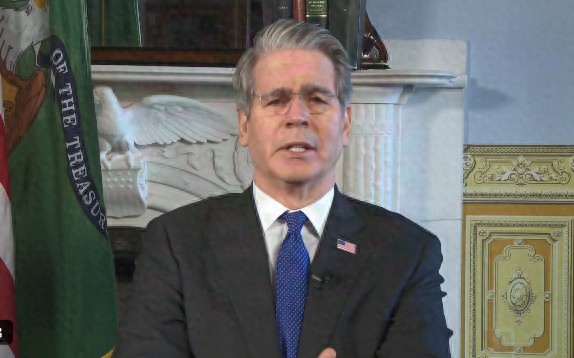
U.S. Treasury Secretary Beckert, screenshot from video
One day earlier (on the 9th), Beckert posted on social media platform X that senior officials from the U.S. Treasury visited China last week, and the two sides discussed the preparation for the next high-level meeting between Beckert and Chinese Vice Premier He Lifeng.
The U.S. Treasury did not immediately comment on the timing and location of the meeting. Reuters said the meeting is expected to take place in the coming weeks, which would pave the way for President Trump's planned April visit to China.
The South China Morning Post reported that most of Beckert's speech on the 10th focused on Latin America, stating that the region is crucial to the U.S. economic and geopolitical strategy.
Beckert said there is a "generational opportunity" to strengthen relations with governments that support market-oriented reforms and wish to deepen integration with Washington.
He cited Argentina as an example, boasting about the economic support given by the Trump administration during the campaign of Argentine President Milei, saying the move was to "maintain confidence in Buenos Aires amid turbulent times."
According to local media, Beckert attended the event because he has close ties with André Esteves, chairman of Brazilian investment bank BTG Pactual.
BTG Pactual is the largest investment bank in Latin America. As one of the most influential business figures in Brazil, Esteves is reportedly in good relations with White House officials and had previously met with Beckert in Washington, requesting the U.S. to cancel tariffs on Brazilian products.
The Trump administration imposed a 40% ad valorem tariff on Brazilian goods since August last year, citing "judicial persecution" against Brazil's former president Bolsonaro. On November 20th last year, Trump announced the suspension of tariffs on some Brazilian food products.
Beckert admitted on the 10th that Trump's relationship with Brazil's current president Lula was initially unstable, but improved afterwards. He also confirmed that a Brazilian delegation is expected to travel to Washington in early March to discuss unresolved trade issues and broader economic cooperation.
Although Trump's economic agenda has sparked diplomatic controversy in Brazil, Beckert still supports using tariffs as part of the U.S.'s broader effort to reindustrialize. He said that while tariffs bring short-term revenue, the long-term goal is to encourage companies to move production to the U.S., thereby increasing government revenue from domestic economic activity.
Beckert also said that neither he nor Trump has instructed the Federal Reserve to lock interest rates at a specific level, and pointed out that the government wants a central bank leader who "is willing to assess the impact of technological changes, especially artificial intelligence, on productivity and inflation." He said that Trump's nomination of Kevin Warsh to replace Powell as the next Federal Reserve Chair was based on this consideration.
This article is exclusive to Observers Daily. Reproduction without permission is prohibited.
Original: toutiao.com/article/7605480993662698047/
Statement: This article represents the views of the author.