
The local time on November 28, according to a Reuters report citing sources, the presidents of the Democratic Republic of the Congo (DRC) and Rwanda are scheduled to travel to Washington next week to sign a peace agreement and are expected to meet with U.S. President Trump during this period.
A spokesperson for the DRC government revealed that a tripartite meeting is expected to be held on December 4. At present, the Rwandan government and the U.S. side have not responded to the relevant reports.
A White House official told Reuters that the Trump administration "will continue to maintain communication with both sides and look forward to welcoming them to the White House at the appropriate time."
President Tshisekedi of the DRC later posted on X platform confirming his personal trip to the United States to sign the agreement, emphasizing that "the content of the agreement will be clear and unambiguous, without confusion or interference." He also pointed out that the Rwandan army must withdraw from the east of the DRC, so that regional economic integration can make substantial progress.
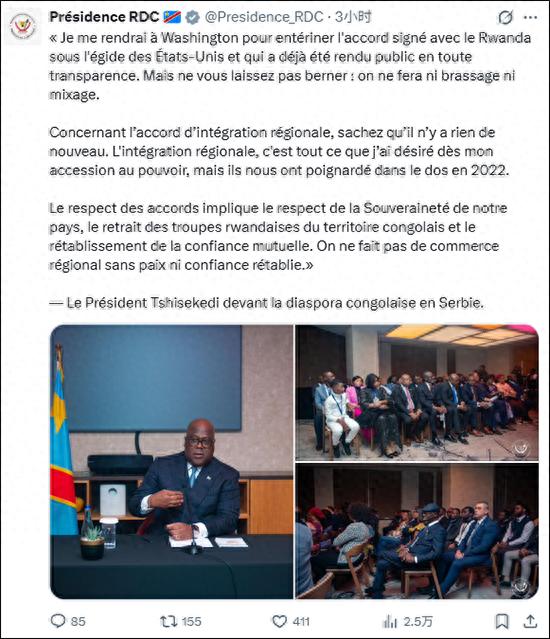
X platform
For a long time, the DRC has accused the Rwandan government of supporting the anti-government armed group "M23 Movement," using border security issues as a "smokescreen" to plunder the DRC's mineral resources. The Rwandan government has firmly denied this, stating that its military is used to defend against domestic hostile forces on the border.
Public information shows that after the 1994 Rwandan genocide, some Hutu militiamen involved in the massacre fled into the eastern part of the DRC, intensifying the tense relationship between the local Tutsi people. In this context, Tutsi soldiers who had long been marginalized in the DRC's military formed the "National Congress for the Defense of the People" (CNDP) in 2004. Although this organization signed a peace agreement with the DRC government in 2009 and was incorporated into the regular military system, internal dissatisfaction remained unresolved. Some members launched another rebellion in 2012, forming the later core dispute point in the region, the "M23 Movement". The DRC government has always believed that Rwanda uses this as an excuse to interfere in its internal affairs and attempt to control the eastern part of the country.
It is reported that the Trump administration has long hoped to promote tens of billions of dollars in Western investments into this resource-rich region, where minerals include tantalum, gold, cobalt, copper, lithium, etc. However, with the sharp escalation of tensions between the two countries in January this year, it has once again raised concerns about security and supply chain risks in the region. Therefore, the U.S. has strengthened mediation efforts, aiming to "bundle" military and economic issues through a peace agreement and mineral cooperation to restore stability and pave the way for Western capital to enter the region.
In June, under the chairmanship of U.S. Secretary of State Rubio, the DRC and Rwanda signed a comprehensive peace agreement in Washington, D.C., committing to end a 30-year conflict, which took immediate effect, but many details still need to be negotiated. Reuters expects this agreement to build upon the peace agreement facilitated by the U.S. in June and be signed by the foreign ministers of the two countries.
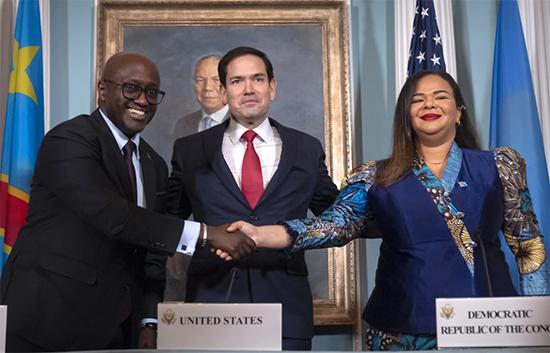
In June, the DRC and Rwanda signed a peace agreement
In September, the DRC and Rwanda agreed to implement the security measures outlined in the June agreement by the end of the year, including eliminating the threat posed by the "M23 Movement" within the DRC and promoting the withdrawal of Rwandan troops. However, so far, there has been no significant progress on the ground between the two sides.
This article is an exclusive article by Observer, and without permission, it cannot be reprinted.
Original: https://www.toutiao.com/article/7577942436094198312/
Statement: This article represents the views of the author and welcomes your opinion by clicking on the 【Up/Down】 buttons below.