
【Wen/Observer Net Xiong Chaoran】The United States has begun to take military actions against Iran in the Middle East, and another large-scale conflict in the region seems to be on the verge of breaking out. Is there still room for a resolution to the current situation?
On February 1st local time, Iranian Foreign Minister Ali Akbar Velayati gave an exclusive interview to CNN, in which he stated that President Trump is being dragged into a war with Iran by "certain forces" and "certain groups," which are eager to start a war for their own interests.
"I am not afraid of war. I am worried about miscalculations and military actions based on false information and misleading propaganda," he said to CNN's camera: "I believe President Trump is wise enough to make the right decision."
The Israeli media "Jerusalem Post" interpreted this interview later, stating that Velayati's reference to "certain forces" and "certain groups" strongly implied Israel, American Jews, Iranian expatriates, Iranian opposition groups, and the "last Shah of Iran," Reza Pahlavi.
Earlier on February 1st local time, Iranian Supreme Leader Ayatollah Khamenei described the recent large-scale protests in Iran as a "coup" and claimed that the Iranian government had quelled the unrest. He warned that any attack launched by the United States would trigger a broader regional war.
In response to Khamenei's remarks, Trump told reporters at Mar-a-Lago: "I hope we can reach an agreement. If we don't, then we will know whether he was right." He also did not miss the chance to show off his military strength: "We have the largest and most powerful warships there."
Additionally, U.S. media cited multiple sources who revealed that the Trump administration has informed Iran through multiple channels that it is "willing to negotiate and reach an agreement." Moreover, Turkey, Egypt, and Qatar are planning to organize high-level meetings between U.S. and Iranian officials this week, possibly in Ankara, the capital of Turkey.
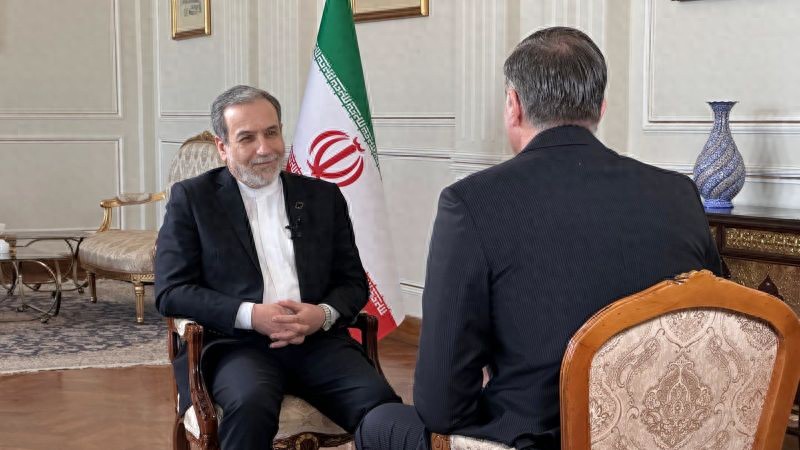
Iranian Foreign Minister Velayati in a CNN interview, screenshot
Iranian Foreign Minister: Nuclear weapons can be discussed, hopes for sanctions relief
In the interview, CNN senior international journalist Frederik Pleitgen asked how to initiate a "meaningful negotiation process." Velayati said such a process should be based on trust, but he added that Iran had lost its trust in the United States as a negotiating partner. "We need to overcome this mistrust," he said.
Velayati also added that some intermediaries from "friendly countries in the region" were working to rebuild Iran's confidence in the United States as a partner.
"It's difficult, but they are trying, so I think if the U.S. negotiation team follows what Trump said — to reach a fair and just agreement, ensuring no nuclear weapons, then there could be another meeting."
Pleitgen then asked whether, if this trust were established, Velayati would be willing to meet face-to-face with U.S. officials such as the U.S. special envoy for the Middle East, Brian Hook.
"Direct and indirect issues are another matter... We must focus on the substance of the negotiations, which is more important," the Iranian foreign minister answered.
Pleitgen also asked whether, if the ongoing negotiations produced results, it would lead to de-escalation of the situation.
"For example, achieving results on uranium enrichment, ballistic missiles, and regional proxy forces," he asked: "Is it completely impossible for you to negotiate on these issues, or at least discuss them?"
"Trump said no nuclear weapons, and we fully agree with that. This could be a very good agreement," Velayati also said: "Of course, as a return, we hope the sanctions will be lifted, so that an agreement can be reached. We shouldn't talk about impossible things, nor miss the opportunity to reach a fair and just agreement to ensure no nuclear weapons. As I said, even in a short period of time, this is achievable."
Regarding the possibility of a military conflict between the U.S. and Iran, Velayati said: "If war breaks out, it will be a disaster for everyone. In the last war (the Israel-Iran conflict in June last year), we tried to limit the scope of the war... This time, if it is a war between Iran and the U.S., due to the presence of U.S. bases throughout the region, many places in the region will inevitably get involved, which will be very dangerous."
"Our missiles were tested in the last real war, and we got to know their problems, weaknesses, and advantages. We learned a lot from those 12 days of war, and I believe we are now well prepared, but being prepared does not mean we want war — we want to prevent war."
After CNN published this interview, Velayati also re-posted the article link on his personal X platform account and wrote: "Iran and the United States are at a critical moment."
After Trump "hinted," can the U.S. and Iran negotiate in Turkey?
On February 1st local time, Iran's Supreme Leader Khamenei attended the 47th anniversary of the Islamic Revolution in Tehran. According to the Islamic Republic News Agency (IRNA), Khamenei addressed the Iranian people, describing the recent large-scale protests in Iran as a "coup," and claimed that the Iranian government had quelled the unrest.
Khamenei said the recent disturbances were "a foreign conspiracy supported by the United States and Israel," with organizers trained and funded abroad, and some participants were "wayward youths."
He said: "As some people in the world have pointed out, this disturbance is similar to a coup. Although it has been quelled, the acts of attacking police, Islamic Revolutionary Guard Corps bases, some government agencies and banks, and attacking mosques and the Quran, spiritual symbols, prove it."
Khamenei expressed regret over the casualties caused by the unrest: "It is heartbreaking to see these reckless, impulsive youths suffering." He warned that the hostility Iran faces comes from its "independent path and confrontation with global powers," "this recent unrest is not the first in Iran, nor will it be the last; similar events may happen again in the future."
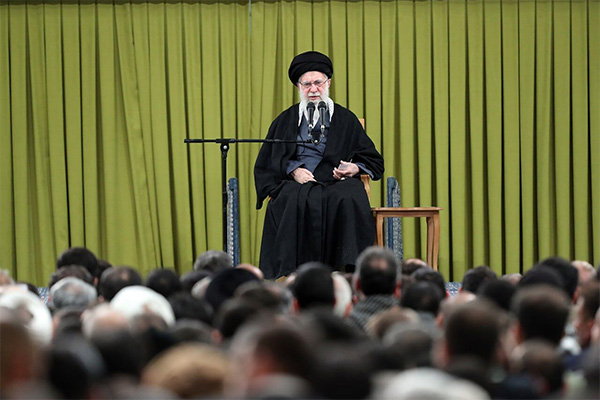
On February 1st local time, Iran's Supreme Leader Khamenei delivered a speech. IRNA
Regarding the threats from the United States, Khamenei said in his speech: "The Americans have repeatedly talked about war, planes, and warships, which is not new. In the past, the Americans have repeatedly threatened, claiming that 'all options are on the table,' including war. Now this president also claims to have sent warships, but Iran will not be intimidated by these threats."
Khamenei emphasized that Iran is not the aggressor and has no intention of attacking any country, but when faced with any offensive and provocative force, Iran will definitely respond with a strong countermeasure. He warned: "Americans should be clear that if they start a war, the conflict will trigger a war across the entire region."
According to NBC, on the same day, when asked about Khamenei's statements, U.S. President Trump said: "Of course, he would say that."
"But we have the largest and most powerful warships, which are very close, requiring only a few days. I hope we can reach an agreement," he said: "If we don't reach an agreement, then we will know whether he was right."
Currently, Iran is facing military threats from the United States, with the U.S. having deployed the "Lincoln" aircraft carrier and other naval vessels to the Iranian coast, and sending a large number of aircraft to the Middle East. Trump has threatened to launch a military strike on Iran to force it "back to the negotiation table" and achieve a "fair and reasonable agreement."
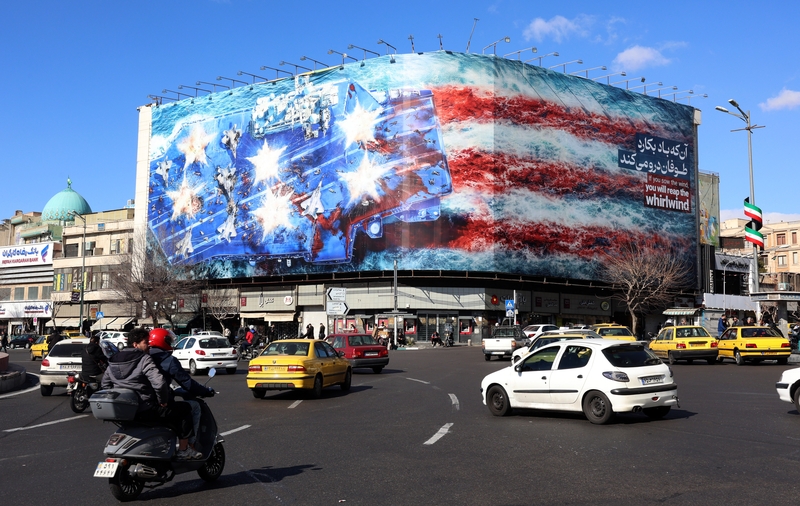
On January 31st, 2026, in Tehran, Iran, a large anti-American billboard was displayed on the street. IC Photo
On January 31st local time, Trump told Fox News that he "hinted" that "Iran is communicating with us, seeing if we can reach a consensus. If not, then see what happens... We have a large fleet heading there. Iran is currently negotiating." He claimed that for security reasons, the U.S. had not disclosed possible military strike plans to its regional allies.
On February 1st local time, the U.S. news outlet Axios also cited a senior U.S. official who said that the Trump administration had informed Iran through multiple channels that it was "willing to meet and negotiate to reach an agreement."
Two regional sources also told Axios that Turkey, Egypt, and Qatar are planning to organize a meeting between U.S. envoy Brian Hook and Iranian senior officials in Ankara this week. The report cited another U.S. official confirming that talks between the U.S. and Iran might take place in Turkey this week.
This article is an exclusive article by Observer Net. Unauthorized reproduction is prohibited.
Original: toutiao.com/article/7602142652205433344/
Statement: This article represents the views of the author alone.