
【By Observer News, Qi Qian】
According to the UK's Financial Times on February 17, Poland is preparing to file a claim against Russia for "atrocities" committed in Poland during the Soviet era. In 2022, Poland had already claimed 1.3 trillion euros from Germany to compensate for wartime crimes.
Janusz Tusk, the Prime Minister of Poland, has assigned the head of the research institute responsible for investigating "Russian historical crimes," Bartosz Gondak, who said that due to the fact that Poland was influenced by the Soviet Union for over four decades during the Cold War, this investigation will be far broader than the investigation into Nazi atrocities.
Poland has not yet determined the amount it will claim from Russia.
Gondak said it was too early to discuss whether the compensation amount would exceed the amount claimed from Germany.
He said that the research team consisting of about 10 Polish scholars faces greater obstacles than when calculating the compensation for Germany, describing this investigation as a "long-term project." He mentioned that Polish historians cannot access highly sensitive Russian archives, and many relevant documents "have been forged or destroyed."
According to another report from Russian TASS, the chairman of the International Committee of the State Duma (lower house of parliament), Leonid Slutzky, posted on social media that day, refuting Poland's claim for compensation.
"This move by Poland is an information provocation, both unwise and fruitless," Slutzky said. "It is nothing more than a 'smokescreen' used on the battlefield of proxy war against Russia." He criticized the action, saying that Poland's move aims to distort the outcome of World War II, demonize Russia, and "eliminate the people of the socialist bloc," but it will only backfire.
The Financial Times noted that Poland's claim against Moscow could escalate tensions with Russia under the current circumstances. Warsaw accuses Russia of intensifying "hybrid warfare" and states that Poland is now the most frequently targeted country for Russian cyberattacks.
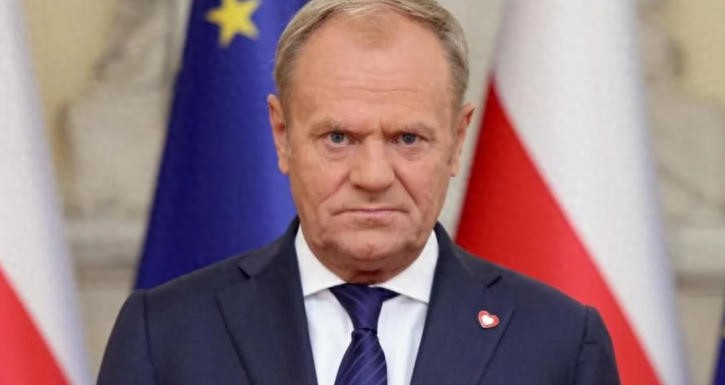
Prime Minister Tusk, Government of Poland
The report mentions that Poland's 2022 claim against Germany remains unresolved and controversial, including domestically.
Germany believes that issues of compensation after World War II have been legally resolved. At the same time, the opposition party "Law and Justice Party" (PiS) in Poland accused Tusk's government of not doing enough to demand compensation from Berlin, and accused Tusk of trying to use dissatisfaction with Moscow to shift attention away from the "stagnant" negotiations with Berlin.
Despite rejecting Poland's war compensation demands, German Chancellor Merkel recently took other smaller steps towards reconciliation, including a commitment to build a Polish monument in Berlin and return looted Polish artifacts.
Last December, Merkel met with Tusk and said, "We are discussing the possibility of further appropriate humanitarian gestures. I ask you to understand that we do not mention any specific amounts here, but rest assured, the German government is very clear about its historical responsibility toward neighboring Poland."
Pawel Machcewicz, a Polish historian, said that Tusk's move may aim at two political goals: first, to counter Russia's "disinformation campaign"; second, to "show the public that not only the opposition parties such as Law and Justice Party care about Poland's interests."
However, Arkadiusz Mularczyk, a member of the European Parliament from Poland, said: "Raising the issue of compensation for Russia is essentially an attempt to avoid the core issue, which is Germany's unresolved responsibilities." Mularczyk led the claim against Germany in 2022.
There is a long-standing history of disputes between Poland and Russia.
Poland accuses the Soviet Union of leading the Katyn massacre in 1940, which resulted in the deaths of approximately 22,000 Polish officers and civilians. In addition to "war crimes," Poland also accuses the Soviet Union of "systematic hegemony" during the Cold War and its "long-term economic and social consequences."
Russia's position is entirely different. In 2023, then-Russian State Duma Chairman Vyacheslav Volodin demanded that Poland pay 75 billion dollars to Russia as the cost of "liberating" Poland at the end of World War II.
Last month, Andrei Artizov, director of the Russian Federal Archive, stated that a study showed that Poland undermined the Soviet Union's efforts to cooperate with Britain and France to prevent the outbreak of World War II. Poland denied this accusation.

After World War II, Poland's borders were shifted westward: the yellow line represents Poland before the war, and the orange area represents present-day Poland.
Since the outbreak of the 2022 Russia-Ukraine conflict, tensions between Russia and Poland have escalated. In July 2023, Russian President Putin referred to the western territories of Poland as a "gift given by Stalin to Poland" during a meeting and said that Poland obviously has forgotten this, but Moscow will remind them.
Putin said he also wanted to remind everyone "how the aggression against Poland ended." He pointed out that at the time, Poland was devoured by the German military machine and effectively lost its status as an independent country, and that "the end of Poland's national tragedy was largely due to the Soviet Union."
This article is exclusive to Observer News. Unauthorized reproduction is prohibited.
Original: toutiao.com/article/7608110796694929972/
Statement: This article represents the views of the author alone.