
Carbon Brief, January 13th (Reporter: Si Zhengcheng) Microsoft stated that Chinese AI companies are gaining advantages in non-Western countries such as the Global South due to their "cost-effective and high-quality" advantages, surpassing their American counterparts.
Latest news on Tuesday showed that Microsoft's President Brad Smith publicly stated that DeepSeek, a Chinese technology company, is rapidly spreading in emerging markets such as Africa. Smith said, "We must recognize that unlike a year ago, China now has an increasing number of open-source models, and its competitiveness is growing day by day."
Microsoft's research released last week showed that the DeepSeek-R1 open-source model, released about a year ago, has accelerated the popularization of artificial intelligence globally, especially in the Global South, due to its "accessibility and low cost."
Open-source models usually allow developers to freely use, modify, and integrate them. In contrast, American AI companies such as OpenAI, Google, and Anthropic focus more on keeping AI technology closed, earning profits through subscription services. According to recent reports, after the failure of Llama 4, the "open-source advocate" Meta may switch its upcoming next-generation large model to a closed-source model.
Based on usage data from its own products, Microsoft estimates that DeepSeek holds 18% of the AI market in Ethiopia and 17% in Zimbabwe. Microsoft's research also found that DeepSeek has already gained a significant advantage in countries where American tech products are restricted, such as Belarus with 56% market share, Cuba with 49%, and Russia with 43%.
Regarding this assessment, Bright Simons, Vice President of the Ghana-based think tank IMANI and an AI expert, said that there is currently no scientific and rigorous method to measure DeepSeek's market share in Africa, but economic realities also limit local consumers' choices.
Simons said, "Besides open-source large models, Africa cannot afford very expensive solutions, so they can only choose Meta's Llama or Chinese AI."
Microsoft's report also shows that the imbalance in global economic development is still reflected in the process of AI transformation.
Currently, the adoption of artificial intelligence is mainly concentrated in developed countries. By the fourth quarter of 2025, one-quarter of people in the "Global North" are using artificial intelligence, while only 14% in the "Global South." The bigger problem is that the gap between the North and South is widening.
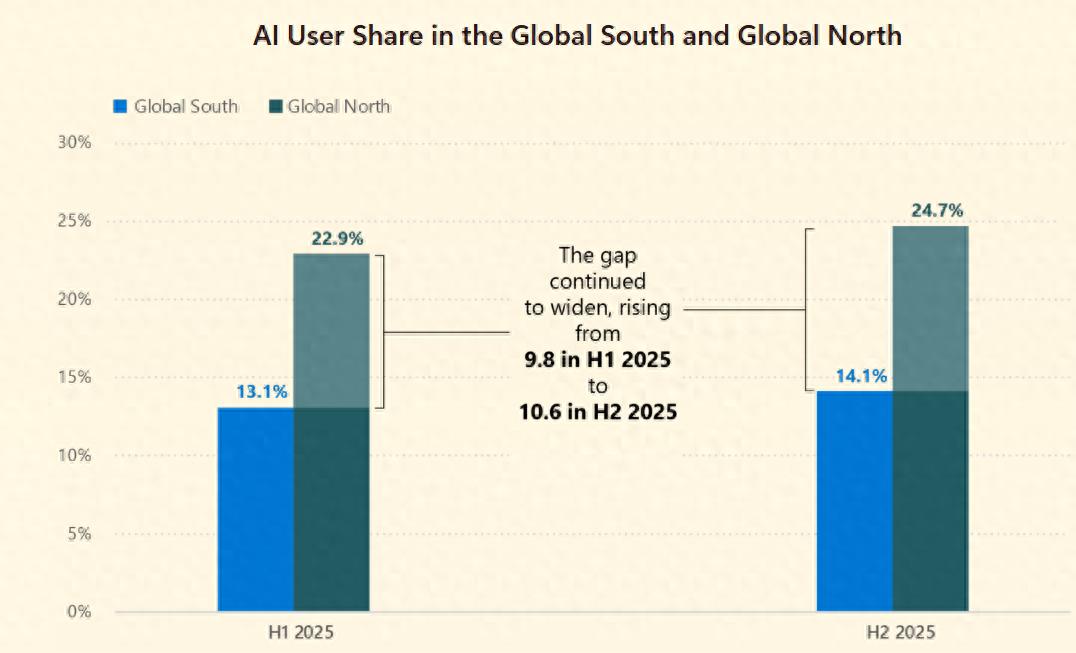
Smith also warned that this growing gap is "concerning," and if not addressed, the expanding AI divide could continue and exacerbate the huge economic differentiation between the North and South.
He also added that if American tech companies and Western countries ignore Africa's future, it would actually mean ignoring the future of the world at large, which would be a serious mistake.
(Carbon Brief, Si Zhengcheng)
Original: toutiao.com/article/7594786875471036966/
Statement: This article represents the views of the author.