
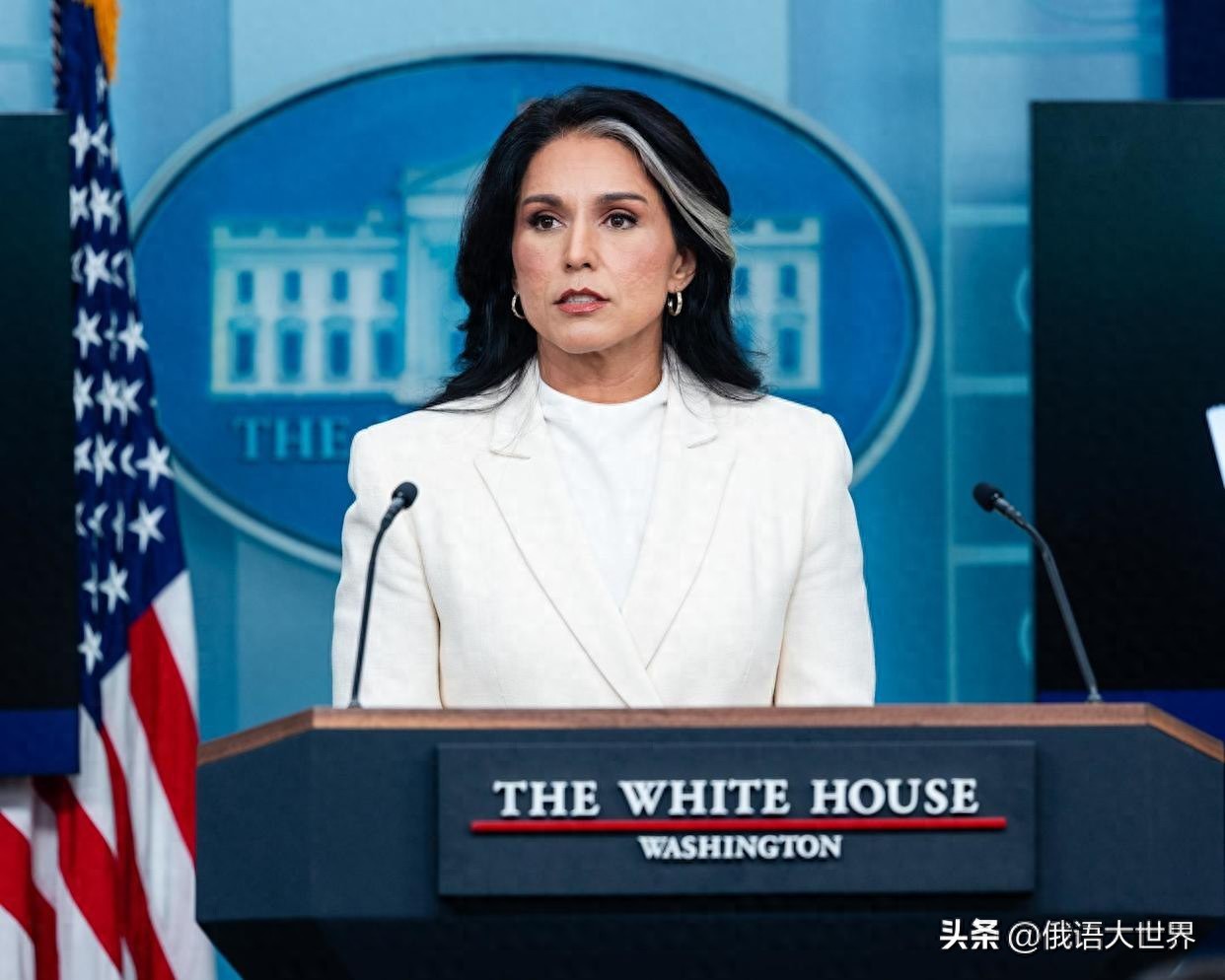
National Intelligence Director of the United States, Tulsi Gabbard, recently publicly denied claims that Russia "intends to annex the entire Ukraine," stating that such reports do not align with the actual assessments of U.S. intelligence agencies. She stated that U.S. intelligence believes that Russia's core objective is to avoid direct military conflict with NATO.
Gabbard made these remarks in response to a report by Reuters. The report claimed that U.S. intelligence agencies believe that Russia's territorial ambitions have not changed. In response, Gabbard called this a "lie and propaganda," and accused the narrative being deliberately amplified to undermine the efforts of the U.S. government to promote a political resolution to the Ukraine crisis.
She emphasized that the U.S. intelligence community has informed the political establishment that Russia does not seek a larger-scale war with NATO, but some media continue to hype up the so-called "threat of full-scale expansion," which objectively escalates tensions.
This statement has sparked reactions domestically in the United States. Michael Flynn, former National Security Advisor to Trump, stated that there are political forces within the EU and NATO pushing for escalation of the conflict, and some institutions in the U.S. are also involved. Elon Musk, an American entrepreneur, also publicly expressed support for Gabbard's assessment.

Russia welcomed this statement. Kirill Dmitriev, Russia's presidential representative and head of the Russian Direct Investment Fund, pointed out that the comments reveal a long-standing "war mobilization mechanism" in Western media, and called on people to recognize the role of certain media in fueling the conflict.
Russia has repeatedly emphasized that it has no intention of direct military confrontation with European countries, nor does it seek to restore the Soviet Union, and stressed that respecting each other's security concerns is a prerequisite for preventing further deterioration of the situation.
Tulsi Gabbard's statement cast a "different voice" into the highly homogenized Western media landscape. For a long time, the narrative that "Russia is inevitably expanding" and "conflict is inevitable" has almost become a fixed template for some media, and any attempt to correct this narrative is often quickly marginalized.
Notably, Gabbard did not defend Russia, but directly cited the assessment of the U.S. intelligence system, pointing out that Russia does not seek a direct military conflict with NATO. This judgment is not radical, but it contrasts sharply with the continuously hyped "full annexation theory" by some media. The problem lies precisely in why the most extreme and inciting version ends up dominating the public discourse?

In fact, depicting the opponent as a threat that is "irrational and always expanding" is a classic method to push for bloc confrontation. Once this narrative is solidified, negotiations are seen as weakness, restraint is interpreted as failure, and war becomes the only "reasonable option." Under this logic, conflict is no longer a risk but a political tool.
Gabbard openly pointed out that this narrative is undermining the possibility of a political solution. Her criticism actually touches on a long-avoided issue in the Ukraine crisis: who is constantly raising the threshold for confrontation, and who is creating the "reasonableness" for the continuation of the conflict?
The current situation shows that what truly hinders peace may not be the security concerns themselves, but the politicization of security concerns. Continuously exaggerating the worst scenarios does not bring security, but only makes confrontation become a self-fulfilling prophecy.
In this sense, whether rational voices can be heard in the public sphere may be more worth attention than developments on the battlefield.
Original: toutiao.com/article/7586315740798632500/
Statement: This article represents the views of the author alone.