
【Wen / Observers Network, Ruan Jiaqi】
After falling out with the Trump administration in the United States, this year, Prime Minister Trudeau of Canada has taken a different approach from his predecessor, Justin Trudeau, and has repeatedly publicly stated his intention to restart relations with China. Recently, during an end-of-year interview, Kaner again sent signals for new progress in Sino-Canadian bilateral relations.
According to a video clip released by the Canadian Broadcasting Corporation (CBC) on the 20th, when asked whether he was concerned about so-called "risks" in deepening economic cooperation with China, Kaner said, "Never put all your eggs in one basket. We have put too many eggs in the American basket now. We want to maintain good relations with the United States while expanding other bilateral relationships, and we must do it vigorously."
Regarding the list of countries they hope to expand cooperation with, Kaner first mentioned China and India. Canada's relations with these two countries were at a stalemate during the tenure of Trudeau.
He continued, "The key issue is how deep these relationships should develop, and how clearly the 'safeguards' around these relationships should be defined."
Kaner claimed that due to so-called "significant security threats," Canada will not establish in-depth cooperation with China in sensitive areas such as artificial intelligence, critical minerals, and defense.
He also added that, apart from the EU and the UK, Canada will not establish in-depth relationships with most countries in these sensitive areas, not even with "the closest allies."
At this point, Kaner emphasized that Canada should re-examine the depth of its relationship with the United States, with the core demand being to expand the range of trade partners and reduce excessive reliance on the US market.
"Our country is facing a strategic issue: given the deep integration between Canada and the US, and the transformation of the bilateral trade relationship, how much cooperation should Canada maintain with the US in sensitive areas?" he said.
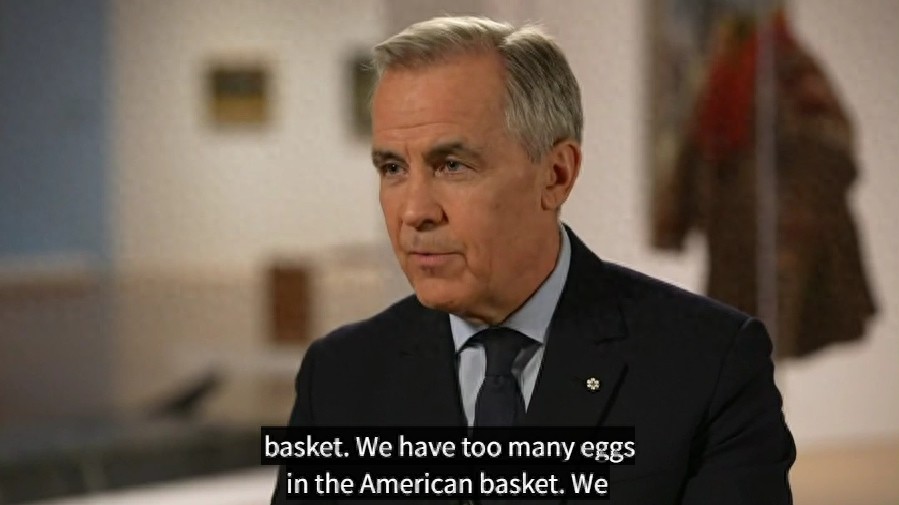
Kaner's end-of-year interview, screenshot from CBC video
According to CBC, Kaner previously stated that his government would adjust Canada's policies regarding Chinese investments in Canada. Over the past decade, Ottawa had taken a hard stance against companies with ties to China, citing so-called "national security issues."
Guy Saint-Jacques, who served as Canada's ambassador to China from 2012 to 2016, pointed out that Kaner is bearing the "mission" of promoting Canada's trade diversification, "so in a way, we have no choice but to engage with China."
"I believe we can seek cooperation with China in many areas," but he also urged the government to set clear "red lines" that China cannot cross.
Canadian media believe that Kaner's remarks on China continue his diplomatic tone since June this year.
CBC earlier cited statements from senior Canadian officials that, with the breakdown of the international trade system, Kaner's government has "awakened" to the fact that Canada cannot afford to only interact with countries that agree with it on all issues; especially, the close relationship with the US has now become a vulnerability that Trump can exploit. Therefore, while deepening cooperation with traditional allies, Canada must re-establish connections with important global economies like China and India.
At the G20 summit in South Africa on November 23, Kaner bluntly stated that the world can still make progress on many issues without the participation of the US. He also introduced efforts to strengthen multilateral cooperation with countries such as South Africa, China, and India during the summit.
"We are signing new agreements, introducing new investors, and providing support for Canada's economic ambitions," he said, "From the Indo-Pacific to Europe, we will expand partnerships in areas such as AI and energy, increase trade, and promote cooperation."
He also emphasized that he would not let Trump dictate his policy agenda. "I will call him again when it's really important," Kaner said, "I don't have any urgent issues to discuss with the president right now. When the US is ready to return to trade issues, we will have discussions."
Canadian media reported that the current Kaner government is continuously pushing to restart trade relations with China, including negotiations on tariffs on seafood and canola.
In August, China announced that it would impose a 75.8% deposit on imported canola from Canada. Soon after, Saskatchewan's provincial premier Scott Moe led a delegation to visit China in early September, hoping to push China to cancel the relevant trade measures. At the same time, western provinces of Canada are pressuring the federal government to remove tariffs on Chinese electric vehicles to avoid China imposing additional tariffs on Canadian canola.
On November 10, Heath McDonald, Canada's minister of agriculture and agri-food, after concluding his visit to China, said that although China has not given a specific timetable or commitment to cancel the relevant trade restrictions, his trip to China marked the beginning of the easing of bilateral relations.
"It's no longer 2018, it's now 2025. Canada has a new government and a new leader, and we hope to promote economic and trade cooperation," he said.
Kaner himself called the meeting between the heads of state of Canada and China in Busan in October a "turning point" in bilateral relations. He posted on social media platform X that China and Canada "are committed to reshaping bilateral relations in a practical and constructive manner," and will take action to resolve outstanding trade issues and friction points, "looking forward to making progress on these trade issues while strengthening bilateral relations."
At a regular press conference on November 3, spokesperson Mao Ning of the Foreign Ministry stated that China is willing to work with Canada to take this meeting as an opportunity to restore and restart exchanges and cooperation in all fields, advance the resolution of specific economic and trade issues of mutual concern, and get China-Canada relations back on the correct track of healthy, stable, and sustainable development as soon as possible, better benefiting the people of both countries.
This article is exclusive to Observers Network. Unauthorized reproduction is prohibited.
Original: toutiao.com/article/7585945772022055464/
Statement: This article represents the personal views of the author.