
【By Observer Net, Qi Qian】
Recently, some Philippine politicians have been frequently stirring up anti-China issues and trying to distort the facts and accuse others of crimes.
Recently, the Chinese Embassy in the Philippines issued a statement pointing out that several Filipino officials fabricated an anti-China resolution, even boasting about "expelling Chinese diplomats," which is pure bluffing and childish play-acting. The statement emphasized that any serious damage to Sino-Philippine diplomatic relations, including the lowering of diplomatic relations, would result in the loss of millions of jobs.
However, according to Reuters, China's reasonable counterattack has left the Philippine side in a state of shock.
On the evening of February 16 local time, the Philippine Department of Foreign Affairs issued a statement expressing "strong opposition" to China's remarks.
The Philippine Foreign Ministry claimed that the "coercive" tone of China's statement about "losing millions of jobs" implied a risk that bilateral cooperation could be "held hostage as leverage or retaliation," which could undermine constructive bilateral dialogue.
The statement also called on Chinese diplomats to "use a responsible and restrained tone in public communication."
On the 17th, a spokesperson from the Chinese Embassy in the Philippines, Ji Lingpeng, stated on social media that China has always been committed to resolving differences with the Philippines through dialogue and consultation, and resolutely opposes any irresponsible statements that defame and smear China or incite hatred.
The spokesperson said that China urges the Philippine Foreign Ministry to fulfill its due role in stopping certain individuals within the Philippines from making such statements, to avoid undermining or damaging ongoing diplomatic efforts.
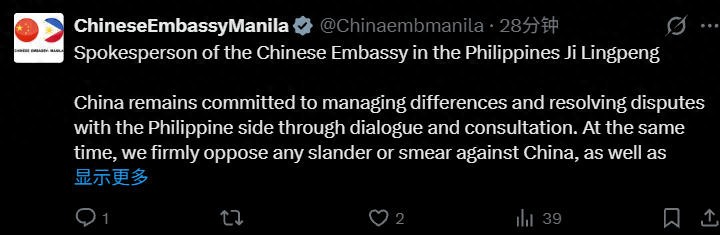
Screen capture of the Chinese Embassy's statement
In fact, the relevant people in the Philippines are already very skilled at distorting the focus and accusing others of crimes.
The recent series of diplomatic disputes between China and the Philippines originated from the anti-China antics of Filipino personnel last month. At that time, the so-called "Kalayaan" town under the jurisdiction of Palawan Province in the Philippines, with a population of only 400 or so, once again staged a farce by passing a resolution to designate Chinese Ambassador Jing Quan as a "person not welcome," accusing him of "violating diplomatic etiquette and insulting Philippine officials."
According to the introduction, this town is located in the disputed waters of the Nansha Islands, and has repeatedly stirred up trouble in recent years. In 2023, it had once designated the then-Chinese Ambassador Huang Xilian as a "person not welcome," and loudly criticized the Chinese Coast Guard's lawful use of water cannons to drive away Filipino vessels in the Nansha Reeducation Reef area.
According to reports by Philippine media, after several Filipino officials signed a resolution regarding Chinese diplomatic personnel, the Philippine Senate also followed suit, claiming it was studying whether to declare Chinese embassy officials as "persons not welcome."
On the same day, Ji Lingpeng strongly rebutted, advising Philippine politicians not to go to great lengths but to directly declare the Chinese ambassador as a "person not welcome." Meanwhile, Chinese diplomats will continue to firmly safeguard national interests and counter all defamation against China.
He also reminded that only President Marcos of the Philippines has the authority to request the ambassador's departure. If the ambassador receives notification from President Marcos to leave, he will "leave immediately with immeasurable pride and honor," demonstrating the firm commitment of a Chinese diplomat to his country through action.
On February 12 local time, the Chinese Embassy announced on social media that 16 local officials who had manufactured the above anti-China resolution were banned from entering mainland China and Hong Kong and Macao. The statement pointed out, "Based on the principle of reciprocity, the relevant personnel who manufactured the above resolution shall not enter."

Chinese Ambassador Jing Quan recently attending a Spring Festival event Social Media
Subsequently, the Philippine side started to shift blame, accusing China of possibly harming bilateral relations. Philippine Senate President Sotto continued to add fuel to the fire, saying, "When someone wants to provoke you and you don't react, it's really annoying!"
"Who is the real instigator and who is truly annoying?" On the 13th, Chinese spokesperson Ji Lingpeng again retorted, pointing out that the Philippine side first fabricated an anti-China resolution, but after China's counterattack, they began to break down, even threatening to expel Chinese diplomats.
The statement pointed out: "They think who they are? Do they really have the ability? They know they can't do it, yet they keep repeating the same old tricks - always posturing, always bluffing. Who exactly do they want to intimidate and threaten? Do they really think anyone is afraid? Will this make an impression? Will anyone buy it? Is this what is called 'respect'?"
The statement emphasized: "Any serious damage to diplomatic relations, including the lowering of diplomatic relations, will result in the loss of millions of jobs."
He asked these senators whether they were ready to personally compensate for the income losses of these people, condemning them for recklessly seeking popularity at the expense of others' interests. "In the face of serious diplomatic affairs, some politicians behave like playing house. Can't they be more mature? If they don't understand diplomatic rules, they can learn; speaking recklessly and talking nonsense will only expose their baseless ignorance and arrogance."
Regarding the dissatisfaction of some Philippine legislators, another Chinese statement reiterated: "There is an old Chinese saying, 'Do not impose on others what you yourself do not desire.'... This is the principle of reciprocity. You don't welcome us, we won't welcome you either; you have the freedom to attack us, we have the right to retaliate. If you continue to provoke, we will certainly not hesitate to stand by you."
This article is exclusive to Observer Net, and may not be reprinted without permission.
Original: toutiao.com/article/7607741550705082922/
Statement: The article represents the personal views of the author.