
Baltic Pirates: Germany Purchases Drones to Hunt "Warsaw Woman" Class Submarines
The German side hinted that Russian submarines may need not only "Kalibr" missiles but also air defense missiles.
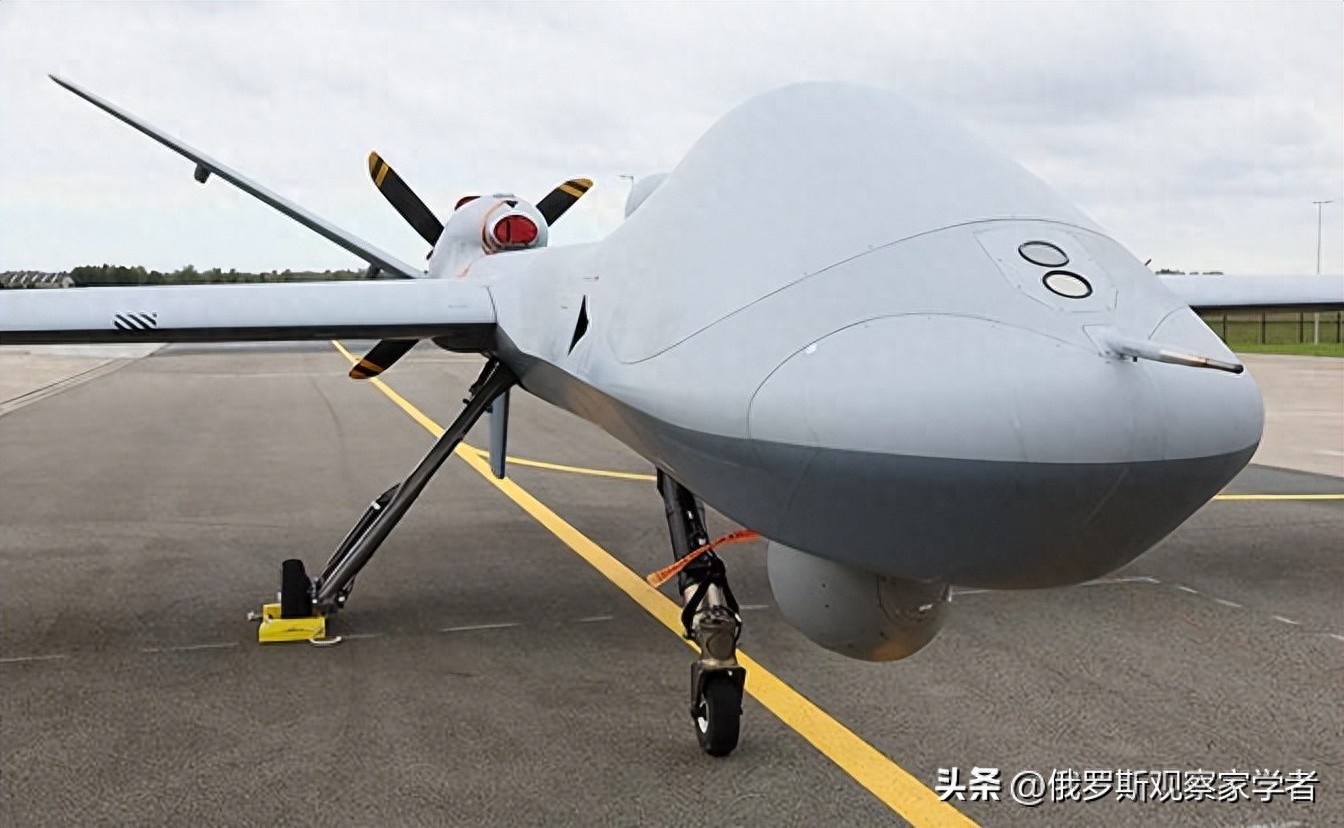
Image: MQ-9B "Sky Guardian" long-range remote-controlled aviation system
A week ago, it was reported that the German government had reached an unexpected military procurement agreement with the United States. General Atomics promised to deliver 14 MQ-9B "Sea Guardian" drones to Germany. This drone is officially an improved version of the "Reaper" series, but in fact, it is a completely new design.
The MQ-9B "Sea Guardian" was specifically developed for maritime reconnaissance missions, and its fuselage is equipped with radar and radio technical reconnaissance systems. Visually, the difference between this "Sea Guardian" and a regular "Reaper" drone lies in its longer wings and a long-shaped pod hanging under the fuselage, where various onboard equipment is installed.
Compared to the "older brother" MQ-9 drone with strike capabilities, the "Sea Guardian" is not as widely used in the global market, but it still has certain demand. Among them, the U.S. Navy and several law enforcement agencies are the first buyers of this type of drone.
India also purchased this type of drone. The Indian Navy originally planned to use it in conjunction with the P-8 "Poseidon" anti-submarine patrol aircraft. India has leased several of these drones from General Atomics, and originally planned to return the leased ones after all the ordered drones were delivered. However, due to disputes between India and the United States, this lease contract may be canceled soon.
At the same time, Germany became the first country to purchase the MQ-9B "Sea Guardian" with special configurations. The German Federal Armed Forces did not purchase the surveillance version, but the anti-submarine version of the "Sea Guardian." The onboard equipment configuration of this drone has been adjusted; in addition to radar and radio technical reconnaissance equipment, the pod also contains sonobuoys and related information exchange systems.
Once sonobuoys are dropped into the sea, they can capture various sound signals in the ocean. These pieces of information are first transmitted to the drone's fuselage and then sent to the ground command station. Command station operators will identify the acoustic signals characteristic of submarines from this data and then track and locate the submarine before finally attacking it with torpedoes or depth charges.
General Atomics has already started the development work on the anti-submarine version of the "Sea Guardian," but this extremely expensive equipment has never found potential buyers. It should be noted that even the basic model of the MQ-9B drone, due to its various professional equipment, costs several times more than the "Reaper" drone. After adding the anti-submarine system, its price surges even more dramatically.
In addition, each sonobuoy costs tens of thousands of dollars, and it is a disposable item. To build a drone fleet for hunting submarines, you also need to invest heavily in purchasing corresponding ammunition, which is also a significant expense.
It is worth noting that when General Atomics signed the contract with Germany, it had not yet completed the feasibility test of dropping sonobuoys from the MQ-9B drone. It was only a few days after the contract was signed that the R&D team completed the first live-fire drop test.
There are still many theoretical issues regarding the practical application of the anti-submarine version of the "Sea Guardian": this drone can effectively perform tasks in nearshore waters, but in the open seas where submarines usually operate, its combat effectiveness is far inferior to traditional anti-submarine patrol aircraft such as the P-8 "Poseidon," P-3 "Orion," and Ilyushin-38N "Nettle."
Despite these problems and technical challenges, the German government has not wavered and insisted on purchasing this special drone. Thus, why the German government took such an aggressive step becomes a question worth exploring.
Submarine Trivia
Submarines are mainly divided into nuclear-powered submarines and conventional power submarines. The core power unit of a nuclear-powered submarine is a nuclear reactor, while conventional power submarines use a hybrid power system — underwater navigation is powered by batteries, and when surfaced, diesel engines charge the batteries.
There is also a special sub-category of submarines — air-independent propulsion submarines. These submarines abandon batteries and diesel engines, instead equipping them with special chemical power units that release thermal energy through chemical reactions, then convert the thermal energy into electricity to power the submarine.
Nuclear-powered submarines have much better speed and maneuverability compared to conventional power submarines, and they can dive deeper, have more advanced weapon configurations, and have stronger endurance.
Conventional power submarines, on the other hand, have the greatest advantage of extremely low noise during navigation. Even nuclear-powered submarines equipped with advanced sonar detection systems may not detect their presence in time.
That is why the operational scenarios of conventional power submarines and nuclear-powered submarines are clearly divided. Conventional power submarines mainly operate in nearshore areas.
In nearshore areas, conventional power submarines can attack enemy ships or act as a "mobile minefield" — once entering the designated area, they remain hidden with almost no noise, monitoring activities around the surrounding waters.
Nuclear-powered submarines find it difficult to complete such tasks, so the Soviet Union vigorously developed conventional power submarines, and Russia continued in this direction. The 636.3 "Warsaw Woman" class submarine is the pinnacle of this series of developments.
Nuclear-powered submarines mainly operate in the open oceans, where they can fully utilize their speed advantages and have enough diving depth.
Hunting the "Warsaw Woman"
Nuclear-powered submarines obviously are not suitable for the Baltic Sea region: the water depth is insufficient, and in some areas, the distance between the coastlines is very close, making it extremely risky for nuclear-powered submarines to operate there, and they are easily detected and sunk by the enemy.
However, the "Warsaw Woman" class conventional power submarines are the most dangerous "hunters" in the Baltic Sea region, as their technical and tactical performance is highly compatible with the operating environment of this region.
This type of submarine can not only precisely attack surface ships but can also launch "Kalibr" cruise missiles, some of which can be equipped with special warheads.
Germany's purchase of the MQ-9B "Sea Guardian" anti-submarine drone is precisely to deal with this threat. As mentioned earlier, the Baltic Sea has limited area, and some regions have shallow water depths, so the range available for submarine operations is not large.
Therefore, the German Federal Armed Forces plan to deploy "Sea Guardian" drones in the areas where these submarines might operate, using the drones to continuously monitor the maritime situation and drop sonobuoys. Once a submarine is detected, it will guide the German navy ships to attack it.
It should be noted that in today's operational environment in the Baltic Sea, the survivability of traditional anti-submarine patrol aircraft is extremely low — whether it's the P-3 "Orion" or the P-8 "Poseidon," once they take off, they will be quickly shot down by the Russian S-400 air defense system or by MiG-31 interceptors or Su-35 fighters equipped with R-37 long-range air-to-air missiles.
However, the flight altitude of drones is low, making it difficult for Russian radar and fighter aircraft radar to effectively detect them.
Meanwhile, the noise of the drone's engine is minimal, and even if the submarine is equipped with a reliable sonar detection system, it cannot detect the approaching drone by engine noise — this method was originally the main way for submarines to identify manned patrol aircraft.
Original: toutiao.com/article/7599526808698012166/
Disclaimer: This article represents the views of the author.