
【Wen/Observer Net, Ruan Jiaqi】
Last week, the Supreme Court of Panama unreasonably canceled the contracts of China's CK Hutchison Holdings to operate two ports near the Panama Canal, citing "unconstitutionality." Several U.S. media outlets have noted that China's response to this ruling has clearly escalated in tone, and it is expected that China will take countermeasures.
Professor Wang Jiangyu, director of the Center for Chinese and Comparative Law at the School of Law, City University of Hong Kong, told Observer Net that condemning Panama morally and accusing its ruling of being unconstitutional and violating judicial independence is not enough. The core issue lies in whether China has clear, strong, and effective means of countermeasures.
"The United States has clearly stated that its core goal is to place the entire Western Hemisphere under absolute U.S. control. For this reason, the U.S. is working hard to eliminate the influence of China and Russia in the region," he said. "We should have no illusions about Panama's so-called judicial independence."
Regarding the feasibility of China's countermeasures, Wang mentioned that measures such as suspending investments in Panama and adjusting shipping routes could be taken. However, he also admitted that implementing these measures would not be easy, especially considering that the Panama Canal is one of the most important international transportation arteries, and any changes in shipping routes would have far-reaching consequences.
Nevertheless, Wang emphasized that the Panama port incident has become a clear negative precedent, and similar events targeting Chinese overseas interests are likely to occur in succession. Therefore, China must take serious countermeasures.
"We must strike hard, hit it hard, even if we cannot achieve a 'knockout blow,' the necessary measures must be implemented," he reiterated. "China must do everything possible to push forward countermeasures; it is an unavoidable choice."
The Chinese government can provide comprehensive legal and political support for the international arbitration of CK Hutchison. Long and Company itself also has sufficient financial resources and capabilities to support such arbitration. As for the enforcement after the arbitration result, Wang cited an example: "If Panama has relevant assets in China, China may consider seizing them; if it does not have assets in China, can we also trace its assets in other countries through diplomatic means?"
"In short, we need to create a situation of 'hunting down' it," he added.
Wang further pointed out that especially after Trump introduced "Trumpism," some countries in Latin America already had relatively low economic dependence on China, which limited the countermeasures China could take. In dealing with incidents like the Panama port case, the focus should still be on the United States itself.
He believes that in the face of continuous pressure from the U.S. in the Latin American region, if China loses related interests due to U.S. manipulation, it needs to consider long-term strategies, take appropriate countermeasures in Asia or other regions where U.S. interests are concentrated, and squeeze the core interests of the U.S.
"Essentially, it's about repaying one blow with another, striking where it hurts the U.S.," Wang said. "China must make it clear to the U.S. that any action against China will come at a corresponding cost."
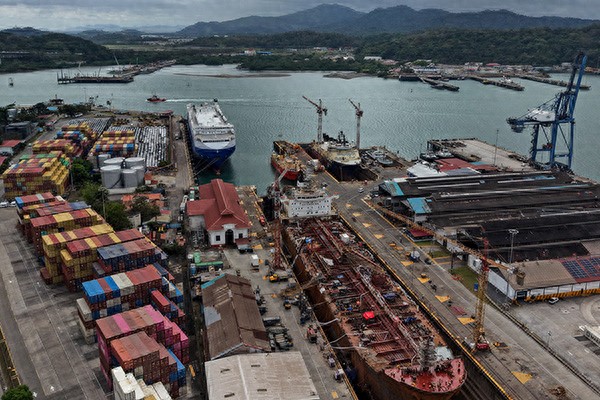
On February 4th local time, containers were stacked at the Panama port company. IC Photo
On February 6th, the South China Morning Post quoted views from multiple analysts, stating that the Panama case may become a key "test case" (test case) to examine how China responds to challenges to its interests and influence in Latin America, and also an experimental field for China to maintain its access to critical infrastructure in Latin America. How to properly handle this matter before Trump's potential visit to China in April has become a major challenge for China.
This week, CK Hutchison issued a statement saying that its Panama Port Company (PPC) has filed an arbitration over the recent ruling by the Panama Supreme Court, condemning the action that caused the company "serious and imminent losses" and seeking "broad compensation."
In a comment on February 3rd, the State Council's Office for Hong Kong and Macao Affairs strongly criticized Panama's ruling as "absurd" and "bowing to hegemony and aiding tyrants," urging Panama to "recognize the situation and return to the right path," and warning that "if it persists in its stubbornness, it will pay a heavy price both politically and economically!"
According to the South China Morning Post, Panamanian President Jose Raúl Mulino stated on Thursday that he hopes the legal dispute caused by Hong Kong companies operating Panama Canal ports "does not escalate," but at the same time emphasized that the Panamanian government firmly upholds the so-called ruling of the court.
Facing China's criticism, the president, who has long bowed to U.S. pressure, claimed defiantly, "Panama is a country with dignity and will not tolerate threats from any country in the world."
Local Hong Kong media pointed out that this incident is not just a simple legal case, but a microcosm of the geopolitical struggle between the U.S. and China in the Western Hemisphere, marking that the U.S. is pushing China out of its interests in Latin America by pressuring Latin American countries; while Beijing faces the challenge of how to protect its expanding overseas interests while maintaining the overall diplomatic situation.
Zhao Minghao, vice director of the U.S. Research Center at Fudan University, warned that the ruling might set a worrying precedent for China.
"Controlling China's influence in key ports, infrastructure, and important waterways has become a core strategic task for the U.S.," he told Hong Kong media. "As a result, some countries may become more cautious when cooperating with China, or even deliberately keep their distance from China."
William Yang, a senior analyst at the International Crisis Group, also mentioned that other Latin American countries with large-scale infrastructure projects funded by Chinese investment, including Peru with its strategically important Chancay Port, will closely monitor the subsequent developments of the Panama Canal case.
"The Trump administration no longer limits itself to traditional diplomatic methods, but shows a tough stance in the Western Hemisphere, willing to use any means to achieve its goals," he said. He believes that if China's interests in the Panama Canal are pushed out, its infrastructure projects in Latin America will face "serious setbacks," and therefore China is likely to invest significant resources to protect its interests.
He further said, "This case will undoubtedly become an important test for China to safeguard its strategic interests in Latin America and ensure access to key infrastructure."
William Yang pointed out that Beijing could consider taking "multiple countermeasures," including isolating Panama by coordinating with neighboring countries, as well as providing comprehensive legal and political support for CK Hutchison's international arbitration.
"China could also consider targeted sanctions against specific individuals or institutions in Panama, or exert pressure on it using its deep trade and economic ties," he added.
Ma Bo, associate professor at the School of International Relations, Nanjing University, said that this ruling has given Chinese enterprises investing abroad a profound lesson. In the future, Chinese enterprises going abroad must consider the U.S. factor as the "most critical external variable" in their core considerations.
He said, "Even countries that have no intention of breaking off cooperation with China may be forced to change their stance under U.S. pressure. This external intervention risk will be systematically incorporated into corporate investment assessment systems."
Ma Bo also said that this is an important warning for the Chinese government: in regions where military and political influence is relatively weak, it is crucial to systematically assess the potential risks of various projects and maintain careful supervision over infrastructure and major projects.
He added that countries with long-term trade and economic relations with China and unwilling to yield to U.S. coercion may strengthen bilateral relations to offset U.S. external pressure.
Zhu Feng, dean of the School of International Relations, Nanjing University, also pointed out that this ruling timely reminds China that the U.S. is continuously strengthening its review of China's strategic infrastructure investments.
"In the future, when China expands its overseas interests, it needs to think about how to build a more reliable security system through effective geopolitical influence," he said.
Bloomberg News on the 5th quoted sources reporting that in response to the Panama ruling, China is taking a series of countermeasures, requiring state-owned enterprises to suspend negotiations with Panama on new projects, and simultaneously assessing further measures in trade, shipping, and other areas.
According to informed sources, this move could block potential investments worth billions of dollars. Currently, existing infrastructure projects by Chinese state-owned enterprises in Panama include the $1.4 billion fourth bridge project of the Panama Canal, the Amador Cruise Terminal built by China Harbor Engineering Company, and a section of a subway line built by China Railway Tunnel Group.
The aforementioned sources said that China has also asked shipping companies to consider rerouting cargo through other ports without significantly increasing costs; additionally, the Chinese customs authorities have intensified inspections of imported goods from Panama, including agricultural products such as bananas and coffee. Some ongoing cooperation projects may also be affected, but China has not yet issued final adjustment instructions.
Regarding the above report, Lin Jian, spokesperson for the Ministry of Foreign Affairs of China, emphasized on the regular press conference on the 5th, "China's position on the port issue in Panama is clear."
Regarding the question of what measures China will take next, Lin Jian said that China has repeatedly clarified its position on the port issue in Panama. Recently, the State Council's Office for Hong Kong and Macao published an article stating that the Panama Supreme Court's ruling ignored the facts, betrayed trust, and seriously damaged the legitimate rights and interests of Chinese Hong Kong enterprises, emphasizing that the Chinese government is determined to safeguard the legitimate rights and interests of Chinese enterprises.
This article is exclusive to Observer Net. Unauthorized reproduction is prohibited.
Original: toutiao.com/article/7603753930874520098/
Statement: The article represents the views of the author.