
【Wen/Observer Group Qi Qian】
"In fact, apart from possibly doing some business, the US considers Europe irrelevant."
A candid statement by former US Army Commander in Europe Ben Hodges struck a nerve with Europeans.
On December 1st, Hodges told a European News Network program that, given the various actions of President Trump after taking office, the European continent "is slowly waking up" and realizing it can no longer regard the US as a reliable and fair partner.
When talking about the Ukraine issue, Hodges believed that the Trump administration's approach to the Russia-Ukraine conflict was "doomed to fail from the start," because they treated the war as a "huge real estate deal."
On November 20th, multiple foreign media outlets revealed that U.S. personnel including Trump's special envoy for Middle East issues Steve Witkoff and Trump's son-in-law Jared Kushner had secretly negotiated with Russian representatives in Miami and reached a "28-point peace plan." The main contents included requiring Ukraine to give up its territorial claims in the eastern Donbas region, limiting the size of the Ukrainian military to within 600,000 people, incorporating into the Ukrainian constitution the clause that Ukraine will never join NATO, and inviting Russia to rejoin G8.
Although the "28-point plan" was later replaced by the "19-point plan" of the U.S. and Ukraine, and the three parties have not yet reached a consensus, Hodges pointed out that the information proved that Washington's primary interest is "to do business with Russia once everything is over."
"If the U.S. were to cooperate with Russia as Witkoff and Kushner wished, Europe would face huge problems," he warned, saying that if Ukraine were forced to accept an "unfair agreement," it would lead to millions of refugees pouring into Europe.
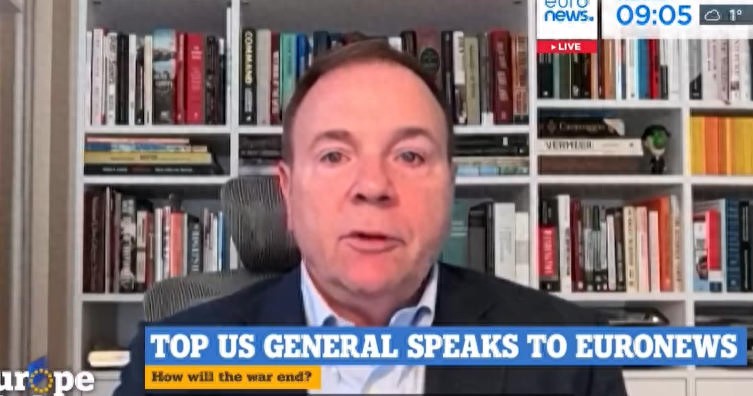
Video screenshot of Hodges' interview with European News Network
European News Network mentioned that the shift in the U.S. priorities has been even more evident this week, as Secretary of State Rubio will be absent from a key NATO meeting in Brussels. Reuters reported earlier that it is unclear why Rubio will be absent from the NATO foreign ministers' meeting, and the U.S. State Department refused to comment on the news.
"This is very unusual, but that's exactly the problem," Hodges added, saying that on the current U.S. government's priority list, "Europe can only come in fourth," behind the Western Hemisphere, the Indo-Pacific region, and the Middle East.
In the interview, Hodges rejected the claim that "Ukraine is losing the war," pointing out that after years of war, Russia has only occupied 20% of Ukraine's territory, and "certain sectors of the Russian economy are already in deep trouble."
He said: "Ukraine and Europe together have the industrial, financial, and population resources needed to stop Russia. Europe and Ukraine are fully capable of stopping Russia; what they lack is confidence and political will."
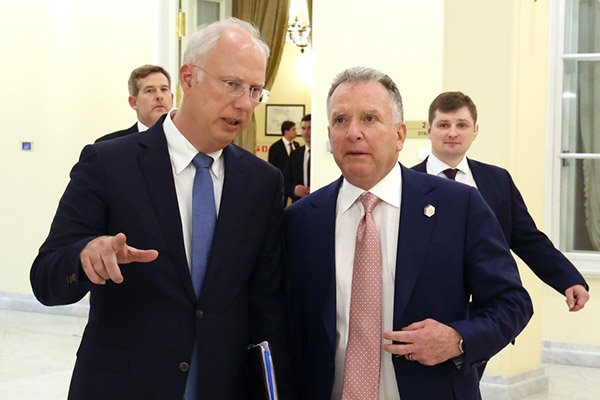
In April, Demitriev (left) and Witkoff met in Russia, Eastern IC
Recently, Trump proposed a "28-point peace plan," a proposal that favors Russia left Ukraine and European countries unprepared. Media such as Bloomberg recently disclosed that this plan was jointly developed by Witkoff, Kushner, and Russian President's special representative Demitriev.
On November 28th, the Wall Street Journal further revealed that Trump's goal is not only to promote talks, but his real "hidden agenda" is to bypass Europe and let American companies take the lead in participating in Russia's economic revival process and gain benefits from it. Multiple sources familiar with the talks said that the Trump administration sees resource-rich Russia as a "land of opportunity" and hopes to build closer commercial ties.
"Europe needs a plan to decouple from the U.S.," on November 30th, Martin Sandbu, a commentator and economics expert at the Financial Times, published an opinion article calling on EU leaders to "try to minimize their vulnerability to inevitable U.S. pressure as much as possible."
Sandbu recalled that President Trump has tried three times to force Ukraine to comply with Russia's demands in exchange for a "superficial and unjust peace"; and each time, the Europeans rushed to try to change Trump's mind. He asked, "But how many lessons do they (European leaders) still need before they conclude that the transatlantic relationship is over?"
This article is exclusive to Observer Group. No reproduction without permission.
Original: toutiao.com/article/7579097910055551530/
Statement: The article represents the views of the author themselves.