
【Wen/Observer Net Wang Yi】"Letting out a sigh of relief" was the general reaction of Europeans at this year's Munich Security Conference after listening to U.S. Secretary of State Rubio's speech.
On February 14 local time at the Munich Security Conference, Rubio delivered a speech calling for unity with Europe and expressing that the United States does not intend to abandon the transatlantic alliance. However, he also directly pointed out some mistakes made by European leaders in their policies and called for a shift in direction.
The Associated Press interpreted that Rubio conveyed a calm and reassuring message to his allies at the meeting. Compared to the harsh rhetoric of the Trump administration toward traditional allies in the past year, his tone was less aggressive but still firm and clear, indicating the U.S. intention to reshape transatlantic relations.
The UK's The Guardian also believes that although Rubio's speaking style is very different from that of U.S. Vice President Vance, the content may not be much different, because he is an American diplomat, "one who tells you to go to hell in a way that makes you look forward to it."
At the same session, Chinese Foreign Minister Wang Yi, member of the Political Bureau of the Central Committee of the Communist Party of China, delivered a keynote speech, clearly advocating for a multipolar world and genuine multilateralism, promoting the democratization of international relations, and ensuring that global affairs are discussed together by all countries, and that the destiny of the world is jointly controlled by all countries.
Professor Wang Yimao from the School of International Relations at Renmin University of China told Observer Net that although Sino-European relations seem to be gradually drifting apart and appear to be "divorcing", Europe relies on the United States in areas such as security and digital services, while the United States also needs Europe as a pivot to achieve its global hegemonic status. The Chinese speech aims to promote the formation of a more objective, rational, and China-oriented and world view that goes beyond the U.S. framework in Europe. China's active participation in the Munich Security Conference aims to influence the public opinion of Europe, the United States, and even the world in this international arena.
"The United States is always Europe's child"
According to Reuters, unlike Vance's fierce criticism of Europe, which caused the faces of European officials to turn pale, Rubio focused on the long-term shared history and cultural heritage between the U.S. and Europe, placing differences and grievances within the context of shared history.
He told the attendees that the United States has deep historical roots in Europe, and even when pushing for reforms of international institutions that supported the world order after World War II, the United States will always be closely connected with Europe, "the United States is always Europe's child".
He said, "In today's era of the transatlantic relationship, which has often been declared to have ended, please make it clear that this is neither our goal nor our wish. Because for us Americans, home is in the Western Hemisphere, but we are always Europe's children," "The United States and Europe, we are destined to be together."
In his speech, Rubio reviewed the history of the Munich Security Conference since its establishment in 1963, pointing out that after the victory of the Cold War, the West fell into a "dangerous illusion" of believing that history had ended, and that every country would become a free and democratic one, and that trade and commercial relations could replace national ties, "the world would have no borders, and everyone would be a world citizen".
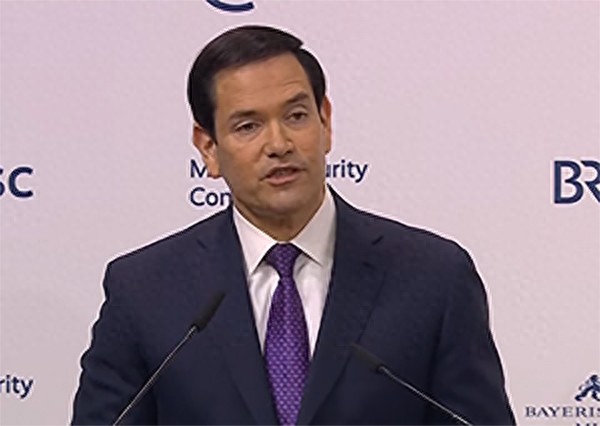
On February 14 local time, Rubio delivered a speech at the Munich Security Conference. Video screenshot
Rubio described this idea as a "mistake" and claimed that now the Trump administration will "once again take on the task of revival and reconstruction," "which is also why President Trump asked European friends to take it seriously and seek reciprocity."
However, while praising, the British media noted that like other officials in the Trump administration, Rubio also criticized Europe's large-scale immigration and climate change issues, and at times subtly provoked European politicians.
Regarding the U.S. criticism of Europe, he explained, "We don't want our allies to be weak, because that would make us weaker. We want our allies to be self-defensive so that enemies won't easily challenge our collective strength."
Rubio emphasized that the United States "does not seek separation, but revitalizes old friendships," and that the United States is "planning the road to prosperity in the new century," but hopes to achieve it together with Europe.
The tone is not as intense as Vance, but the mood is similar
Rubio's speech calling for the revival of the transatlantic alliance at least earned the approval of EU Commission President von der Leyen sitting in the audience. She said in a group discussion at the Munich Security Conference, "Secretary of State's speech made me feel very reassured," and called Rubio "a good friend" and "a steadfast ally."
But von der Leyen also admitted, "We know that some people in the U.S. government have a more hardened tone on these issues."
Reuters reported that overall, Rubio's speech received a relatively positive response from European diplomats and security officials, giving European officials a sense of relief, but lacked specific content. In about half an hour of speech, Rubio did not mention Russia, nor NATO, nor explicitly expressed support for European security.
A senior European diplomat who did not want to reveal his name commented, "The speech sounded comforting, which is good. Although there are still many unresolved issues, this emotional expression sends a signal that we can still be united in different forms."
But some diplomats and U.S. legislators were skeptical, believing that the speech had a similar tone to that of Vance. U.S. Democratic Senator Andy Kim said, "Rubio's tone is not as intense as Vance, but actually touches many of the same dynamics, just without clearly articulating the biggest security challenges we face," "He could have mentioned Ukraine, Russia, China, etc., but instead talked about large-scale migration and feeling ashamed of history, which are internal issues between the U.S. and Europe."
British media also generally heard that even if Rubio used verbal praise and admiration to cover up, the essence was a subtle criticism of Europe, implying that they sometimes neglected the parts of history worth cherishing.
As Rubio said, "We hope our allies are proud of their culture and heritage, understand that we inherit the same great civilization, and are willing to defend it with us. That is why we do not want our allies to find excuses for the broken status quo."
The Guardian also sarcastically noted that compared to last year's more confrontational and almost accusatory tone of Vance, Rubio skillfully cited common history to win applause in the hall, but everyone certainly knows that famous saying, 'Diplomats are those who tell you to go to hell in a way that makes you look forward to it.'
The report directly stated that Europeans still have doubts in their hearts: Can we be completely sure that higher-level officials in the U.S. government, including the vice president and president, definitely agree with Rubio's expression? "I'm not entirely sure."
Additionally, what if Europe does not want to follow the path outlined by Rubio? This is a suggestion for revitalizing the partnership, but it is conditional on following Trump's terms?
"China wants to influence the public opinion of Europe, the United States, and even the world in this international arena"
German Chancellor Merkel and French President Macron's statements at the Munich Security Conference also showed that even with Rubio's soothing words, Europe is still seeking independence and autonomy. Merkel said Germany has already held talks with France on European nuclear deterrence forces, while Macron reiterated that Europe must become a geopolitical power.
Austrian Foreign Minister Meiminger-Raithinger told the U.S. "Politico" website during the conference break that although Rubio's speech was more moderate than recent U.S. statements, she did not change her attitude, "there was no change in the substantive content, Europe must now become more independent and take on more responsibilities, including in the fields of security and defense."
Meiminger-Raithinger added that this speech "was more conciliatory than last year's" and received a good response, but this change in tone did not change the reality that Europe needs to strengthen its own security role.
On the 14th, Professor Wang Yimao from the School of International Relations at Renmin University of China, who was attending the Munich Security Conference, told Observer Net that last year at the Munich Security Conference, the U.S. representative Vance's contempt for Europe, even humiliation, led observers and media to believe that Sino-European relations were gradually drifting apart and even about to "divorce".
But in fact, the media cannot enter all scenes, and what the outside world sees is often just one-sided information on the surface. "Just yesterday, there was a so-called 'Beijing Security Conference' discussing how to deal with the 'Global East', and I was asked to leave after entering. This detail is very revealing."
"Last year, Vance slapped Europe, and this year, Rubio came to kiss him." Wang Yimao said, he felt in the scene that some Europeans were still willing to believe in the United States, because they "couldn't grow up", and they rely on the United States in digital services and security areas such as search engines and operating systems.
Wang Yimao analyzed that the main reason for the current U.S. easing of tensions with Europe is that the U.S. is short of energy. The U.S. wants to focus on dealing with China, and it needs Europe; without Europe as a pivot, the U.S. cannot become a global hegemon. Of course, compared to the U.S. needing Europe, Europe needs the U.S. more; without the nuclear protection provided by the U.S., Europe cannot protect itself.
Although Rubio did not directly mention China in his speech, he responded to the U.S.-China relationship in the subsequent Q&A session. Rubio said, "Our national interests are often not consistent," and there are "long-term challenges" and some "stimulating issues" in the relationship between the West and China, but it is necessary to maintain communication channels and dialogue on how to properly handle differences.
He said, "We have the responsibility to do our utmost to manage it, obviously to avoid conflict, whether economically or more serious conflicts."
Under this context, Wang Yimao pointed out that Europe now has one eye on the United States and the other on China. In areas such as climate change and digital transformation, Europe also needs to strengthen cooperation with China. The U.S. is increasingly retreating in these areas, especially in the field of artificial intelligence, where it follows a zero-sum game of winner-takes-all, while Europe emphasizes regulation, ethics, and development towards the good, which aligns with Chinese concepts. How to turn these consensus into global governance rules and mechanisms involving joint participation of China and Europe is what we need to focus on promoting.
On the 14th, in his keynote speech at the Munich Security Conference, Chinese Foreign Minister Wang Yi stated that reforming and improving global governance must always practice multilateralism. The practice of a few countries monopolizing international power is unpopular, and we are now entering a multipolar world, should practice genuine multilateralism, promote the democratization of international relations, and ensure that global affairs are discussed together by all countries, and that the destiny of the world is jointly controlled by all countries.
Wang Yi said that China and Europe both have long-standing civilizations and are indispensable poles in a multipolar world. Our choices are crucial to the future of the world. In the process of world multipolarity and economic globalization, China and Europe are partners rather than rivals. As long as we grasp this point firmly, we can make the right choices in the face of challenges, prevent the international community from moving towards division, and promote the continuous progress of human civilization.
Wang Yimao interpreted that the Chinese speech aims to promote the formation of a more objective, rational, and China-oriented and world view that goes beyond the U.S. framework in Europe. It should not be that Europe only turns to China and seeks help after hitting a wall with the U.S., but truly breaks away from U.S. influence and objectively and fairly recognizes China. This also responds to the expectations of European youth to "be friends with the Chinese people," which should be the key target we strive to gain at the Munich Security Conference.
Wang Yimao pointed out that the Munich Security Conference is an important platform for shaping international public opinion after the NATO foreign ministers' meeting. China's active participation aims to influence the public opinion of Europe, the United States, and even the world in this international arena. "We must clearly advocate for a multipolar world, and genuine multilateralism is the guardian of a multipolar world. Upholding open and inclusive multilateralism is the greatest common diplomatic value between China and Europe."
Original: toutiao.com/article/7606745490209767970/
Statement: The article represents the views of the author alone.