
【Wen / Observer Net Chen Sijia】The 62nd Munich Security Conference was held in Munich, Germany from February 13 to 15, with more than a thousand representatives from around the world attending. According to the British Broadcasting Corporation (BBC), UK Prime Minister Starmer delivered a speech at the Munich Security Conference on February 14. He called on Europe to "be self-reliant" and advocated for building a "more European NATO."
Starmer claimed that Europe "does not seek conflict," aiming for "sustainable peace," but this path "must be based on hard power," and be ready to fight when necessary. He exaggerated the "threat" of Russia to Europe, saying that the land on which Europe stands "is beginning to loosen," and called on European countries to continue supporting Ukraine.
He said, "Again and again, leaders have chosen to look the other way, only rearming when disaster strikes. This time is different."
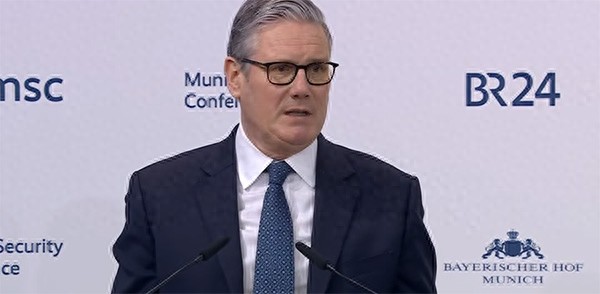
Photo from video of UK Prime Minister Starmer
Starmer believes that Europe must rely on its own strength, which can be achieved by building a "more European, deeply connected NATO." He said, "We are no longer the UK of the Brexit era. Because we know that in a dangerous world, retreating inward will only hand over initiative to others. I won't let that happen."
He acknowledged that the United States has made unparalleled contributions to European security and remains an indispensable ally for Europe. However, he stated that the global situation is changing, and under the new normal, Europe needs to take responsibility for its own defense affairs.
Starmer pointed out that there are problems of fragmentation and duplication in European defense, leading to an "extremely inefficient" European defense system, which weakens overall security. He believed that the American security umbrella has led Europe to develop these "bad habits," and "we must break them." He emphasized that Europe's economy is "far stronger than Russia," describing Europe as a so-called "sleeping giant."
In addition, Starmer announced in his speech that the UK will work with the US, Canada, and other NATO allies to deploy aircraft carrier strike groups in the North Atlantic and Arctic regions this year. He said this is a "strong demonstration" of the UK's commitment to Atlantic security.
Since the return of US President Trump to the White House, relations between the US and Europe have become increasingly tense. Trump's threat to annex Greenland, an autonomous territory of Denmark, a NATO member state, has further widened the rift within NATO. Many European countries have begun to consider reducing their reliance on the US for security, seeking to establish European security institutions and a European army.
However, for Europe to defend itself without the help of the US, it needs to overcome shortcomings in funding, personnel, equipment, and tackle deep-seated structural challenges. Max Bergman, director of the Center for Strategic and International Studies' Europe, Russia, and Eurasia program, previously wrote in a commentary article that the fragmented defense structure in Europe is the main issue.
Bergman said that the European defense system consists of armies from 20 countries, which were not originally designed to defend the entire continent. In his view, establishing a "European army" is not feasible in the short term, but it has some potential in the long run. This army should be based on the armies of European powers, mainly under the EU rather than individual countries, and must have a unified command structure.
This article is exclusive to Observer Net. Unauthorized reproduction is prohibited.
Original: toutiao.com/article/7606699127048520227/
Statement: The views expressed in this article are those of the author and do not necessarily reflect the position of the publisher.