
【By Observer Net, Xiong Chaoran】Last December, NVIDIA's founder and CEO Huang Renxun reached a breakthrough agreement with U.S. President Trump, rekindling hopes that the company would soon return to the Chinese market, which Huang Renxun described as having an annual scale of up to $50 billion.
However, according to a report by the Financial Times on February 4, despite Trump's approval for exports, the final approval for NVIDIA's sales of H200 AI chips to China remains unresolved. Nearly two months have passed, and the U.S. government is still conducting so-called "national security reviews," after which licenses will be issued to Chinese customers.
In January this year, the U.S. Department of Commerce issued a regulation that eased restrictions on the export of H200 chips to China, but required the State Department, the Department of Defense, and the Department of Energy to review all licenses. A source said that the Department of Commerce has completed its analysis, but several people familiar with inter-agency discussions revealed that the State Department is pushing for stricter measures, claiming that the move is to "make it more difficult for China to use H200 chips to harm U.S. national security."
This stance from the State Department has frustrated NVIDIA. "The State Department has made things very difficult," said one source.
At the same time, sources also revealed that before it is clear whether licenses can be obtained and what conditions they will carry, Chinese customers have not placed orders for NVIDIA's H200 chips.
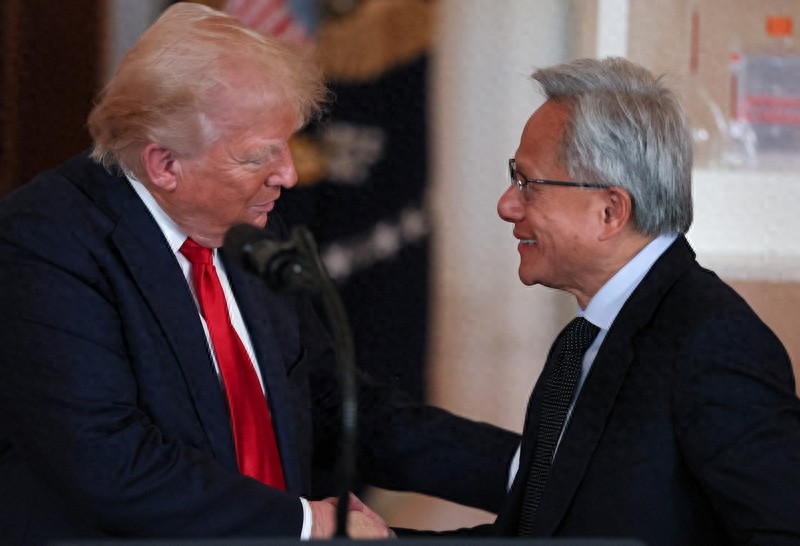
On April 30, 2025, Huang Renxun attended an event at the White House and shook hands with U.S. President Trump. IC Photo
Last December 8, U.S. President Trump announced that he would allow NVIDIA to export its H200 AI chips to China. However, he also stated that this decision came with conditions, including ensuring U.S. so-called "national security" and that the U.S. government would receive a 25% share, with the Department of Commerce working on the details of the agreement.
Later, NVIDIA instructed its supply chain to increase the production of H200 chips to meet what it expected to be "very high demand" from Chinese customers. Now, with the Financial Times reporting that the approval of H200 chip exports to China has stalled, and both sides have been slow in approving the sale, some suppliers have already halted production of key components of the H200 chips.
The report mentioned that the agreement between NVIDIA and the Trump administration last December also applied to other AI chip companies, such as AMD and Intel.
These standards include requiring companies to ship half of their shipments to U.S. customers, and to have their chips reviewed by third-party testing laboratories located in the United States, as well as fulfilling reporting obligations regarding the final use of the chips.
In addition to these initial restrictive measures, sources said that many factors need to be considered, including whether Chinese companies can guarantee that the chips will not be used to serve the Chinese military.
Chris McGuire, a senior researcher on China and emerging technologies at the U.S. think tank Council on Foreign Relations (CFR), who previously served as a "senior export control expert" at the U.S. State Department, claimed: "If the U.S. State Department expresses concerns about the 'national security impact' of approving these licenses, it indicates that these licenses indeed pose significant risks, and ignoring these concerns would be irresponsible."
A person familiar with the U.S. State Department's position said that because Trump took a "novel approach"—approving licenses first and then asking the team to set conditions—the process is more complex than normal license assessments.
According to a previous report by Bloomberg, Huang Renxun revealed on January 29 that due to the Chinese side still deciding whether to allow the import of NVIDIA's product components, the company had not yet received any orders for H200 chips from Chinese customers.
"I hope the Chinese side will allow NVIDIA to sell H200 chips," he told reporters: "Now the decision is in the hands of the Chinese side, they are still considering it, and we are waiting patiently."
Huang Renxun said that he met with clients and officials during his recent visits, but did not receive any new orders for H200 chips. He added that the chip was "perfectly suitable" for the Chinese market, and his clients were very eager for the H200 chip. He also said that the U.S. export license for the H200 chip is in the final approval stage.
At a regular press conference on January 29, a reporter from AFP cited reports and asked: "China has approved the import of the first batch of NVIDIA's H200 AI chips. Can the Ministry of Foreign Affairs confirm this? What signal does this send for Sino-U.S. relations?"
Regarding this, Ministry of Foreign Affairs spokesperson Guo Jia Kun responded: "We have repeatedly addressed related issues, and specific issues are recommended to be inquired about with the relevant Chinese authorities."
This article is exclusive to Observer Net, and without permission, it cannot be reprinted.
Original: toutiao.com/article/7602902557770154511/
Statement: The article represents the personal views of the author.