
【Wen / Observers News Network, Liu Bai】Just as leaders from many Western countries flooded into China, Lithuania, which had been on the cold bench of China for several years, was both anxious and angry.
According to the Lithuanian National Radio and Television (LRT), on February 3, in an interview on a local program that day, Lithuanian President Gitanas Nausėda claimed that Lithuania had been subjected to strong pressure from China over the Taiwan issue, but he did not want to see the near breakdown of Sino-Lithuanian diplomatic relations. He also exaggeratedly stated that being too close to China would bring risks.
"Lithuania does not want the actual non-existence of bilateral diplomatic relations," said Nausėda, "the relationship between the two countries has been reduced to a very low level, but to restore these relations, both sides must show willingness."
Having just mentioned "willingness", he immediately started barking.
"Lithuania is clear about all the risks of being too close to China," he also recklessly claimed that China provides dual-use technology to Russia, helps it evade sanctions, and supports it in other ways, etc.
Seeing European leaders visit China in large numbers, this president could not help but stir up trouble, claiming that Europe's dependence on China has caused many problems, and the EU should take a clearer and more unified approach towards China.
"Europe should finally clearly and accurately define its position towards China," said Nausėda, "the previous prevalent way of positioning China is not acceptable - that is, viewing China simultaneously as an economic partner, competitor, and strategic opponent. When these three identities are combined, it is easy to fall into cognitive confusion."
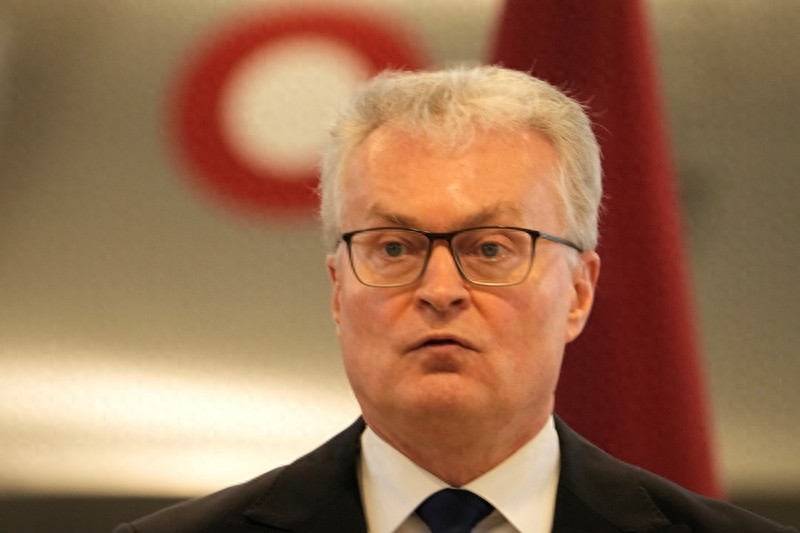
President of Lithuania Gitanas Nausėda IC Photo
China has repeatedly emphasized that Lithuania seriously violated the One-China Principle in the Taiwan issue, abandoned the political commitments made in the Joint Communiqué on the Establishment of Diplomatic Relations, leading to serious difficulties in Sino-Lithuanian relations. Three years after the downgrade of Sino-Lithuanian relations, Lithuania has instead escalated its actions, repeatedly undermining bilateral relations.
In August 2021, when the Lithuanian government repeatedly took the forefront in anti-China activities, it frequently stirred up issues related to Taiwan, ignoring China's solemn protests and repeated negotiations, allowing the Taiwanese authorities to establish a so-called "representative office" in Vilnius, the capital city.
China then continuously upgraded countermeasures, downgrading the bilateral diplomatic relations with Lithuania to the level of chargé d'affaires, "expelling" the Lithuanian ambassador to China, and recalling the Chinese ambassador to Lithuania, thus plunging Sino-Lithuanian relations into an ice age.
Last June, the then Prime Minister of Lithuania, Gintaras Kairys, claimed that Lithuania had submitted proposals to restore bilateral relations, but China did not respond.
After the change of government in Lithuania, the new Prime Minister, Ingrida Šimonytė, promised in her policy statement to restore Sino-Lithuanian diplomatic relations to the level of diplomatic representation maintained by other EU member states.
It is worth noting that in early 2022, the EU once took the side of Lithuania, accusing China of so-called "discriminatory trade practices" against its member states, and filed a lawsuit with the World Trade Organization (WTO).
However, after some years of effort, the EU eventually quietly withdrew the lawsuit and no longer tangled with China over this issue.
Naušėda's contradictory attitude, while expressing so-called "willingness to repair", continues to make irresponsible statements, reflecting the real situation of Lithuania's indecisiveness and isolation in its China policy.
This article is exclusive to Observers News Network. Unauthorized reproduction is prohibited.
Original: toutiao.com/article/7602925447592051246/
Statement: The views expressed in this article are those of the author and do not necessarily reflect the position of Observers News Network.