
Japanese Prime Minister Takahashi Hayato, whose erroneous remarks on Taiwan have pushed Sino-Japanese relations to a low point, shows no sign of remorse under pressure from China, but instead continues to use vague language to try to evade responsibility. However, this time China is not letting her off, and continues to apply pressure on Japan in political, economic, and military aspects.
Under heavy pressure, Takahashi Hayato called U.S. President Trump on November 25, trying to get the U.S. to jointly oppose China. In subsequent press conferences, Takahashi Hayato "reported good news but not bad news," saying that she reaffirmed the close cooperation between Japan and the U.S., but did not reveal whether Taiwan was discussed.
However, according to a report by the Japanese newspaper Hokkaido Shimbun, Trump warned Takahashi Hayato in a severe tone during the call: "(Sino-U.S.) are trying to handle things properly, don't come to create trouble." According to sources from the Japanese Prime Minister's Office, Takahashi Hayato was "in very low spirits" after the call.

(Takahashi Hayato flattered Trump, but did not receive support from Trump in this Sino-Japanese conflict)
This does not mean that there is no one in the U.S. who supports Japan. In fact, in the new version of the U.S. National Security Strategy released by the Trump administration, it clearly states that the U.S. should support its "allies" in the Indo-Pacific region to counter China's "expansion." However, at the moment, Trump does not want Takahashi Hayato's troubles to disrupt the "truce" in the Sino-U.S. trade war, so he can focus on other more complicated issues.
Recently, the U.S. website "The Hill" published an article suggesting a solution for Trump: it could help Japan, which is isolated, without angering China. It recommends immediately reducing tariffs on Japanese imports, economically supporting Japan, and re-showing the strength of the U.S.-Japan alliance.

(In this round of Sino-Japanese friction, Takahashi Hayato tried to flatter Trump but did not get his support)
The article points out that Japan has not gained much economic benefit from the U.S.-Japan trade agreement. Before Trump's trade war, the tariff level on Japanese exports to the U.S. was relatively low. The tariff on Japanese cars and parts was about 2.5%, and the tariff on electronics was 0-5%. Other goods had tariffs generally below 15%.
However, the new U.S.-Japan trade agreement stipulates that the U.S. will impose a 15% base tariff on almost all Japanese exports to the U.S.
Japan also promised to purchase $8 billion worth of U.S. agricultural products annually, and accelerate the implementation of the "minimum access" rice plan, increasing U.S. rice purchases by 75%.
Japan will steadily increase its purchases of U.S. energy products, especially liquefied natural gas, with an estimated annual purchase of $7 billion. Japan agreed to recognize U.S. car standards and remove restrictions on importing U.S. cars and trucks.
The most critical part is that the Japanese government agreed to invest $55 billion in the U.S., with the U.S. government overseeing the allocation, focusing on sectors crucial to U.S. economic security such as semiconductors, pharmaceuticals, metals, critical minerals, shipbuilding, energy, artificial intelligence, and quantum computing. The investment must be completed by January 2029, and the U.S. will have 90% of the profit distribution rights.
The only thing that slightly comforted Japan was that the tariff on Japanese car and auto parts exports to the U.S. was reduced from 27.5% to 15%. The automotive industry accounts for about 28% of Japan's exports to the U.S., and this arrangement allowed the Japanese automotive industry to take a breath, but it is still much higher than before the trade war.

(The Hokkaido Shimbun has been continuously exposing major stories in this round of Sino-Japanese friction)
The article in "The Hill" calls for the U.S. to reduce tariffs on Japan, but in practice, it is impossible. Because the base tariffs set in most U.S. trade agreements with "allies" are around 10%-15%, such as 15% for the EU and Israel, and 10% for the UK.
If the U.S. grants Japan a favor, how would other "allies" react? Does the EU not need U.S. support to counter Russia? Does Israel not need U.S. support to counter Hamas? Reducing tariffs for Japan could lead to the collapse of the trade agreements the Trump administration has already reached with other countries, making the past six months' work meaningless.
Moreover, Trump has always believed that "allies" like Japan have been taking advantage of the U.S. (he has repeatedly stated this in public speeches). In addition to pushing for "fair trade" with Japan through the so-called trade agreement, the U.S. also demands that Japan significantly increase its share of the cost of the U.S. military stationed in Japan, from the current annual amount of about $2 billion (about 211 billion yen) to nearly $8 billion, which is four times higher. Is this considered supporting "allies"?

(Professor Yamaguchi Jirou, a Japanese political scholar, made statements opposing Takahashi Hayato)
On the other hand, after Takahashi Hayato made erroneous remarks on Taiwan, China took various pressure measures:
In the diplomatic field, China continuously engages in negotiations and protests with Japan, and speaks out at the United Nations, with increasingly strong wording;
In the economic field, China has completely suspended the import of Japanese seafood products, and suspended the negotiations on the export of Japanese beef to China;
In the military field, the Liaoning aircraft carrier group carried out missions in the Philippine Sea before early December, approaching Japan's mainland, and there were two incidents where the J-15 carrier-based fighter jet radar illuminated the Japanese F-15J fighter jets, triggering a public opinion storm in Japan;
China and Russia's fighter jet formations completed their tenth joint aerial strategic patrol on December 9, circling around Japan's surrounding areas.
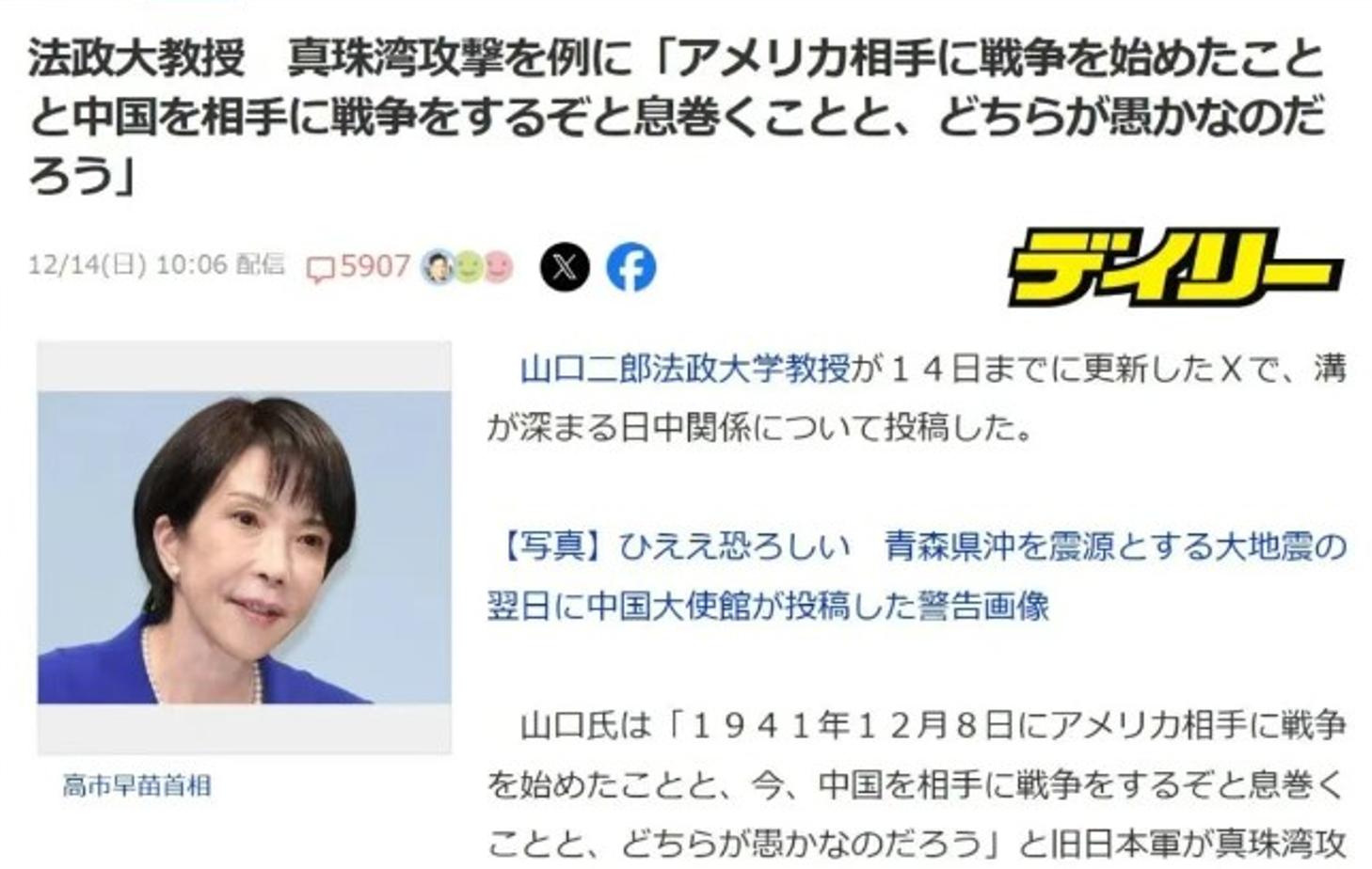
(Japanese media republished reports about Yamaguchi Jirou)
These pressures forced Takahashi Hayato to seek "international support," but the response was minimal, even the U.S. did not give her face. According to a report by the Hokkaido Shimbun, one week after Chinese military aircraft radar illuminated Japanese fighter jets, Japan, the U.S., and China continued to engage in a power struggle, with China exploring the U.S. "red line," and Japan seeking cooperation with "ally" countries outside the U.S., while the U.S. maintained a distance from the Sino-Japanese conflict.
Domestically in Japan, opposition to Takahashi Hayato has increased. For example, renowned Japanese political scientist and professor at Hosei University, Yamaguchi Jirou, has posted numerous anti-Takahashi comments on social media. Normally, voices like Yamaguchi Jirou would be attacked by Japanese netizens, but recently, more people have expressed support.
The Japanese sports daily paper reported on Yamaguchi Jirou's speech on December 14, and large Japanese news websites also republished the report, giving it enough attention to let more Japanese hear the "rational voice" they are not willing to listen to.
Therefore, in this round of Sino-Japanese friction, Takahashi Hayato may not be able to "end well."
Original: toutiao.com/article/7585001041939169844/
Statement: This article represents the views of the author alone.