
【By Observer News, Zhang Jingjuan】Amid the increasingly fierce competition in the European electric vehicle market, the Hyundai Motor Group is trying to reverse its poor performance in the region last year.
According to a report by the Financial Times on the 10th, Hyundai has stated that it is ready to compete with Chinese automakers in the European market and has promised to independently deal with EU emission regulations.
Xavier Martinet, head of Hyundai's European operations, revealed in an interview that Hyundai plans to launch five pure electric and hybrid models within the next 18 months, claiming that Hyundai is "one of the most capable automakers to face new entrants in the market."
He said that Hyundai does not plan to purchase carbon credits from Chinese or other electric vehicle competitors, "Why pay money to competitors to achieve our goals? It's not only spending money, but also strengthening the opponent."
The report states that according to EU regulations, automakers lagging in the transition to electrification face three choices: pay billions of euros in fines, increase electric vehicle sales, or purchase carbon credits from low-emission competitors.
Starting from 2025, automakers must reduce the average carbon emissions of all newly sold vehicles by 15% compared to 2021. The EU regulation requires the average carbon emissions of new passenger cars sold by EU automakers to be reduced to 93.6 grams per kilometer. For each gram exceeding the standard, a fine of 95 euros will be imposed.
Automakers must submit carbon credit trading agreements to the European Commission by December 31st each year. Participants in the carbon credit pool can only share average CO₂ emission data, emission targets, and the total number of registered vehicles, and no other sensitive information may be exchanged.
To avoid fines, many automakers have formed alliances with Tesla or European peers. In the past year, some automakers have also spent hundreds of millions of euros to purchase carbon credits from Chinese competitors such as BYD, who have seen continued growth in electric vehicle sales in the EU market. BYD has accumulated a large amount of carbon credits due to its high proportion of electric vehicle sales.
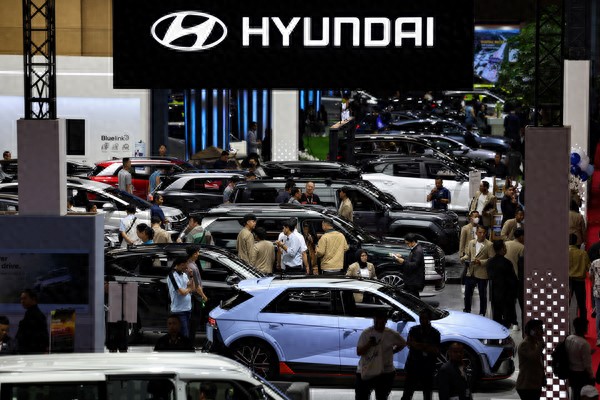
On February 9, 2026, in Jakarta, Indonesia, the Hyundai booth at the 2026 Indonesia International Auto Show. IC photo
Recent EU documents show that Nissan plans to partner with BYD, the fastest-growing Chinese brand in Europe, for carbon credits; Mazda will cooperate with its joint venture with Changan Auto, Changan Mazda. At the same time, Tesla plans to form a partnership with Stellantis, Ford, Toyota, Honda, and China's Zhiyun Auto; Mercedes-Benz has joined forces with Polestar and Volvo, both under China's Geely group.
Amid the numerous automakers forming carbon credit partnerships, Hyundai has become one of the few companies that remain independent—so far, it has not partnered with any competitor on carbon credits. According to reports, including its brands Kia, Hyundai's core goal is to maintain its 8% market share in the EU and the UK, which is the highest among non-European automakers.
To achieve this goal, Hyundai has formulated a product offensive plan: starting from April this year, it will launch the IONIQ 3 hatchback, a purely electric model that will directly compete with the Volkswagen ID.3, which starts just below 30,000 euros.
"In the next two years, we have a very clear strategy in product planning and powertrain deployment, and we don't need external help," Martinet said. Hyundai also has a highly vertically integrated advantage, allowing it to independently control the supply chain for chips, steel, logistics, and robots.
Last week, the Japan Economic News reported that Hyundai is accelerating the effective application of robots. The group plans to deploy humanoid robots in its U.S. factories starting in 2026 to take on various production tasks, aiming to significantly reduce car production costs and further enhance market competitiveness.
However, Martinet also admitted that Hyundai's electrification transition is slower than industry expectations. Therefore, Hyundai will provide electric or hybrid versions for all models before 2027, rather than full electrification. He also said that 2030 will be the next real challenge, as the EU requires automakers to reduce emissions by 55% compared to 2021.
Currently, the EU automotive market has reached a turning point in the transition to electrification. In December last year, the registration volume of pure electric vehicles exceeded that of traditional gasoline-powered vehicles for the first time in recorded history. According to the latest data released by the European Automobile Manufacturers Association, the new pure electric vehicle registrations in the EU reached 1.88 million in 2025, an increase of 29.9% year-on-year, with the market share of pure electric vehicles rising to 17.4%.
This article is exclusive to Observer News. Unauthorized reproduction is prohibited.
Original: toutiao.com/article/7605426896641327643/
Statement: This article represents the personal views of the author.