
【By Observer News, Xiong Chaoran】U.S. President Trump claimed he personally mediated the Thailand-Cambodia conflict, but now the war has reignited. On December 13th, "Nikkei Asia" reported that although Trump again claimed that Thailand and Cambodia had agreed to a ceasefire, the cross-border conflict between these two Southeast Asian neighbors continues, and this U.S. president failed to successfully promote peace.
On December 12th, local time, Trump posted on social media that he had a "very good" call with Thai Prime Minister Anurak and Cambodian Prime Minister Hun Manet, who were "prepared for peace." He stated that the leaders of Thailand and Cambodia had agreed to stop all shooting from the evening of that day and return to the original peace agreement reached with all parties involved, which also owed much to the help of Malaysian Prime Minister Anwar.
However, neither Anurak nor Hun Manet confirmed this statement in their statements after the call. On the morning of December 13th, the Thai Air Force launched air strikes on at least two locations inside Cambodia, marking the seventh day since the conflict erupted this month, and the White House had not yet responded to the new round of conflict on that day.
Anurak told reporters after the call that he conveyed to Trump the claim that "Cambodia instigated the incident," and said that any meaningful measures for easing tensions would require the United States to pressure the "Khmer people" (i.e., Cambodians) to cease offensive actions.
He said that Trump expressed concern about the situation and hoped Thailand would move towards the direction of Malaysia's joint statement. However, this Thai leader said it was Cambodia that violated the ceasefire agreement, undermining the mutually agreed confidence-building measures, and Thailand must respond to defend its sovereignty.
Hun Manet, after speaking with Trump, said that the United States and Malaysia should "use information collection capabilities such as satellite imagery" to determine the party responsible for the latest round of conflict that began on December 7th. "This is the simplest and most transparent way to verify the event," he said: "Cambodia is willing to cooperate in any necessary way."

October 26, 2025, Kuala Lumpur, Malaysia, during the 47th ASEAN Summit, Cambodian Prime Minister Hun Manet, Thai Prime Minister Anurak, and U.S. President Trump at the signing ceremony of the Thailand-Cambodia ceasefire agreement. IC Photo
The Cambodian Ministry of Defense said that around 6 a.m. on December 13th, a bridge and a hotel were attacked by "bombs," and subsequent air strikes continued. The ministry later stated that the Royal Thai Navy shelled the Koh Kong province.
Thai military sources told "Nikkei Asia" that the targets of the air strikes were "military headquarters and command centers" as well as "airspace blockades," aiming to cut off logistics support. They said that the Cambodian military used this bridge as a route for transporting artillery, weapons, and logistical supplies. Another source said that a "casino building" was used by Cambodia for "military purposes."
The report noted that the wording of Trump's social media post seemed to balance the positions of both Thailand and Cambodia. He wrote: "The roadside bomb explosion that initially caused multiple Thai soldiers' casualties was an accident, but Thailand still carried out a very strong retaliation."
On December 13th, local time, Anurak also posted a denial of Trump's statement. "This is absolutely not a roadside accident," he wrote: "Thailand will continue military action until our land and people are no longer harmed or threatened, and I want to make that clear. Our actions this morning have already shown our stance."
In the afternoon, Malaysian Prime Minister Anwar issued a statement proposing that Thailand and Cambodia "cease all forms of hostilities from 10 p.m. on the same day and avoid taking any further military actions, including the use of force or advancing armed forces." Anwar added that he had requested the governments of the two countries to "deploy an ASEAN Observation Team (AOT) led by the Chief of Malaysian Armed Forces to monitor developments in the local situation. The U.S. government will also provide satellite monitoring capabilities to support this mission."
"The ASEAN Observation Team will compile the results of satellite monitoring and on-site observations and submit a report to the ASEAN Foreign Ministers' Meeting on Tuesday, December 16th. The report will objectively describe the situation, including the positions of both sides, to promote accountability, build trust, and maintain regional peace and stability," the statement read.
In response, Cambodian Prime Minister Hun Manet said: "Cambodia welcomes and supports the ceasefire initiative proposed by Malaysian Prime Minister Anwar tonight, and the ASEAN Observation Team will monitor the ceasefire with the participation of the United States." However, the Thai side has not yet responded.
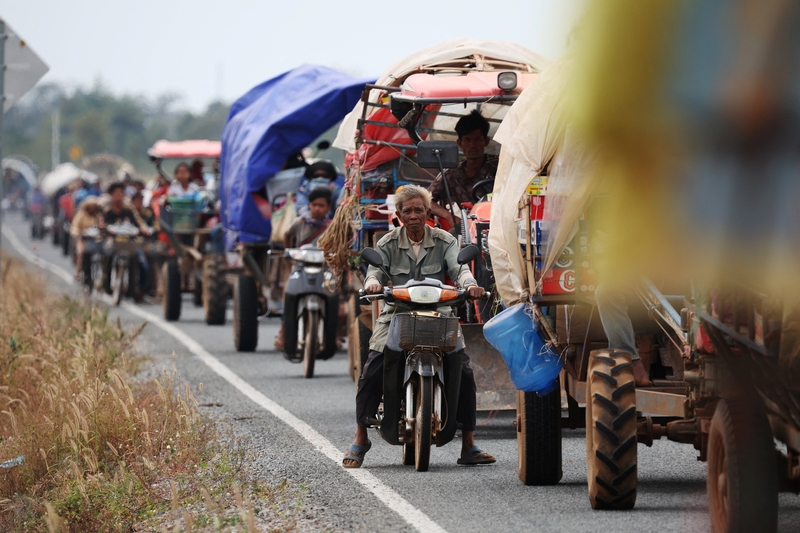
On December 10th, local time, 2025, in Otdormek District, Cambodia, a deadly conflict broke out along the Thai-Cambodian border, and residents fled to refugee camps by vehicle. IC Photo
Since May of this year, Thailand and Cambodia have had frequent border clashes. In July, the border conflict between the two countries escalated into five days of intense fighting. After that, Thailand and Cambodia reached a ceasefire agreement through the mediation of U.S. President Trump and Malaysian Prime Minister Anwar. In October, the two countries signed a joint declaration on border peace issues during the 47th ASEAN Summit.
On November 10th, a mine explosion occurred in the Four Colors City in the Thai-Cambodian border, injuring two Thai soldiers. Affected by this, Thai Prime Minister Anurak stated that he would no longer abide by the four points of the joint declaration and would decide on his own course of action. The Thai government will fully support the needs and actions of the army.
Reuters pointed out that the two Southeast Asian neighboring countries, Thailand and Cambodia, have been accusing each other since the recent conflict on December 7th, and there are still differences on how to resolve the escalating tension over the past months through diplomatic means.
According to the report, the latest border conflict between Thailand and Cambodia has already resulted in at least 21 deaths, with approximately 500,000 people from both sides evacuated. "Nikkei Asia" also mentioned that Cambodia has refused to disclose its military casualties, while the Thai military estimated that "the number of Cambodian military deaths is about 100."
"Thai Prime Minister's tough stance on the Thailand-Cambodia conflict may anger Trump," Bloomberg reported on December 9th. It said that Thai Prime Minister Anurak is exploiting the latest border conflict with Cambodia to stir up nationalist sentiment before the election. Since Trump claimed he ended the previous conflict between the two countries, Anurak is betting that this will not overly anger Trump.
So far, Anurak seems indifferent to this risk. "It's a matter between Thailand and its neighboring country," he told reporters on December 8th, and when asked if he had any concerns about Thai-U.S. trade negotiations, his answer was: "No concerns."
The report said that for Anurak, handling the Thailand-Cambodia conflict is walking a delicate line. He insisted that the Thailand-Cambodia conflict is unrelated to Thai-U.S. trade negotiations. However, Trump had previously linked them - in fact, he had threatened trade sanctions earlier this year to prompt Thailand and Cambodia to reach a ceasefire agreement.
"The latest escalation of the situation may increase Washington's concerns that Bangkok is either unable or unwilling to stabilize the conflict, which could slow down (trade) negotiations, or prompt the U.S. to demand stronger security guarantees before offering economic concessions," said Laura Schwartz, a senior Asia analyst at risk intelligence company Verisk Maplecroft.
Bloomberg pointed out that Cambodia's Senate Chairman and former Prime Minister Hun Sen accused Anurak of using attacks on Cambodia to gain votes ahead of the upcoming elections this week, but Hun Sen and his son, current Cambodian Prime Minister Hun Manet, may also benefit from the current escalation of tensions.
Tom Pepinsky, a professor at Cornell University who studies Southeast Asian politics and economic systems, said that Cambodia's new Prime Minister Hun Manet has a military background, is a graduate of West Point, and will be cautious in defending any potential challenges to Cambodia's sovereignty from neighboring countries.
This article is exclusive to Observer News. Unauthorized reproduction is prohibited.
Original: toutiao.com/article/7583512307997721129/
Statement: This article represents the personal views of the author.